1967

Only a few weeks after completing Guess Who’s Coming to Dinner (1967), Spencer Tracy died of a heart attack at the age of 67. It was the last of nine films in which Tracy and Katharine Hepburn starred together, stretching from Woman of the Year (1942) to 1967, a period of 25 years.

After suffering many years from ill-health and bi-polar depression, British actress Vivien Leigh died at the age of 53 from the effects of tuberculosis. 34 year-old sexy and buxom screen star Jayne Mansfield, was killed in a horrific car crash in Louisiana.  Although she suffered major head trauma, there were also numerous rumors of her decapitation, all untrue, due to photographs of her wig (or scalp) at the accident site

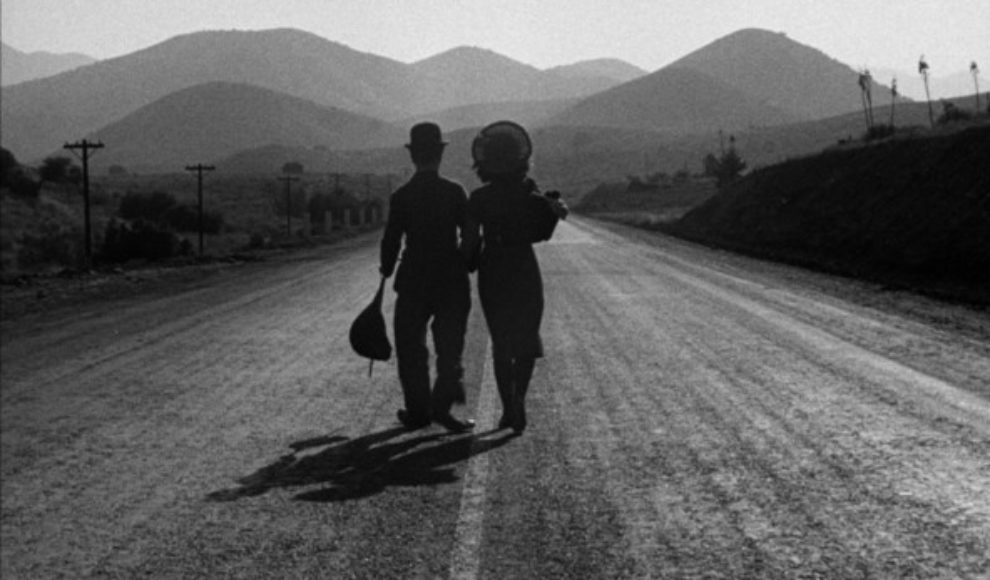
Writer/director/actor/composer Charlie Chaplin directed his final film, the romantic comedy The Countess from Hong Kong (1967), starring Sophia Loren and Marlon Brando.  It was a major flop.  It was Chaplin’s first and sole color (and widescreen) film, and only one of two films during his entire career in which he did not also play a major starring role. A brief cameo in the film as an unnamed, elderly steward marked his final screen appearance.

The Countess from Hong Kong – Sophia Loren and Charles Chaplin on set

Two UK films released in 1967 are noted for the first use of the four-letter word ‘f–k’: director Michael Winner’s film I’ll Never Forget What’s ‘is Name (1967) and Ulysses (1967).  The first major (commercially-released) US studio film to include the word ‘s–t’ (or ‘bulls–t’) in its dialogue was writer/director Richard Brooks’ In Cold Blood (1967).

The national average ticket price for theatre admission in the USA was $1.22, according to the National Association of Theatre Owners (NATO).

Billboard’s number one single of 1967 was the movie theme “To Sir with Love” sung by Lulu.  The Pulitzer Prize for Literature went to Bernard Malamud’s The Fixer.  Edward Albee’s A Delicate Balance won for drama.  Time Magazine’s Man of the Year was President Lyndon Baines Johnson.

*************************************

1967 looks to be a great year for Hollywood and beyond.  The list I will choose from is here.  I have already reviewed In the Heat of the Night, Don’t Look Back, and Festival.

Montage of stills from Oscar winners.

Montage of stills of nominees in the major Oscar categories.

1966 Recap and Ten Favorite Films

I have now watched 94 films that were released in 1966.  A complete list can be found here.  Despite my endless complaints, 1966 was actually a fairly strong year at the top.  Not for Hollywood, however, which has only one film on my list.  The films are only in very rough order.  I gave the number one slot to the film I would be most likely to put in my DVD player if I had to choose today.  I reluctantly left Alfie and King of Hearts off my list.

I’m excited to be moving on to 1967!

10.  Nayak – Directed by Satyajit Ray

9.  The Face of Another – Directed by Hiroshi Teshigahara

8.  The Endless Summer – Directed by Bruce Brown

7.  Sword of Doom – Directed by Kihachi Okamoto

6. Who’s Afraid of Virginia Woolf – Directed by Mike Nichols

5.  Blow-Up – Directed by Michelangelo Antonioni

4. Andrei Rublev – Directed by Andrei Tarkovsky

3.  The Battle of Algiers – Directed by Gillo Pontecorvo

2.  Persona – Directed by Ingmar Bergman

1.  The Good, the Bad and the Ugly – Directed by Sergio Leone

Andrei Rublev (1966)

Andrei Rublev
Directed by Andrei Tarkovsky
Written by Andrey Konchalovskiy and Andrei Tarkovsky
1966/USSR
Mosfilm/Tvorsheskoe Obedinienie i Kinorabotnikov
Repeat viewing/Netflix rental

[box] Andrei Rublyov: I am what I am. You couldn’t teach me integrity.[/box]

Frame after exquisite frame make up this sublime meditation on art, religion, faith, and life.

The setting is early 15th Century Russia.  The film pivots on real-life master icon painter Andrei Rublev.  Rather than an autobiography though, we get a complex portrait of medieval Russia delivered through several episodes, some of which do not feature Rublev. Included is a Tartar invasion, monastic life with a sort of Mozart-Salieri artistic jealousy thing going on, a very early hot air balloon, etc. etc.

My favorite episode is the one where a Prince orders a young man, the only survivor of a dynasty of bell-makers, to cast a humungous church bell.  The penalty for the bell’s failure to ring will be quick execution.  We get deep into the casting process and it is just fascinating.

This is a very long but endlessly rewarding film.  In only his second feature film, Tarkovsky pulls off shots that are literally jaw-dropping in their scale and beauty.  It ends by transitioning from B&W to glorious color as Tarkovsky takes an up-close view of Rublev’s icons.  The score is fantastic.  Very highly recommended.

I am ending 1966 on a high note.  I was stunned when I discovered this was not a List film for 1966 but it turns out that is the IMDb date based on a private screening for Soviet authorities.  The Book has the film dated 1969, which is when it was first publicly screened in the USSR.  1967 here we come!

The Psychopath (1966)

The Psychopath
Directed by Freddie Francis
Written by Robert Bloch
1966/UK
Amicus Productions
First viewing/YouTube

[box] “Some werewolves are hairy on the inside.” ― Stephen King, Danse Macabre[/box]

Creepy dolls are always a plus in a horror movie.

Murder victims are piling up in London.  All of them are found in grisly positions accompanied by a doll resembling the deceased.  Scotland Yard is on the case.  It develops that all were members of a Commission that falsely convicted an accused Nazi war criminal.

I found this thing rather dull.  It has a boffo ending but one that doesn’t come as a surprise.


Here Is Your Life (1966)

Here Is Your Life (Här har du ditt liv)
Directed by Jan Troell
Written by Jan Troell and Bengt Forslund from a novel by Eyvind Johnson
1966/Sweden
Svensk Filmindustri
First viewing/Amazon Instant


[box] “I like work: it fascinates me. I can sit and look at it for hours.” ― Jerome K. Jerome[/box]

Beautiful, if overlong, coming-of-age story.

It is 1914 in rural Sweden and our hero Olof Persson (Eddie Axberg) is as old as the century.  Circumstances force him to search for work.  The jobs he can find involve hard manual labor in the outdoors with men at least twice his age.  Olof makes many different friends that help shape his life.

After a few years, he meets a cinema owner (Gunnar Bjornstrand) who hires him to post advertisements.  He moves on from there to ticket taker and usher before getting a job with a travelling circus as a projectionist.  We see him become interested in philosophy and leftist politics.  He also has various forms of girl and woman trouble as he ages.

This is a good looking and well-acted film (many Bergman regulars are in the cast).  On the other hand, it is almost three hours long and took at least an hour to grab my attention.  Once it did, I liked it a lot.

Clip (with Max von Sydow)


Queen of Blood (1966)

Queen of Blood
Directed by Curtis Harrington
Written by Curtis Harrington from a story by Mikhail Karzhukov and Otar Koberidze
1966/USSR/USA
Cinema West Productions
First viewing/YouTube


Allan Brenner: [disgusted] She’s a monster.

John Saxon, Basil Rathbone, and Dennis Hopper appear in but do not save this dud.

The year is 1990.  An  alien spacecraft sends a distress signal from Mars and Earth sends a rescue team including astronaut scientists Alan Brenner (Saxon) and Paul Grant (Hopper).  Dr. Farraday (Rathbone) supervises from earth.  Naturally, when they find a surviving female alien they put her on board where they belatedly find she feeds on human blood.  And breeds.

Roger Corman bought up a bunch of Soviet scifi films for their special effects.  He then gave directors such as Harrington a few dollars and some washed-up actors for Americanization.  If this hadn’t had an appearance by Basil Rathbone I would have given it a miss.  But poor Basil could not rescue this bad bad (as contrasted with good bad) movie.  Also has one of the most rip-off non-endings EVER!  You have been warned.  

I watched this on YouTube with commercial interruptions but I don’t think those did the movie any harm.

Nayak (1966)

Nayak (The Hero)
Directed by Satyajit Ray
Written by Satyajit Ray
1966/India
R.D. Banshal & Co.
First viewing/Amazon Instant


[box] Sankar: A film actor is nothing but a puppet, a puppet in the hands of the director, a puppet in the hands of the cameraman, in the hands of the sound-recorder. He is also a puppet in the hands of the editor who cuts and pastes the movie.[/box]

Excellent film from my beloved Satyajit Ray, somehow channeling Fellini a bit.

Arindan Mukherjee (Uttam Kumar) is a matinee idol.  On this particular day, he awakes to a scandalous newspaper story about a drunken brawl he was involved in the previous night. He decides to take the train to Delhi to pick up an acting award rather than take a plane as previously planned.  On this particular train are a number of passengers who want to get into the business and even more with opinions on the sad state of Indian cinema.

Mukherjee agrees to grant an interview to beautiful young journalist Aditi (Sharmila Tagore), who is in the camp that sees nothing of value in Indian cinema.  He opens up to her and in the process comes face to face with the moral bankruptcy of his life and chosen career.  He worries that he is about to lose it all, a message seeming to come from all sides as well as from his restless dreams.

I loved this movie.  Here, Ray seems to pick up a cue from Fellini and Antonioni and produces one of the great meta films about filmmaking.  The dream sequence (see clip) where the actor falls into quicksand made of mountains of cash is memorable.  There are other slightly surreal aspects to this that I have not seen in his other work.  Ray also wrote the effective score.  Highly recommended.

Dream sequence

Apa (1966)

Apa (Father)
Directed by Istvan Szabo
Written by Istvan Szabo
1966/Hungary
MAFILM3 Jatekfilmstudio
First viewing/Amazon Instant


[box] [on critics who claim that a knowledge of Hungarian history is necessary to understand his films] I’m talking universally about how our subconscious apprehension of our history guides and controls us. It runs us without our knowledge necessarily. You don’t need Hungarian history to explain it. – Istvan Szabo[/box]

Wry tragi-comedy parallels one boy’s history and that of Hungary.

Tako Bence’s doctor father died in 1945 when he was just six.  Tako spends the next twenty years fantasizing about his father’s heroic role in the war.  By the time he is 25 he doesn’t know which of his memories are real. His relationship with a Jewish girl helps him finally come of age.


I don’t have a lot to say about this movie but I did really enjoy it.  I love the way Eastern Cinema laughs through the tears during this period.

Clip

Au hasard Balthazar (1966)

Au hasard Balthazar
Directed by Robert Bresson
Written by Robert Bresson
1966/France/Sweden
Argos Films/Athos Films/Parc Film/Svensk Filmindustri
First viewing/Netflix rental
One of 1001 Movies You Must See Before You Die

[box] Gerard: Lend him to us.

Marie’s mother: He’s worked enough. He’s old. He’s all I have.

Gerard: Just for a day.

.Marie’s mother: Besides, he’s a saint. [/box]

Visually stunning film but sad film that chronicles the suffering of a young girl and the donkey she adopted.

Marie and her family seem to live an idyllic life in rural France.  The children come upon a nursing donkey colt and beg to adopt it.  Father is eventually agreeable and he is brought home, where the children dote on him.  The donkey is baptized Balthazar.  When he is old enough, he is put to work hauling loads on the farm and pulling the donkey cart that the family travels in.

The family becomes increasingly impoverished,  Years later Marie has the misfortune of meeting and falling in love with a thorough delinquent named Gerard.  Gerard runs with a gang of teenagers who are constantly up to no good.  He finds malicious ways of exploiting Balthazar.  Balthazar falls into various hands, all of which mistreat him.  But he is stoic to the end.  Not so Marie, who has by now become corrupted.

This movie is about saintliness with Balthazar being the true saint – faithful and long-suffering.  Humans pale in comparison.  This is not an easy film to watch as there is a fair amount of animal cruelty.  I can see why it is considered a masterpiece though. It is visually stunning in that slow Bressonian way and the music is exquisite.  Amateur acting can at times be a drawback.


Madame X (1966)

Madame X
Directed by David Lowell Rich
Written by Jean Holloway from a play by Alexandre Brisson
1966/USA
Ross Hunter Productions/Universal Pictures/Eltee
First viewing/Amazon Instant

[on the headlines about the Stamponato case] I read everything, then reread it, attempting to analyze the whole awful happening. And after I had done that I felt totally drained. The press had done their worst, and now I knew exactly what that worst was. And I’d have to survive it. – Lana Turner

This hoary melodrama about infidelity, exile, alcoholism, and mother love has been remade many times. The 1966 version is the most over-the-top of them all.  That is not necessarily a bad thing.

The story begins as fabulously wealthy Clay Anderson (John Forsythe) brings his new bride Holly (Lana Turner) home to the palatial family manse.  She is introduced to her mother-in-law Estelle (Constance Bennett). Estelle puts on her best manners but it is clear she looks down on her daughter-in-law.  Clay has political ambitions and is making a lot of high profile trips that take him away from his family. During the last protracted absence, Holly, in her loneliness, starts a brief affair with Phil Benton (Ricarcdo Montalban).  When her husband returns, she calls the affair quits.  But poor Holly is left holding the bag when Phil accidentally dies during the couple’s farewell scene.

This causes Estelle to convince Holly that the best thing for her husband and son is to fake a sudden disappearance/death. Holly’s situation goes from bad to worse as her alcoholism escalates during her long wanderings through Europe and later Mexico.  In Mexico things get even more interesting when reprobate Dan Sullivan (Burgess Meredith) manages to drag Holly’s secret from her while she is in a drunken stupor.  By this time, Clay has been elected Governor, sonny boy has graduated from law school, and Dan has blackmail on the brain.  With Keir Dullea as the grown-up son.

Phil Benton:  Never end on a dangling insult!
Holly: Please, let me go!
Phil: IF you promise not to leave!

Something told me that I should watch this movie.  I was so right.  Dialogue like the above raises the film from merely stupid to one hell of a fun run. It is a throw-back to melodramas of the 50’s with an update to include some of the new freedoms of the 60’s. If you like high camp (and I do) and want to look at the most glamorous settings and costumes since the Golden Age, I would say go for it.

This was Bennett’s last film in an acting career that began in 1916.