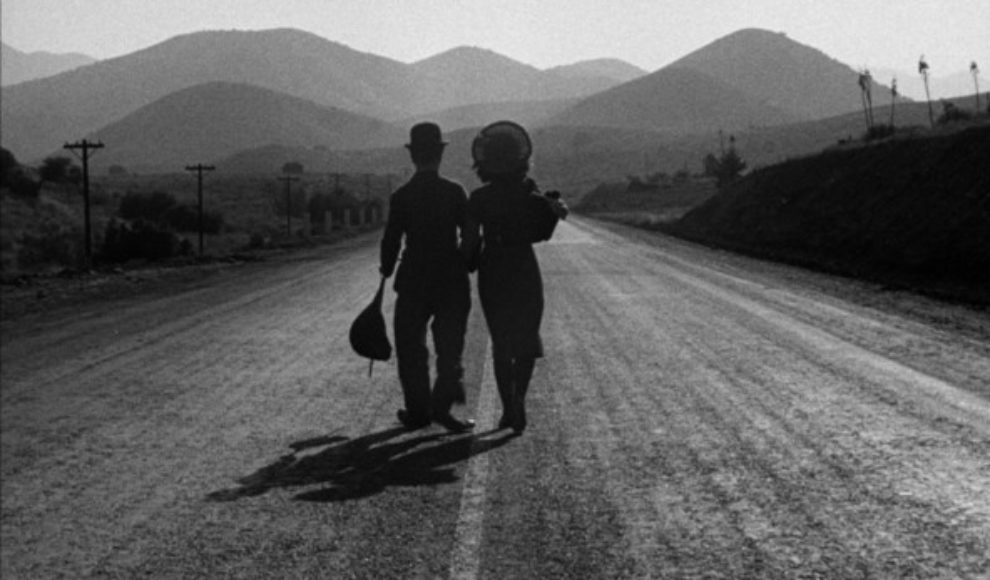


Directed by William Wyler
Written by Howard Hoch based on a play by W. Somerset Maugham
1940/USA
Warner Bros.
Repeat viewing/Netflix rental
Howard Joyce: Be flippant about your own crimes if you want to, but don’t be flippant about mine!
This gripping tale of deception and revenge features one of Bette Davis’s greatest performances and splendid moonlight-drenched cinematography.
The setting is a rubber plantation overseen by Robert Crosbie (Herbert Marshall) and his wife Leslie (Davis) in colonial Malaya. The story begins as Leslie stands over a man’s body in cold rage and pumps several bullets into him. She later explains to her husband and a couple of officials that she shot the man, whom the couple knew but had not seen in several months, in self-defense after he drunkenly attempted to “make love” to her. Her explanation is deemed so detailed and believable that arresting her is a mere formality. Her acquittal is even more assured since the victim had committed the seemingly unpardonable sin of marrying a “Eurasian” woman (Gale Sondergaard).
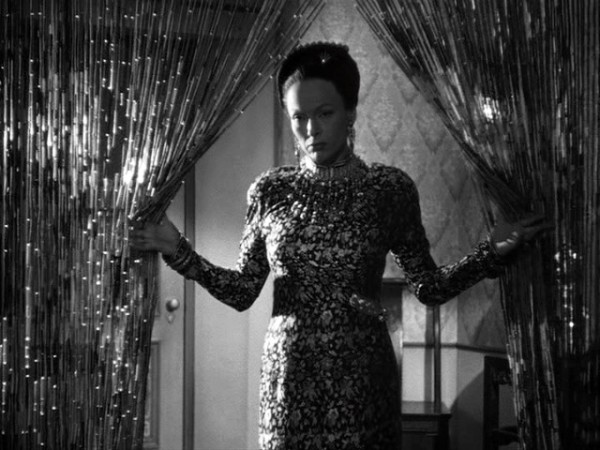
The couple proceed to Singapore where they hire family friend and lawyer Howard Joyce (Robert Stephenson). Joyce finds Leslie’s story a bit fishy but the jig is up when his law clerk (the appropriately oily Victor Sen Yung) tells him that the widow is in possession of a letter Leslie wrote the day of the murder begging the victim to come to her. She is willing to sell the document for a sum that conveniently happens to be almost the entire balance of devoted Robert’s savings account. The other requirement is that Leslie deliver the money in person.
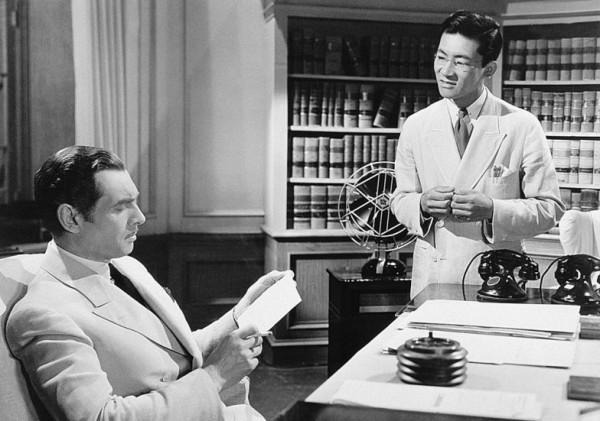
Leslie initially denies the letter is genuine and then tries to make it appear innocent but Joyce isn’t buying it. And Joyce has serious ethical and legal reservations to buying the letter either but reluctantly decides to do so out of friendship to Robert. Leslie is indeed acquitted. Will justice at last be done?

This is a beautiful, beautiful movie with most key scenes taking place on moonlit nights amid shadows worthy of the best films noir. Bette Davis is convincing as the utterly controlled Leslie, her emotions suppressed by obsessive lace tatting until they aren’t. There are almost no Davis mannerisms in evidence here. Her tear-stained face after the climax of the film is utterly believable. The supporting cast is equally fine. Highly recommended.
The Letter was nominated by the Academy in seven categories: Best Picture; Best Actress; Best Supporting Actor (Stephenson); Best Director; Best Black-and-White Cinematography (Tony Gaudio); Best Film Editing; and Best Original Score (Max Steiner).
Trailer

Just a few days ago, I revisited THE LETTER. For me, the film has lost none of its appeal. Wyler and Davis remain a dynamic duo. Highly recommended.
I liked it on this second viewing even more than I did the first time!
I recently (only this morning) wrote that The Letter is awful. I now think I had it mixed up with another film, because I remember this one you describe and I did quite like it. I am not a big Davis fan but the cinematography in this film is classy.
Well I’m glad to bring back a good memory!
The cinemaphotography should have won an Oscar……..the mood set by the moonlight and window blinds speaks of bad things to come. I could write paragraphs heaping praise on this gem but I think you all agree.
The only thing that jumps out as something the Code insisted upon was in the final scene when the policeman comes by and sees…….. well, you know who he sees (I don’t want to spoil the ending for anyone who hasn’t seen it). The film should have ended about 30 seconds before that but the Code prevailed.
Crime cannot pay! I thought Herbert Marshall was wonderful in this. Poor guy, always getting kicked around by Bette Davis in the movies!
That should have been “cinematography” in my last comment!!!