Category Archives: Movie Reviews

Reviews of movies I have seen.

Alexander’s Ragtime Band (1938)
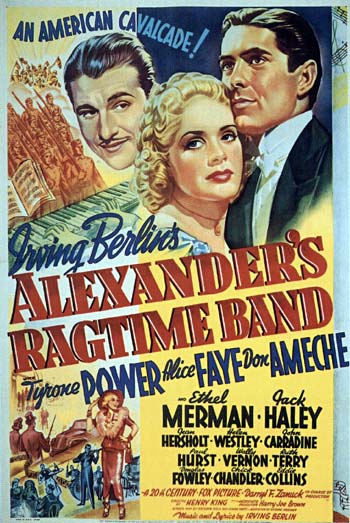
Alexander’s Ragtime BandAlexanders_Ragtime_Band Poster
Directed by Henry King
Written by Kathryn Scola and Lamar Trotti based on an adaptation by Richard Sherman
1938/USA
Twentieth Century Fox Film Corporation

First viewing/Netflix rental

[box] Broadway has been very good to me. But then, I’ve been very good to Broadway. — Ethel Merman [/box]

If you love old standards, Irving Berlin, or Ethel Merman, this movie is for you.  I’m there on all three counts.  For story, not so much.

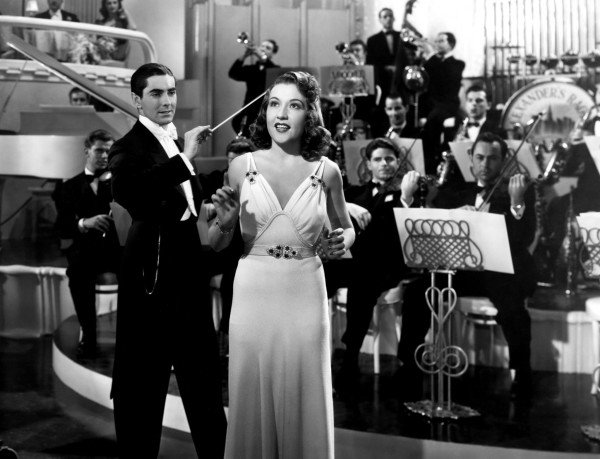
Darryl F. Zanuck’s idea was to do a biopic on the composer Irving Berlin.  Berlin preferred fiction so we get the story of band leader Alexander (Tyrone Power), singer Stella Kirby (Alice Faye), and composer/pianist Charlie Dwyer (Don Ameche) in a love triangle reminiscent of In Old Chicago.  Charlie loves Stella but Stella loves Alexander.  A series of misunderstandings separates Alex and Stella for years leading to many torch songs on Stella’s part.  The story is a vehicle to showcase the history of American popular music in the early 20th century through the songs of Irving Berlin.  With Jack Haley as a drummer, Ethel Merman as the band’s second vocalist, Jean Herscholt as Alex’s violin teacher, and John Carradine as a taxi driver.
Alexander's Ragtime Band 1

This was a prestige production and a pet project of studio head Zanuck.  No expense was spared and the production is lavish.  Thirty Berlin songs are included and these are all performed as parts of various shows.  Irving Berlin specifically asked for Alice Faye, but I must say I’m not a huge fan of her singing.  Ethel Merman, on the other hand, is electrifying in her film debut.  She is quite a bit softer and less brassy than later in her career.  Jack Haley and others have some good comedy numbers.

Alfred Newman won an Oscar for his scoring of Alexander’s Ragtime Band, in which he arranged the songs to reflect the style characteristic of each period.  The film was also nominated by the Academy in the categories of Best Picture, Best Writing (Original Story), Best Art Direction, Best Film Editing, and Best Original Song (“Now It Can Be Told”).

Trailer


Port of Shadows (1938)

Port of Shadows (“Le quai des brumes”)
Directed by Michel Carné
Written by Jacques Prevert from the novel by Pierre Dumarchais
1938/France
Ciné-Alliance

Repeat viewing/Netflix rental


[box] Le peintre: A tree. But when I paint one, it sets everyone on edge. It’s because there’s someone or something hidden behind that tree. I can’t help painting what’s hidden behind things. To me a swimmer is already a drowned man..[/box]

I was surprised how little I remembered about this really excellent film.

Jean (Jean Gabin) is a French army deserter who has also apparently committed some crime of passion.  He arrives in Le Havre seeking a way to escape.  Nelly (Michele Morgan) is a seventeen-year-old running away from her jealous, lecherous godfather (Michel Simon) and a past affair with Maurice.  Lucien (the fantastic Pierre Brasseur) is a cowardly gangster in search of Maurice and some papers.  Fate is not kind to any of these people.

The docks of Le Havre are permeated by fog and cruel destiny.  1938 seems to have been a very good year for French proto-noirs.  No one could be more doomed than our hero and, while our heroine is sincere, she is nonetheless fatal.  The acting is excellent.  I seem to admire Michel Simon more with every performance I see.  The Jacques Prevert (Children of Paradise) dialogue is haunting as is the score.  This is a dark and sad film but very beautiful.   I highly recommend it.

Re-release trailer

A Slight Case of Murder (1938)

A Slight Case of Murder
Directed by Lloyd Bacon
Written by Earl Baldwin and Joseph Schrank from a play by Damon Runyan and Howard Lindsay
1938/USA
Warner Bros.

First viewing

[box] Nora Marco: Why isn’t he in B-E-D?

Douglas Fairbanks Rosenbloom: Because I want more to E-A-T, you old C-O-W.[/box]

Edward G. Robinson is always a pleasure to watch but I didn’t get any laughs out of this gangster comedy.

When Prohibition ends, Remy Marco (Robinson) decides to become a legitimate brewer and employ his gang members as salesmen.  Only problem is he has never tasted his own beer and his men are afraid to tell him it is wretched.  After four years, Remy is half a million dollars in debt and the bank is ready to foreclose.  He leaves for his summer house in Saratoga, after stopping at the orphanage where he grew up to take the worst boy he can find for the summer.

When he gets to Saratoga, Remy discovers that a gang has robbed all the bookmakers for the race track of $500,000.  When he gets to the house, four dead robbers are in one of the bedrooms.  In the meantime, his daughter has become engaged to a very rich state trooper whose father comes to check the family out.  Hijinx ensue.  With Margaret Hamilton in a very small role as the matron of the orphanage.

This tries to be madcap but was a miss in my opinion.

Trailer


Bluebeard’s Eighth Wife (1938)

Bluebeard’s Eighth Wife
Directed by Ernst Lubitsch
Written by Billy Wilder and Charles Brackett from a play by Albert Savoir
1938/USA
Paramount Pictures

First viewing


[box] Nicole de Loiselle: I wish someone would tell you what I really think of you.[/box]

Any film that combines Ernst Lubitsch, Billy Wilder, and this cast has to be entertaining.

Michael (Gary Cooper) is a decisive multi-millionaire.  He meets Nicole (Claudette Colbert) in a Paris department store while trying to purchase only the top of some pajamas.  Nicole buys the bottoms and, without further ado, Michael decides she will be his wife.

Nicole’s father (Edward Everett Horton) is broke and Michael funnels some money his way by buying an allegedly antique bathtub from him.  At first, Nicole resists Michael’s advances but eventually she falls in love with him.  At their engagement party, she discovers that he has been married seven times before.  He explains that his wives have made out fine as he signs a prenuptial agreement with each one guaranteeing $50,000 per year for life,  Nicole holds out for $100,000 per year and hatches a plot to ensure their divorce.  With David Niven as Nicole’s friend.

This is good fun even if parts of the story don’t hang together too well.  Cooper is very good in a part reminiscent of Mr. Deeds.  The dialogue sings.

Trailer


Marie Antoinette (1938)

Marie Antoinette
Directed by W.S. Van Dyke
Written by Claudine West, Donald Ogden Stewart, and Ernest Vajda based in part on the book by Stefan Zweig
1938/USA
Metro-Goldwyn-Mayer

First viewing


[box] Marie: I cannot wear a crown upon my heart.[/box]

I am not big on 2 1/2 hour-plus costume dramas … especially if Norma Shearer is going to play a teenager in any part of them.

Marie (Shearer) is thrilled when her mother, the Empress of Austria, arranges with Louis XV (John Barrymore) for her to wed the Dauphin (Robert Morley).  Her enthusiasm wanes when she discovers on her wedding night that the future Louis XVI is a socially inept fellow who has no interest in her or in producing heirs to the throne.

After a couple of years of boredom, the scheming Duke d’Orleans (Joseph Schildkraut) convinces Marie to enter the social whirl of decadent court life in Paris.  At one of her soirees, Marie meets and falls in love with the Swedish Count Fersen (Tyrone Power). They scarcely consummate their passion when Louis XV orders Marie’s exile for failure to produce an heir and for insulting his mistress Madame du Barry (Gladys George).

Marie is saved by the bell when Louis XV dies.  She and the Count agree that they cannot continue their affair and Marie, who has formed a close friendship with the Dauphin, becomes Queen.  INTERMISSION.

Marie and Louis produce a couple of children.  They have great compassion for the poor of France but Count d’Orleans conspires to frame Marie for the purchase of a priceless necklace while the people are starving.  Marie and Louis are eventually imprisoned.  Count Festen comes to Marie’s aid, but to no avail.

This film is not without its good points.  Robert Morley, in his film debut, is fantastic as Louis XV1 and Joseph Schildkraut is suitably evil in his role and looks great in wig and powder.  The production is lavish and all aspects from costume design to art direction to score are first-rate.

That said, this film is way too long for its story and the story itself is trite.  I don’t know whether there actually was a Count Fersen or not, but his story line felt very contrived.  I like Norma Shearer’s pre-Code work as sophisticated ladies.  I find her pretty dreadful whenever she attempts to play naive virgins or lovelorn romantic  heroines.  She spends most of her time doing the later here.

Marie Antoinette was nominated for Academy Awards in the categories of Best Actress (Norma Shearer), Best Supporting Actor (Robert Morley), Best Art Direction, and Best Original Score. This was Irving Thalberg’s last project while head of production at MGM and Shearer, his widow, stuck with it through completion in 1938.

Trailer


A Christmas Carol (1938)

A Christmas CarolChristmas Carol Poster
Directed by Edwin R. Marin
Written by Hugo Butler from a novel by Charles Dickens
1938/USA
Metro-Goldwyn-Mayer

Repeat viewing


“Bah,” said Scrooge, “Humbug.” ― Charles Dickens, A Christmas Carol

Dickens’ classic Christmas story gets the MGM treatment.

Skinflint Ebenezer Scrooge (Reginald Owen) thinks Christmas is for fools until he is visited by his deceased partner’s ghost (Leo G. Carroll) and the Spirits of Christmases Past, Present, and Yet to Come.  With Gene Lockhart as Bob Crachit.

christmas carol 1

This festive adaptation takes most of the scares, pathos, and interest out of the original.  I thought Reginald Owens’ Scrooge was converted much too easily.  I’m afraid I am an Alastair Sim purist when it comes to A Christmas Carol.

The DVD I received contained some interesting extras – “Jackie Cooper’s Christmas Party”  (1931), a kind of Christmas card from MGM with lots of its stars; Judy Garland singing “Silent Night” (1937); and “Peace on Earth” (1939), an anti-war Technicolor cartoon in which Grandpa Squirrel explains to the youngsters what “men” were and how they destroyed themselves.

Trailer


Pygmalion (1938)

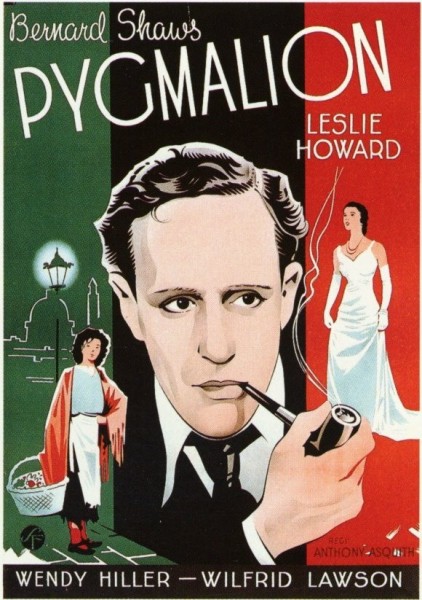
PygmalionPygmalion Poster
Directed by Anthony Asquith
Written by George Bernard Shaw
1938/UK
Gabriel Pascal Productions
Repeat viewing


Prof. Henry Higgins: Yes, you squashed cabbage leaf, you disgrace to the noble architecture of these columns, you incarnate insult to the English language, I could pass you off as the Queen of Sheba!

This may be the best adaptation of George Bernard Shaw’s play.  I love this film!

Professor Henry Higgins (Leslie Howard) bets that he can pass Cockney flower seller Eliza Doolittle (Wendy Hiller) off as a duchess with six months of training in phonetics. With Wilfred Larson as Alfred P. Doolittle and Esme Percy as Count Aristid Kaparthy.

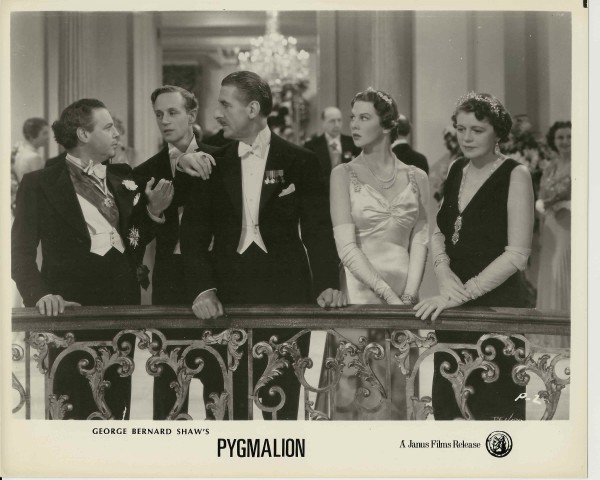
Pygmalion 1

Leslie Howard makes a splendid Henry Higgins but the real revelation is Wendy Hiller in her second film.  With Hiller, Eliza is keeping her Cockney soul under check at al times whereas Audrey Hepburn always seems to me as a born princess struggling to escape her flower girl disguise.  The other performances are of a very high standard.  Asquith does an excellent job of opening up the story so it does not seem unnecessarily stagey.  I had a smile on my face throughout.  Very warmly recommended.

George Bernard Shaw and the adaptors of his play won the Academy Award for Best Screenplay, making Shaw the only Nobel Prize winner to also have an Oscar.  Shaw said “It’s an insult for them to offer me any honour, as if they had never heard of me before – and it’s very likely they never have. They might as well send some honour to George for being King of England.”  Pygmalion also received nominations in the categories of Best Picture, Best Actor (Howard) and Best Actress (Hiller).

“Trailer” – Professor Higgins makes Eliza an offer she can’t refuse

Sweethearts (1938)

SweetheartsSweethearts poster
Directed by W.S. Van Dyke
Screenplay by Dorothy Parker and Alan Campbell based on a story by Fred De Grasac et al
1938/USA
Metro-Goldwyn-Mayer

First viewing

Sweetheart, today will never fade
Like an eternal serenade
For love will end the way it starts
Forever we’ll be sweethearts — lyric by Robert C. Wright & Chet Forrest

The singing is the high point of this movie.

Gwen Marlowe (Jeanette MacDonald) and Ernest Lane (Nelson Eddy) play sweethearts in the long-running Broadway show of that name and are happily married in real life.  A film studio is trying to lure them to Hollywood.  Stakeholders in the Broadway show resort to desperate measures to split up the team to prevent their departure.  With Frank Morgan as a Broadway producer, Mischa Auer as a playwright, and Ray Bolger as a dancer.

Sweethearts 1

Despite the sterling cast of character supporting actors, I thought the comedy fell flat.  The story also takes quite awhile to get going.  The first hour or so is filled with flimsy excuses for one musical number after another.  Ordinarily I would not object but here the tunes are not very catchy.  There is a nice number featuring Ray Bolger’s loose-limbed dancing at the very beginning.  MacDonald and her red hair look very good in color.

Sweethearts won an Honorary Academy Award for its Technicolor cinematography.  It was nominated in the categories of Best Sound Recording and Best Music, Scoring.

Jeanette goes clothes shopping for Hollywood (1938 fashion on parade)


Block-Heads (1938)

Block-HeadsBlock-Heads-Poster
Directed by John G. Blystone
Written by Charlie Rogers, Felix Adler, et al
1938/USA

Hal Roach Studios
First viewing


Oliver: But, Toots, Stan is different.
Mrs. Hardy: I’ll say he’s different!

For some reason, this just did not tickle my funny bone.

The story opens in the trenches of WWI France.  Ollie departs for combat with the rest of his battalion leaving Stan to guard the trench.  Twenty years later, Stan is still guarding it. When he shoots down a French pilot, he is sent home where he is reunited with Ollie. The two get in to many “fine messes”.

Block-Heads 1

The film was announced as being the last Laurel & Hardy movie and it was the last Hal Roach production for Metro-Goldwyn-Mayer.  Laurel & Hardy went on to make many films at Hal Roach Studios.

Happy Thanksgiving to all celebrants!

Clip – first scene

Alexander Nevsky (1938)

Alexander Nevsky
Alexander Nevsky Poster
Directed by Sergei M. Eisenstein and Dmitri Vasilyev
Written by Sergei M. Eisenstein and Pyotr Pavlenko
USSR/1938
Mosfilm

Repeat viewing


[box] Alexandr Nevsky: Go tell all in foreign lands that Russia lives! Those who come to us in peace will be welcome as a guest. But those who come to us sword in hand will die by the sword! On that Russia stands and forever will we stand![/box]

My appreciation of this film took a nose dive due to the substandard print and sound track on the rental DVD I received.  I rated it very highly when viewed in a restored print.

The story is based on the historical Prince Alexander (1220-1263) who defeated an army of Teutonic Knights of the Holy Roman Empire who were invading Novgorod.

Most of Russia, save Novgorod, has fallen to the Mongol Horde.  The people call on Alexander, who had previously defeated a Swedish invasion, to free Russia of the Mongol yoke.  Alexander declines, saying that the real threat will come from Germany.  Soon enough, the Teutonic Knights have defeated the city of Pskov, massacring its civilian population (and throwing babies into bonfires).

The people beg Alexander to lead them against the foe and he arrives in Novgorod, where the nobility and merchants desert the town.  The common people, including woman warrior Vasilisa, bravely fight the Huns on frozen Lake Peipus.  The Germans are roundly defeated and their clergy crushed.  The people take pity on captured German foot soldiers but have no mercy for Russian traitors.

Alexander Nevsky (1938)1B

The main attractions of Eisenstein’s film are the magnificent Prokofiev score and the masterfully edited and shot battle sequences.  These were obscured by a blurry print and a  tinny, static-fillied soundtrack in the version I watched.  In addition, the subtitles made the characters sound like medieval Yodas.  I can recommend the Criterion Collection version and I am sure there are other good restored prints out there.

The film was a great success on its 1938 release.  In 1939, it was withdrawn from circulation when Stalin entered the Ribbentrop-Molotov pact with Hitler.  Following the Nazi invasion of the USSR in 1941, it was rapidly returned to Soviet screens.  Eisenstein was awarded the Stalin Prize for the film the same year.

Clip – Battle on the Ice