Category Archives: Movie Reviews

Reviews of movies I have seen.

Nights of Cabiria (1957)

Nights of Cabiria (“Le Notti di Cabiria”)
Directed by Federico Fellininights of cabiria poster
Written by Federico Fellini, Ennio Flaiano, Tullio Pinelli and Pier Paolo Pasolini based on a novel by Maria Molinari
1957/Italy/France
Dino de Laurentis Cinematografica/ Les Films Marceau

Repeat viewing; Criterion Collection DVD
#337 of 1001 Movies You Must See Before You Die
IMDb users say 8.3/10; I say 10/10

<i>Maria ‘Cabiria’ Ceccarelli: There’s another girl, my friend Wanda, she lives there too, but I don’t bother with the others. The others all sleep under the arches in Caracalla. Mind you, I have my own house with water, electricity, bottled gas, I’ve got everything, even a thermometer. See this one here? She never ever slept under an arch. Well, maybe once… or twice. Of course, my house is nothing like this. But I like it.<i>

Right before Fellini got deep into Fellini-esque territory, he made this heartfelt masterpiece. I love Giulietta Masina and this film.

Cabiria (Masina) is a prostitute with a weakness for the wrong guys.  Despite supporting what seems to be a series of freeloaders, she has managed to buy her own little house and amass a small nest egg.  Things begin to go wrong when her latest boyfriend snatches her purse and pushes her in the river where she is only just saved from drowning.  She wonders why since she always gave him whatever he wanted.  (Favorite line from her rant: “Go back to selling balloons!”).

nights of cabiria 2

Cabiria pulls herself together and goes back to trading insults with her friends and plying her trade. One night, she heads for the Via Veneto, usually off limits for such as herself, where she chances a meeting with a famous movie star who takes her home.  She can’t believe her luck but ends up locked in a bathroom when the star’s lover appears to patch up a quarrel.

An encounter with a man distributing alms to the poor and the sight of a once well-off prostitute reduced to living in a cave inspires Cabiria to join friends on a pilgrimage to a holy site.  One of their group seeks a miracle cure but Cabiria prays only that the Virgin help her to change her life.  Later she takes the stage in a hypnotist’s show.  While under, she reveals her essential purity and dreams of marriage.  It looks like her prayers may have been answered when she meets an accountant afterwards who says he wants to marry her and doesn’t care about her past.

nights of cabiria 4

Everyone should see this movie so I won’t give away the ending.  Suffice it to say that it is among the most moving in film history.

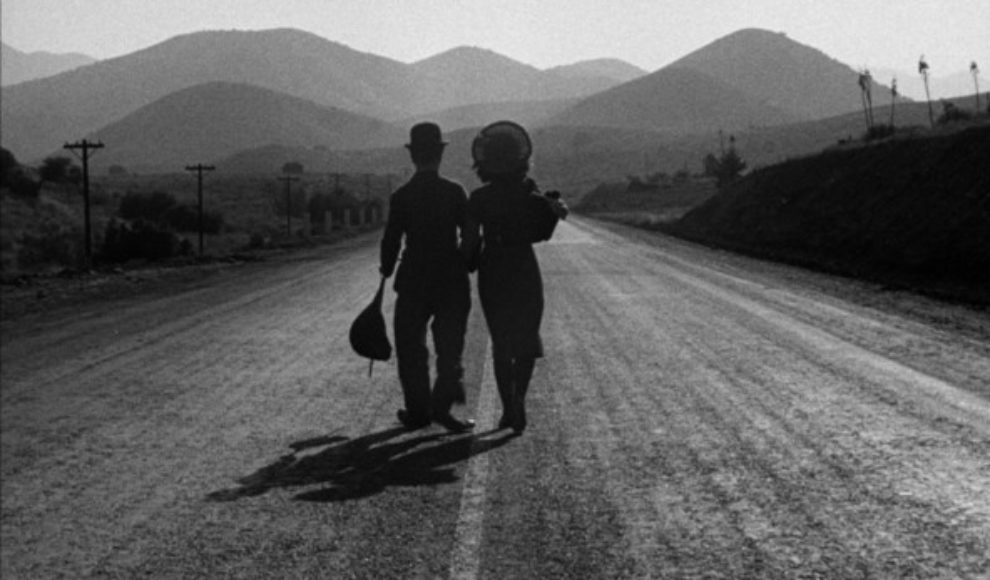
Nights-of-Cabiria 5This is a movie about hope and survival.  Maybe a bit like post-war Italy?  Cabiria makes more than her fair share of mistakes and takes many more than her fair share of lumps but always comes out smiling.  She is played with incredible delicacy by Giulietta Masina, who must have one of the greatest faces of any actress ever and who moves with the grace of Chaplin.  (Her mambo is outstanding!)  I love the combination of comedy and pathos and the ever-present social satire Fellini weaves in throughout.  Add to that the Nino Rota score and you certainly have a classic for the ages.

Nights of Cabiria won the Oscar for Best Foreign Language Film.  Masina won the award for Best Actress at the Cannes Film Festival.  Cabiria later became a New York dime-a-dance girl when the story was remade as the Broadway musical Sweet Charity and its 1969 screen adaptation directed by Bob Fosse and starring Shirley MacLaine.

Re-release trailer

Tarzan Finds a Son! (1939)

Tarzan Finds a Son!
Directed by Richard Thorpe
Written by Cyril Hume based on the characters created by Edgar Rice Burroughs
1939/USA
Metro-Goldwyn-Mayer

First viewing/Netflix rental


[box] Jane: What’s the matter?

Tarzan: People![/box]

This is tolerable but a big step down from the previous film in the series, Tarzan and His Mate.

A plane mysteriously crashes in a special corner of the African jungle.  All aboard are killed but a baby, who is miraculously uninjured.  Cheeta finds the boy and takes him home to Tarzan and Jane.  At Tarzan’s suggestion, they name him Boy.  Several years later, an expedition arrives searching for the wreckage and any trace of the passengers.  It turns out Boy stood to inherit a large fortune.  They figure out the identity of Tarzan and Jane’s child quickly but most of the party stand to profit from Boy’s demise.  The rest of the story is a good guys v. bad guys adventure.

This is not terrible but it does lack a lot of the charm of the earlier film.  There are some nice jungle conveniences a la Gilligan’s Island.  Otherwise, it is a routine action film with elephants saving the day.

Trailer


Intermezzo: A Love Story (1939)

Intermezzo: A Love Story
Directed by Gregory Ratoff
Written by George O’Neill, Gösta Stevens and Gustaf Molander
1939/USA

Selznick International Pictures
Repeat viewing/Netflix rental


[box] Anita Hoffman: I have been an intermezzo in his life.[/box]

This little melodrama of adulterous love introduced the utterly radiant Ingrid Bergman to America.

Violin virtuoso Holger (Leslie Howard) comes home to his loving family after a world tour culminating in the retirement of his accompanist.  He soon meets brilliant and beautiful young pianist Anita (Ingrid Bergman) who is giving his eight-year-old daughter lessons. Holger is captivated first by Anita’s playing and then by her person and they fall in love.  Anita is plagued with moral scruples but cannot resist the attraction.

Well, one can immediately see why Bergman became a great big star!  She is fabulous. The movie is ok but why oh why do they always have to toss a child under a car to bring a man to his senses?

Clip – first encounter

Golden Boy (1939)

Golden Boy
Directed by Rouben Mamoulian
Written by Lewis Meltzer, Daniel Taradash, Sara Y. Mason and Victor Heerman from a play by Clifford Odets
1939/USA
Columbia Pictures Corporation

First viewing/Netflix rental

[box] Joe Bonaparte: [Last Lines] Poppa, I’ve come home.[/box]

This is worth seeing if only for the very young William Holden and an amazing performance by Lee J. Cobb — oh, wait!  there’s Barbara Stanwyck too.

Joe Bonaparte (Holden) is the light of his father’s (Cobb) life.  Joe is a fine violinist and Poppa has bought him a rare Italian violin for his 21st birthday.  But Joe is sick of the ribbing he takes from the guys and anxious to make money.  It turns out that he is also a fabulous boxer.  He seeks out manager Tom Moody and Moody reluctantly substitutes Joe for an ailing fighter.  He wins the fight and Moody takes over his management.  But Joe still has ties to home and his music.  Moody sends out his girlfriend Lorna (Stanwyck) to seduce him back into training.  She is more successful than Moody intended, hooking Joe into the bargain.  When gangster Eddie Fuseli (Joseph Calleia) tries to buy Joe, Moody resists but Joe, thinking he has been spurned by Lorna, goes along for the opportunity for a championship fight.  Has Joe sold his soul into the bargain?

When you are dealing with a Clifford Odets screenplay you know you are in for some very literate dialogue and heaping helpings of social consciousness.  Other than that, this is a fairly predictable boxing movie.   But the acting pulls this above the ordinary.  Lee J. Cobb, only seven years older than Holden, absolutely disappears into the character of his just-off-the-boat Italian father.  It is truly wonderful to behold.  And then Holden is extraordinarily gorgeous with his mop of curly hair and Stanwyck is her very able self.  I enjoyed it.

Victor Young received an Academy Award nomination for his beautiful original score.

For TCM clip from movie go here:  http://www.tcm.com/mediaroom/video/221247/Golden-Boy-Movie-Clip-You-Better-Than-That-.html

TCM Intro by Robert Osborne


Daybreak (Le jour se leve) (1939)

Daybreak (Le jour se leve)
Directed by Marcel Carné
Written by Jacques Viot and Jacques Prévert
1939/France
Productions Sigma

First viewing/Netflix rental
#134 of 1001 Movies You Must See Before You Die

[box] M. Valentin: You’re the type women fall in love with . . . I’m the type that interests them.[/box]

This has many fantastic elements but the story didn’t hang together well for me on this first viewing.

The story is told as a series of flashbacks as François (Jean Gabin) sits in his bachelor apartment waiting out the police and contemplating the events leading him to fire a fatal shot.  François works as a sandblaster in a filthy factory.  (Why in American films do the characters so frequently have no visible means of support?)  One day Françoise (Jacqueline Laurent) comes in to deliver flowers to a foreman’s wife and François is instantly in love with the young beauty.  It seems to him a match made in heaven because they are both orphans named after St. Francis.  He starts seeing her but it soon appears that there is another man in her life.

François follows her to a rendezvous with Valentin (the superb Jules Berry) a middle-aged dog trainer with a silver tongue.  At the bar, Valentin’s ex-assistant and mistress Clara (Arletty) strikes up a conversation with François.  The two begin an on-again-off-again tryst but François continues to see and pine for Françoise.  Valentin shows up to try to break up the relationship, claiming to be the girl’s father.  Things take their inevitable course until Valentin ends up in Francois’s apartment with a bullet in his gut.

The acting in this, with the exception of the ingenue’s, is absolutely outstanding.  Gabin is at his intense working class hero best and Jules Berry makes a very interesting, even mesmerizing, villain.  Likewise, the film is exquisitely shot.  I loved the touch of the ringing alarm clock at the end.  However, I never did fully understand the nature of Françoise’s relationship with Valentin and I had a hard time buying into Francois’s desperation for some reason.  While I could understand why this is a key work of French poetic realism (and another great 1930’s French proto-noir), I didn’t love it.  Maybe it will take me more than one viewing.

Daybreak was remade as The Long Night in 1947 by director Anatole Litvak with Henry Fonda, Barbara Bel Geddes, Vincent Price and Ann Dvorak.  I’d like to see that sometime.

Clip – Gabin brooding (no subtitles, but little dialogue either)


Jesse James (1939)

Jesse James
Directed by Henry King
Written by Nunnally Johnson
1939/USA
Twentieth Century Fox Film Corporation

First viewing/Netflix rental


[box] Engineer: What you aimin’ to do, pardner?

Jesse Woodson James: I ain’t aimin’ to do nuthin’. I’m doin’ it. I’m holdin’ up this train.

Engineer: The whole train?[/box]

I didn’t know what to expect but I found this to be a solid and enjoyable western.

This is a highly fictionalized account of the criminal career of Jesse James (Tyrone Power) and his brother Frank (Henry Fonda).  As such it emphasizes the folk hero aspect of their exploits.  The story takes place in the aftermath of the Civil War.  Rapacious railroad companies have hired armed thugs to bilk farmers out of their land at unconscionable prices.  Jesse and Frank fight with the men who try to take their mother’s farm.  The railroad agents organize a posse to arrest the brothers for attempted murder and frighten the mother (Jane Darwell) into a premature death.

Many local men are in the same boat and Jesse and Frank easily organize a gang to take revenge by holding up trains.  The communities believe that this is simple justice and support the boys.  But as Jesse’s wife (Nancy Kelly) predicts, he soon descends into common criminality.  With Brian Donlevy as a particularly evil railroad man, Donald Meek as the railroad president, Randolph Scott as a local lawman, Henry Hull as Jesse’s father-in-law and crusading editor, and John Carradine as the coward Robert Ford.


This kept my interest throughout despite the seemingly obligatory love triangle sub-plot. This features one of Tyrone Powers’ better performances and all the character actors are first-rate.  It was interesting to see Henry Fonda be a robber after his more noble 1939 performances.  He steals all the scenes he is in.

Two horses were actually blindfolded and forced to go over a cliff during an escape scene. The incident led the American Humane Association to begin overseeing the use of animals in films and eventually to its certification: “No animals were harmed in the making of this motion picture.”

Clips – Confronation between Frank and Jesse James – comparison of scenes between this film and The True Story of Jesse James (1957, dir. Nicholas Ray)

The Story of Vernon and Irene Castle (1939)

The Story of Vernon and Irene Castle
Directed by H.C. Potter
Written by Richard Sherman, Oscar Hammerstein II, and Dorothy Yost
1939/USA
RKO Radio Pictures

First viewing/Netflix rental


[box]Opening credits: In a fabulous and beloved era, near enough to be warmly remembered, two bright and shining stars, VERNON and IRENE CASTLE, whirled across the horizon with the hearts of all who loved to dance. This is their story.[/box]

Given my lukewarm reaction to some of the later Astaire-Rogers films, I was very pleasantly surprised with this one.

This is a biopic on which Irene Castle was a consultant and a kind of tribute to her late husband Vernon.  At the start, Vernon Castle (Fred Astaire)  is a slapstick comedian on the vaudeville circuit.  He meets Irene (Ginger Rogers) when they both attempt to rescue the same stray dog from drowning.  Irene takes Vernon home to dry off and then “entertains”  him with a very bad comedy song of her own.  Vernon hightails it out of there as fast as possible, but not before revealing that he is a superb dancer.

When she sees Vernon on stage, Irene is appalled and tells him so.  That is enough to hook Vernon.  He starts rehearsing a ballroom dance act with Irene and they rapidly fall in love and marry.  But vaudeville producers believe that no one will pay to see a man dance with his wife.  With the help of manager Maggie Sutton (the wonderful Edna May Oliver) the Castles get work in Paris where they introduce Europe to American ragtime and become major pop culture icons.   Their married bliss is interrupted when the accentless British Vernon feels compelled to enlist in the Canadian Flying Corps at the outbreak of World War I.  Walter Brennan plays a sort of nanny and constant companion to Irene.

The story is sweet and sentimental, without the snappy dialogue usual to Astaire-Rogers films.  It is nonetheless absolutely charming. What hooked me, though, was the beautiful dancing.  The score is made up of old-fashioned tunes and Astaire and Rogers are just divine with this more sedate material.

This was Astaire and Rogers last film together at RKO.  They would not be paired again until ten years later in The Barkeleys of Broadway when Rogers stepped in to replace an ailing Judy Garland..

Clip – Fred and Ginger waltzing


The Little Princess (1939)

The Little Princess
Directed by Walter Lang
Written by Ethel Hill and Walter Ferris based on the novel by Frances Hogson Burnett
1939/USA
Twentieth Century Fox Film Corporation
Repeat viewing/Netflix rental

[box] [last lines] Sara Crewe: Your Majesty. My Dad.[/box] Shirley Temple Black died today.  She gave a lot of people a lot of pleasure through a very dark time and went on to be the U.S. representative to the UN and U.S. Ambassador to Ghana and Czechoslovakia.  She was 85.  May she rest in peace.  Her obituary can be found here: http://www.nytimes.com/2014/02/12/arts/shirley-temple-black-screen-star-dies-at-85.html?_r=0

Oddly enough, one of her movies was next up for me to watch.  I remember this made me cry as a child.  It seems more calculated now but there are still some nice moments.

The year is 1899.  The place is London.  Captain Crewe is called up for duty in the Boer War and puts his daughter Sara (Temple) into a snobby boarding school for girls.  The Captain comes from a very good family and owns a diamond mine so the irrepressible Sara is catered to by the stern headmistress (Mary Nash).  Everyone takes to calling her “The Little Princess.”  Then her father turns up in the roster of the dead and the headmistress discovers his property was confiscated by the Boers.  Sara, now an orphan, becomes a kind of scullery maid and lives in Dickensian conditions in the attic of the school.  Sara refuses to believe that her father is really dead and continues to search for him among the wounded.  With Arthur Treacher as an ex-music hall performer, Cesar Romero as an Indian servant, and Anita Louise and Richard Greene as the obligatory young lovers. This is quite OK.  I was surprised to find it had been shot in color since I think the only times I had seen it before were on our old black and white TV.  I think Mary Nash was the standout   She was particularly good in Sara’s dream sequence.

Trailer

Drums Along the Mohawk (1939)

Drums Along the Mohawkdrums-along-the-mohawk poster
Directed by John Ford
Written by Lamar Trotti and Sonya Levien based on the novel by Walter D. Edmonds
1939/USA
Twentieth Century Fox Films Corporation

First viewing/Netflix rental

Reverend Rosenkrantz: Any man failing to report to duty will be promptly hanged. Amen.

John Ford was on quite a roll in 1939.

During the Revolutionary War, Gil Martin (Henry Fonda) takes his bride Lana (Claudette Colbert) from her comfortable home in Albany to his farm in the wilderness in the Mohawk valley of Upstate New York. The couple struggles to survive amid attacks by Tories and their Indian allies.  After they are initially burned out of their homestead, they take shelter as the hired help of a gruff but kindly widow (Edna May Oliver).  The surrounding community is a comfort to both when Gil and Lena are separated in the fighting.  With John Carradine as a one-eyed Tory, Ward Bond as a fellow patriot, Arthur Shields as a preacher, Francis Ford as a drunk, and Jessie Ralph as a neighbor.

drums along the mohawk 1

I liked the slow pace of this which created a real feeling for the challenges of Colonial living.  All the performances are good, though some of the minor roles tend to stray into farce.  Oliver is especially wonderful.  Once again, the stars are Ford and his camera. Many of the scenes, both outdoor and indoor, are framed and lit like paintings.  This was Ford’s first color film and he adapts magnificently.  One can sense the approach of a new War in the patriotic tone of the piece.

Drums Along the Mohawk was nominated for Academy Awards in the categories of Best Supporting Actress (Oliver) and Best Color Cinematography.

Trailer (Black and White)

Each Dawn I Die (1939)

Each Dawn I Die
Directed by William Keighley
Written by Norman Reilly Raine and Warren Duff from the novel by Jerome Odlum
1939/USA
Warner Bros.

First viewing; Netflix rental

[box] Frank Ross: I’ll get out if I hafta kill every screw in the joint![/box]

This is an OK prison film with the always enjoyable James Cagney in the lead.

Crusading journalist Frank Ross (Cagney) is framed by corrupt officials for vehicular manslaughter and sentenced to one to twenty years.  Frank’s reporter friends work on the outside to prove his innocence.  The prison is a hell hole of sadistic guards. Early on Frank becomes friendly with gangster “Hood” Stacey (George Raft).  Frank is a believer in following the rules but eventually gets so fed up that he assists Stacey with an escape attempt so that Stacey can help find the truth on the outside.  With George Bancroft as the warden.

This is pretty standard prison film fare but entertaining.  There are a couple of good scenes where Cagney cracks up reminiscent of White Heat.

Re-release trailer