With one thing or another, it took me 18 months to watch less than 40 films for 1978. I hope to get through 1979 at a more normal rate! Anyhow, the following were my favorite films of those I watched. I watched Reinhard Hauff’s Knife in the Head years ago. It features Bruno Ganz in a fabulous performance as an amnesiac with a traumatic brain injury. It would probably be on the list if it had been accessible to me during this round.
The Tree of Wooden Clogs (L’albero degli zoccoli) Directed by Ermanno Olmi Written by Ermanno Olmi 1978/Italy IMDb page
First viewing/Criterion Channel
Don Carlo: Above all, try always to love one another. The love between two people is something money can’t buy. God says not to seek worldly riches but the blessings of paradise. And remember that paradise begins with the love that we show each other here on earth.
This film is three hours long with relatively little dialogue. I wasn’t looking forward to it but it is so beautiful in every way that it captured me from the start.
Film takes place in a feudal farm in Bergamo Italy at the end of the 19th century. All the dialogue is in the Bergamese dialect and the actors are amateurs. The story follows both the life of the community and the life of the members of the Bastini family. We get birth, love, a wedding, death, and unremitting field work. There’s plenty of love and help to neighbors in need to set off the poverty of the people.
Director Olmi did the fabulous cinematography himself. The music is dreamy. Recommended.
This is the last film I will watch from 1978. It took me 1 1/2 years to watch less than 40 films! 1979 looks to be a particularly good year so here’s hoping!
Panna a netvor (Beauty and the Beast) Directed by Juraj Herz Written by Juraj Herz, Ota Hofman and Fantisek Hruben from a fairy tale by Jean-Marie Leprince de Beaumont 1978/Czechoslovakia IMDb page
First viewing/YouTube
“Every woman has the power to make beautiful the man she loves.”
This is a beautiful Gothic rendering of the timeless fairy tale. It is scarier than other versions of the story but also very beautiful.
Surely everyone knows the story of Beauty and the Beast. This version is no different except for there is no arrogant young suitor in real life for young Belle, who is called Julie here.
The movie is a visual and auditory feast. Costumes and sets are intricate and lush. The music, which moves from scary Gothic organ music in the first half to a beautiful love theme in the second, is wonderful. If you loved Cocteau’s “La belle et la bete”, give this one a try. I think it’s as good.
The Boys from Brazil Directed by Franklin J. Schafner Written by Haywood Gould from a novel by Ira Levin 1978/USA IMDb page
First viewing/Amazon Prime rental
Professor Bruckner: Is Mengele… trying to reproduce himself?
Ezra Lieberman: No! No, he has brown eyes, and he comes from a very wealthy family.
I can’t decide where this is so bad it’s good or just plain good. Whichever, it is extremely entertaining. Gregory Peck’s outlandish performance as Josef Mengele must be ranked as the most audacious in his career.
I’ll keep my plot synopsis brief. Ezra Lieberman (Laurence Olivier) is a renowned Nazi hunter. An amateur Nazi hunter gets wind of a large cell of Nazis (mostly war criminals) in Paraguay. He reports this to Lieberman who is not impressed, saying that every man on the street knows that there are Nazis in South America.
Later, Lieberman learns that Joseph Mengele himself is joining this group. After investigating thoroughly he finds his way to Paraguay where he runs in to some extremely dangerous men and an unthinkable project. With James Mason as Eduard Seibert, Mengele’s superior and Bruno Ganz as a doctor who explains the cloning process to Lieberman.
Everything about this movie is just that little bit over the top causing me to wonder if this was deliberate on the part of the filmmakers. Peck throws all reserve to the wayside and portays Mengele as a devil straight from HELL. Olivier is also simply fantastic. He looks like he was having fun doing his German Jewish accent and tons of bits of business that are fun for the audience too. This totally exceeded my expectations.
The Boys from Brazil was nominated for Oscars for Best Actor (Olivier), Best Film Editing and Best Original Score (Jerry Goldsmith).
My journey through film history remained stalled in 1978 during 2022. Instead, I binged on pre-Code, 1930’s, screwball comedies and film noir. I had seen most of these films before. It made easy watching and quite a few laughs. Will 2023 be the year that launches me closer to the present? I’m planning on moving this year so who knows. I did not keep track of the number of films I watched. I did manage to see about one a day for the last several months.
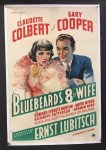
Bluebeard’s Eighth Wife
Directed by Ernst Lubitsch
Written by Billy Wilder and Charles Brackett
1938/US
Paramount Pictures IMDb page
First viewing/Criterion Channel
Nicole de Loiselle: Here’s to our agreement. No lovemaking. No quarrels.
Michael Brandon: Just like an ordinary married couple.
Nicole de Loiselle: I said no quarrels.
What do you get when you mix a screenplay by Billy Wilder and Charles Brackett with direction by Ernst Lubitsch and two utterly charming leads? Comedy gold.
Michael Brandon (Gary Cooper) is a stern, eccentric multi-millionaire. Nicole de Loiselle (Claudette Colbert) is the daughter of a penniless marquis (Edward Everett Horton). The two meet cute at a department store where Michael is attempting to buy a pajama top for half the price of a set of pajamas. Nicole is game to buy the bottoms. It is love (or something) at first sight for Michael, he relentlessly pursues her, and they fall in love.
On their wedding day, Nicole discovers he has been married seven times before. He claims it is all right because he gives his discarded wives $50,000 a year after the divorce. Nicole is dismayed but for the sake of her father negotiates $100,000 a year. Michael happily agrees. But Nicole has no intention of ever collecting and takes him for a ride while she tames him. With David Niven as Michael’s secretary and Nicole’s erstwhile suitor.
I enjoyed this. It is possibly the last of Lubitsch’s American films that I had left to see. Wilder’s script is a scream and the leads are adorable. Cooper is so good at this kind of deadpan comic character and Colbert, as usual, is warm, natural, mischievous, and sexy. Horton is also a highlight. Recommended.
Big City Blues Directed by Mervyn LeRoy Ward Morehouse and Lillie Hayward from Morehouse’s play 1932/US Warner Bros. IMDb page
First viewing/Forbidden Hollywood Vol. 9
Cousin ‘Gibby’ Gibboney: Here you are, baby. Saturate the bridgework.
Joan Blondell brings a spot of joy to even the saddest of stories.
Bud Reeves (Eric Linden) is a naive young man from small town USA. He decides to go to New York with his small inheritance in his pocket. He is promptly set upon by his cousin “Gibby” Gibboney (Walter Catlett), a fast-talking con artist, who is intent on parting Bud from as much of his money as possible. Gibby talks Bud into holding a lavish party in his posh hotel complete with a lot of “the good stuff”. Prime attractions will be chorus girls including Vida Fleet (Joan Blondell) and other theater people.
Bud falls hard for Vida, who is possibly the only honest character in the entire movie. But Bud’s life will change forever when guests Humphrey Bogart and Lyle Talbot (neither of whom are credited) get into a drunken brawl in which one of the girls ends up dead. Bud becomes the prime suspect. Vida stands by her man.
This is about an hour long and fairly entertaining. Key moment for me was when the guests were arriving for the party and a handsome young man caught my eye. I thought that looks like Humphrey Bogart! And it was! It was his first film for Warner Bros. which took another four years to sign him to a long term contract. I can’t understand why neither he nor Lyle Talbot were credited when they both had key parts and several lines of dialogue.
Jewel Robbery Directed by William Dieterle Written by Erwin Gelsey and Bertram Bloch from a story by Ladislas Fodor 1932/US Warner Bros. IMDb page
Repeat viewing/Forbidden Hollywood Vol. 4
Robber: Come with me. I’ll drop you somewhere in the suburbs, untouched.
Baroness Teri von Horhenfels: Untouched? In the suburbs? Oh, no! No, that doesn’t intrigue me at all!
I rewatched this delightful farce without realizing I had already reviewed it here. If possible, I enjoyed it even more the second time. Powell’s pairing with Francis is second only to his screen “marriage” to Myrna Loy. Kay is the more sly of the two. Highly recommended.
Heroes for Sale Directed by William A. Wellman Written by Robert Lord and William Miznar 1933/US First National Pictures (Warner Bros.) IMDb page
Repeat Viewing/Forbidden Hollywood Collection Vol. 3
Thomas ‘Tom’ Holmes: You used to hate the capitalists.
Max Brinker: Naturally. That was before I had money.
William Wellman delivers the epic story of an idealistic “Forgotten Man” in only 70 minutes.
If Tom Holmes (Richard Barthelmess) didn’t have bad luck, he would have no luck at all. His story begins in the trenches of WWI, where he is assigned with several other men to capture a German officer. This is basically a suicide mission but Tom does manage to get his man. Unfortunately, he is badly wounded and his cowardly comrade got the credit and the medals. Tom is taken prisoner by the Germans, who prescribe morphine to ease his agonizing pain. By the time he returns to the US, he is addicted.
His supply gradually dries up and he is tempted to embezzle from the bank he works for to satisfy his habit. He is too honorable for this and tries to get what he needs from a doctor who refuses and then calls the bank on him. So Thomas is fired and sent to the State Narcotic Farm for a couple of years.
When he is released from the Farm in the early 1920s, Tom has beaten his habit and heads out to look for work and a place to stay. He gets a job in a commercial laundry and a room in the boarding house of Mary Dennis (Aline McMahon). Mary has an instant crush on Tom but after she introduces him to Ruth Loring (Loretta Young) it is love at first sight. They marry and have a child.
Time continues to march on. A card carrying Communist has been hanging around spouting all the usual propaganda. This guy has invented a combination washing machine -mangle (!) that will save much manual labor. Tom agrees to raise the capital needed to patent the invention only on the condition that the machine will allow workers more leisure time and not result in the loss of jobs. The laundry owner is agreeable. But when the owner commits suicide, the new owners throw the agreement in the trash. The inventor has no problem with this and works with them to install more machines in other cities. Many workers lose their jobs and blame Tom for this. I’m going to stop here.
I had seen this before and liked it even more this time. Wellman and the screenwriters kept the story moving through decades of turmoil with masterful economy. The hero is seen as both an Everyman and as a fully realized individual. The crowd scenes, in particular, are powerful. Recommended but be warned it is an unsentimental misery sandwich.
I’ve been a classic movie fan for many years. My original mission was to see as many movies as I could get my hands on for every year from 1929 to 1970. I have completed that mission.
I then carried on with my chronological journey and and stopped midway through 1978. You can find my reviews of 1934-1978 films and “Top 10” lists for the 1929-1936 and 1944-77 films I saw here. For the past several months I have circled back to view the pre-Code films that were never reviewed here.
I’m a retired Foreign Service Officer living in Indio, California. When I’m not watching movies, I’m probably traveling, watching birds, knitting, or reading.
Photographs and videos found in this blog, unless indicated, are not owned by me and are here only for the purpose of education and discussion. Media found here are not intended for any commercial purpose. Copyright infringement is not intended.
Written material belongs to me and is copyrighted by flickersintime.com


 Director Olmi did the fabulous cinematography himself. The music is dreamy. Recommended.