Category Archives: Movie Reviews

Reviews of movies I have seen.

No Regrets for Our Youth (1946)

No Regrets for Our Youth
Directed by Akira Kurosawa
Written by Eijirô Hisaita
1946/Japan
Tojo Company
First viewing/Hulu Plus


[box] “Anyone who fights for the future, lives in it today.” ― Ayn Rand[/box]

Kurosawa’s genius made manifest after several trial efforts. Setsuko Hara (Tokyo Story, Late Spring) is a revelation as a young woman who matures from indifference to commitment.

Yukie Yagihara (Hara) is the daughter of a liberal professor at Kyoto University who has written about the dangers of militarism at a very inopportune time in Japan.  A group of students idolizes the professor, who is under fire by the government.  Two of the students are interested in Yukie.  Noge is constantly haranging the group about academic freedom. Itokawa is quieter.  Yukie is afraid for her father and does everything possible to avoid any talk about political matters.

Finally, the professor is forced to resign and the students start to organize a protest.  Noge is the ringleader but Itokawa backs out to please his mother.  Noge is arrested and Itokawa goes on to become a public prosecutor.  After Noge has spent several years in prison, he returns to visit the professor and Yukie in the company of Itokawa, who secured his release after being convinced that Noge had changed his opinions.  Itokawa has also secured a job for Noge in China.  Yukie is so shook up by this development that she packs up that very day to move to Tokyo.  Her father tells her she must be ready to suffer for her freedom.

Yukie has a series of uninspiring jobs in Tokyo.  She then meets Itokawa on the street and finds out from him that Nobe is now working as a researcher in the city.  Longing for meaning in her life, she gradually works up the courage to see Nobe.  She quickly senses that he is still fighting for the old causes, now to keep Japan out of the war.  She has always been half in love with him and they marry.

Their happiness is marred by a sense of impending doom but their motto is “no regrets in my life.”  Nobe is again arrested and Yukie is jailed for some time for refusing to answer questions about Nobe’s activities.  Yukie is eventually released through Itokawa’s intervention but Nobe dies in jail.  Yukie sets out to visit Nobe’s estranged peasant parents and seeks redemption through hard work in the fields amid peasants who believe the entire family to be traitors and spies.

I admire Setsuko in the many Ozu films she made but this performance is really something different.  She plays a modern woman with a core of iron here and is sensational.  She is really the reason to watch this movie but the story is quite moving too.  Who said Kurosawa couldn’t create multi-dimensional women? Recommended.

Fan Tribute

Dillinger (1945)

Dillinger
Directed by Max Nossek
Written by Philip Yordan
1945/USA
King Brothers Productions
First viewing/Netflix rental


[box] These few dollars you lose here today are going to buy you stories to tell your children and great-grandchildren. This could be one of the big moments in your life; don’t make it your last! — John Dillinger [/box]

This is a fun B noir with plenty of violence and a chilling debut by Lawrence Tierney.

John Dillinger (Tierney) gets sent away for seven years for stealing $7.20.  While in prison. he meets up with the men will teach him to aim higher, including “Specs” (Edmund Lowe), Marco Minnelli (Eduardo Ciannelli), and Kirk Otto (Elisha Cook, Jr.).  When Dillinger gets out the first thing he does is to rob a movie theater cashier.  The second thing is to date up the cashier.  And the third is to spring his buddies from prison.

Immediately the gang goes on a bank robbery spree, with Dillinger planning the more impossible jobs.  He also begins demanding his full share (Specs has been taking a double share).  This does not set too well with Specs.  When Dillinger again breaks out of jail, he is indisputably the boss.  But the good times don’t last long and his girlfriend buys a new red dress …

This is one of those no-punches-barred tiny-budget noirs.  The good performances make it a very entertaining watch.  I found the commentary by John Milius (who directed Dillinger (1973)) and screenwriter Philip Yordan as interesting as the film.  Milius filled us in on the true story and Yordan had some nice anecdotes about Tierney who was apparently as scary as the characters he played.  All the major studies had signed a pact not to make a movie about Dillinger, Baby Face Nelson or Pretty Boy Floyd.  Monogram did not, probably accounting for why this big-budget worthy material appears in such a cheapie.

Dillinger was nominated for an Academy Award for Best Writing, Original Screenplay.

Trailer

Sanshiro Sugata Part Two (1945)

Sanshiro Sugata Part Two (“Zoku Sugata Sanshirô”)
Directed by Akira Kurosawa
Written by Akira Kurosawa from a novel by Tsuneo Tomita
1945/Japan
Toho Company
First viewing/Hulu Plus


[box] “Dont fear the man who practices 10,000 kicks once, fear the man who practices one kick 10,000 times” – Bruce Lee [/box]

Kurosawa reportedly did not want to make this sequel. It shows.

This picks up where Sanshiro Sugata left off.  Now an acknowledged champion, it is our hero’s turn to rescue a young rickshaw driver from an abusive American sailor.  The boy becomes his own disciple.  Sanshiro is then challenged to a boxing match with an American.  He refuses because honor forbids him to fight for money.  He goes to watch the fight though and sees the Japanese opponent defeated. Vowing to avenge Japanese martial arts, Sanshiro renounces his code in order to defeat the boxer.  Sanshiro is also under fire by a couple of brothers who are challenging him to a match up between karate and Sanshiro’s judo practice.  They face off in the snow.  It does not take a genius to figure out who will win.

 I thought Part I, Kurosawa’s directorial debut, was better than its reputation.  This one, however, suffered from a weaker plot and was less visually interesting.  The visual impact might have suffered from the bad quality of the print available to me.

I kept wondering where the American boxer and Caucasians in the audience for the boxing match came from and hoping they weren’t prisoners of war.

Clip – representative of print quality available on Hulu Plus

Back to Bataan (1945)

Back to Bataan
Directed by Edward Dmytryk
Written by Ben Barzman and Richard H. Landau; Original Story by Aeneas MacKenzie and William Gordon
1945/USA
RKO Radio Pictures
First viewing/Netflix rental

[box] Maximo Cuenca: [a poor student dying in his teacher’s arms after heroic action] Miss Barnes, I’m sorry I never learned how to spell “liberty”. [dies]

Bertha Barnes: [tearfully] No one ever learned it so well.[/box]

For propaganda-combat, this takes the cake.

Col. Joseph Madden (John Wayne) is an old-time Philippine hand.  At the moment, he has his hands full staving off hordes of Japanese invaders on Bataan.  One of his officers, Captain Andrés Bonifácio (Anthony Quinn), is the grandson of a great Filipino freedom fighter.  Bonifácio is in turmoil because his girlfriend Dalisay Delgado has become something like the Tokyo Rose of the Philippines, broadcasting daily to get the Filipinos to give up.  Col. Madden is called back to Corregidor to get new orders.

General MacArthur has just received orders to leave for Australia and it looks like Bataan will fall any day.  Madden is told to organize the Filipino guerrilla resistance.  He returns to the island in time for the fall of the village that is the cradle of Filipino independence.  There we see Japanese atrocities against the principal of the local school, etc.  The schoolteacher (Beulah Bondi) joins the rebels in the mountains.  She wants Madden to go back to the village and avenge the life of the principal on the Japanese.  Madden has orders to blow up a Japanese gas dump and refuses.  The ragtag band of untrained guerillas is surprisingly effective in its mission and also manages to rescue Captain Bonifácio from the Bataan Death March.

I could go on but it is unnecessary.  Suffice it to say that MacArthur makes good on his promise to return.

Take a look at the quote up top and you will get a good idea of what is wrong with this movie.  In fact, the whole reason for Beulah Bondi’s character seems to be to spout off platitudes such as this.  The entire movie is first a tribute to Filipino resistance and only secondarily a story, much of which does not make much sense.  We keep getting big potential payoffs, such as the real identity of Quinn’s girlfriend, that are then more or less thrown away.  Speaking of Quinn, he looks just ludicrous as a Filipino.  Especially so when seen with dozens of actual Filipinos in this film.


Trailer


The Seventh Veil (1945)

The Seventh Veil
Directed by Compton Bennett
Written by Muriel and Sydney Box
1945/UK
Ortus Films/Sydney Box Productions
First viewing/YouTube


[box] The attraction of the virtuoso for the audience is very like that of the circus for the crowd. There is always the hope that something dangerous will happen. — Claude Debussy[/box]

I hate when a man’s cruelty and abuse is portrayed as disguising untold love in movies. Despite this, and my general distaste for psychoanalytic stories, I found myself absorbed in this film.  James Mason and Ann Todd were the principal reasons.

The film is told in flashback after a young woman’s suicide attempt and subsequent catatonia.  We learn that she was a famous concert pianist before her hospitalization.  Psychiatrist Dr. Larsen (Herbert Lom) gets her talking through hypnosis.

Francesca (Todd) was fourteen and living at boarding school when she applied for a scholarship to a music conservatory.  Unfortunately, she had just been caned on the hands for disobedience and failed the audition.  Her parents die shortly thereafter and she is sent to live with her only living relative, second-cousin Nicholas (Mason).  Nicholas is a confirmed bachelor and is none to happy to have Francesca around.  Then Francesca plays the piano for him and he has a new passion – making her a virtuoso.  He sends her to music college.

At college, Francesca falls in love with a swing band leader and wants to marry him.  But Nicholas snatches her off to Paris where he completes her training, makes her a star, and controls every aspect of her existence.  Finally, after seven years, they return to London. There, he hires a painter to paint Francesca’s portrait.  When the painter and Francesca fall in love, Nicholas, no longer able to force Francesca to his will as her guardian, goes off the deep end.  As a result, so does Francesca.  It is up to Dr. Larsen to save the day.

My plot summary does not do justice to how really cruel Nicholas is to Francesca.  The resolution of this film just drove me nuts.  Ditto for how two sessions of hypnosis and listening to a couple of records are just the cure for suicidal depression and anxiety amounting almost to phobia.  Nonetheless, Mason is mesmerizing and Todd is very, very good (although I kept imagining Joan Fontaine in the part).  It kept my attention throughout.  Recommended if the story appeals at all.

The Seventh Veil won the Oscar for Best Writing, Original Screenplay.

Trailer

Vacation from Marriage (1945)

Vacation from Marriage (AKA “Perfect Strangers”)
Directed by Alexander Korda
Written by Clemence Dane and Anthony Pelissier
1945/UK
London Film Productions/Metro-Goldwyn-Mayer British Studios
First viewing/Amazon Instant Video


[box] Proverbs often contradict one another, as any reader soon discovers. The sagacity that advises us to look before we leap promptly warns us that if we hesitate we are lost; that absence makes the heart grow fonder, but out of sight, out of mind. — Leo Rosten[/box]

Just when I think that a year has no more treasures to offer along comes a hidden gem that makes it all worthwhile.

Robert Wilson (Robert Donat) is a mild-mannered clerk in The City of London who runs his life on a strict timetable.  Wife Cathy (Deborah Kerr) has a perpetual cold and fusses over him constantly.  Then, Robert is called up to the British Navy.  After a few initial rough spots, he finds he likes it.  The exercise and shaving off his mustache make him look years younger.  He even asks a nurse out dancing.

Robert has long forbidden Cathy to work.  With him gone, she decides to join the Womens Royal Naval Service (WRENS).  A kindly fellow WREN (Glynis Johns) takes her under her wing and gets her to start wearing make-up, also forbidden by Robert.  She starts falling for an officer.  One thing and another prevents Robert and Cathy from sharing a leave for three years.

When a meeting can finally be arranged, both are filled with trepidation.  Neither wants to go back to the life they had, yet expects the other to demand nothing less.  Their reunion reveals a lot – not only about who they are now but who they actually were to begin with.

I thought this was pretty great.  The dialogue sparkles, but in a most convincing way, and Donat and Kerr are magnificent.  I don’t know how they did it but Donat’s change in appearance was amazing.  This has one of the best ending lines ever, too.  The whole thing is set to a background of variations on “These Foolish Things”, which only makes it more romantic.  I imagine that the story resonated with a lot of couples at the end of the war.  Recommended.

Vacation from Marriage won the Oscar for Best Writing, Original Story.

Trailer

Anchors Aweigh (1945)

Anchors Aweigh
Directed by George Sidney
Written by Isobel Lennart suggested by a story by Natalie Marchin
1945/USA
Metro-Goldwyn-Mayer
First viewing/Netflix rental

[box] Anchors Aweigh, my boys,/ Anchors Aweigh. Farewell to foreign shores,/ We sail at break of day-ay-ay-ay./ Through our last night ashore,/ Drink to the foam,/ Until we meet once more./ Here’s wishing you a happy voyage home.[/box]

Take out Gene Kelly’s dancing, and there’s not a whole lot left.  But what dancing!

Joe (Gene Kelly) and Clarence (Frank Sinatra) are awarded the Silver Star and four days leave in Los Angeles as the movie starts.  Seems that Joe rescued Clarence after a firefight in which both displayed conspicuous bravery.  Joe is the kind of sailor with a girl in every port and is anxious to hook up with his LA lady Lola.  Clarence, on the other hand, is shy around women and is looking for Joe to provide him with some leads and tips.  He figures that, since Joe saved his life Joe is responsible for him.

Joe can’t shake Clarence.  Then the two sailors get stuck seeing home a lost little boy (Dean Stockwell) who wants to join the navy.  The boy’s Aunt Susie turns out to be the girl of Clarence’s dreams.  She aspires to be a professional singer and Joe gets Clarence to promise her an audition for Jose Iturbe.  Complications ensue.

This is one of those musicals that feels more like a contrived way to showcase various talents than an integrated story.  Even if the plot did matter, though, it is fairly trite.  Kelly has three boffo numbers, Sinatra sings the Original Song nominee, Grayson trills through two, and Iturbi leads the orchestra in the title tune.    It all doesn’t add up to much in my opinion.

George Stoll won the Academy Award for Best Music, Scoring of a Musical Picture.  Anchors Away was nominated for Oscars in the categories of Best Picture; Best Actor (Kelly); Best Cinematography, Color; and Best Music, Original Song (“I Fall in Love Too Easily” by Jule Styne and Sammy Cahn).

Trailer


Objective, Burma! (1945)

Objective, Burma!Poster - Objective, Burma_03
Directed by Raoul Walsh
Written by Ranald MacDougall and Lester Cole; original story by Alvah Bessie
1945/USA
Warner Bros.
First viewing/Errol Flynn Adventures DVD

[box] Pvt. Nebraska Hooper: It’s sure peaceful so far.
Cpl. Gabby Gordon: That’s the way I like it… peaceful. I already said when I starved to death, I want it to be peaceful.[/box]

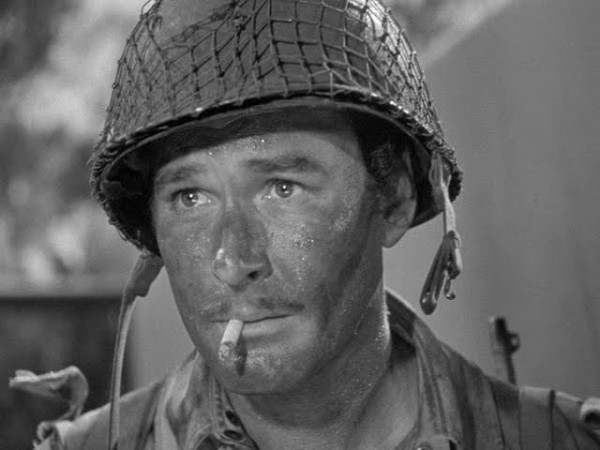
Raoul Walsh puts together some unusual and effective combat set pieces.  Otherwise, it’s routine Warner wartime material, including the ever-present George Tobias as the token Brooklynite.

Captain Nelson (Errol Flynn) is selected to head a force of paratroopers on an important mission into Japanese-held Burma to knock out a radar station.  Journalist Mark Williams (Henry Hull) insists on tagging along even though he is well along in middle age and inexperienced in such matters.  The affable Nelson agrees.

Things go swimmingly at first.  The men parachute in undetected and wipe out 30 Japanese and the radar station with no loss of life to themselves.  This looks like it will be a cakewalk.  The plane sent to retrieve them is getting ready to land when they detect a Japanese patrol looking for them.  The plane drops some supplies and returns to base.

Errol Flynn in Army Film

The men struggle to reach the next rendezvous point.  But by then the brass has decided that it is too dangerous to for a plane to land anywhere and orders the men to walk out through about 150 miles of jungle.  Finally, the orders are changed again and the men have to change direction away from the base and simply wait.  Then the radio is lost, supplies are exhausted, and Nelson and his men must get through on pure guts.

objective burma 5

The sequences with the dozens parachutes are beautiful and there is an ambush at night that is really striking.  Otherwise, I’ve seen a few too many combat movies now and this one was nothing special.  I always like Flynn but he seemed a little tired here.  On the other hand, my husband stayed awake throughout the entire thing, a rare tribute, and enjoyed it.

Objective, Burma! was nominated for Academy Awards in the categories of:  Best Writing, Original Story; Best Film Editing; and Best Music, Scoring of a Dramatic or Comedy Picture (Franz Waxman).

Clip

San Pietro (1945)

San Pietro (AKA “The Battle of San Pietro”) 
Directed by John Huston (uncredited)
Written by John Huston (uncredited)
1945/USA
U.S. Army Pictorial Services
Repeat viewing/Treasures from American Film Archives DVD
#190 of 1001 Movies You Must See Before You Die

[box] War alone brings up to their highest tension all human energies and imposes the stamp of nobility upon the peoples who have the courage to make it. — Benito Mussolini [/box]

The army got a whole lot more than it bargained for when it assigned John Huston to make this movie.

This is an account of the Battle of San Pietro Infine which was a major engagement from 8–17 December 1943 in the Italian Campaign of World War II involving Allied Forces attacking from the south against heavily fortified positions of the German “Winter Line” just south of Monte Cassino about halfway between Naples and Rome. The film contains graphic combat footage.  We are informed that the Italian campaign was more-or-less a feint to keep the German army occupied while preparations for the D-Day invasion could be completed.  Thus, the divisions involved in the campaign were under-manned and under-supplied.

I’ve seen so many war documentaries in the past several months that the combat portions of this film did not seem like anything special.  However, Huston narrated the opening sequence as a kind of travelogue describing the green vineyards and olive groves of the countryside and the 700-year-old village and its church over shots of the total wreckage that was left after the battle.  The short film ends with scenes of the villagers emerging from their hiding places and attempting to rebuild their lives.  Huston’s narration of the abject gratitude of these people to their “deliverers” sounds deeply ironic to these ears. IMDb says that the army felt the original edit was too anti-war and cut it from its original five reels to the current 32-minute version.  I would give anything to see the film in its original state.

The film is in the public domain and is currently widely available on YouTube.

Clip

The Southerner (1945)

The Southerner
Directed by Jean Renoir
Written by Hugo Butler and Jean Renoir from the novel “Hold Autumn in Your Hand” by George Sessions Perry
1945/USA
Jean Renoir Productions/Loew-Hakim
Repeat viewing/Netflix rental


[box] The saving grace of the cinema is that with patience and a little love we may arrive at that wonderfully complex creature which is called man. — Jean Renoir[/box]

I’m a huge Renoir fan but for some reason this one has never captured me, despite its evident beauty.  I think maybe the story is a bit too “American” for a European sophisticate like Renoir to entirely pull off.

Sam Tucker (Zachary Scott) and his wife Nona (Betty Field) work as cotton pickers.  Two small children and Granny (Beulah Bondi) complete the family.  Sam decides to see about renting his own piece of land from his boss to work as a sharecropper.  He is full of enthusiasm about the rich earth, ignoring the dilapidated house, dry well, and other serious defects.  He counts on his neighbor to help out on the water front but discovers the man (J. Carroll Naish) is a jealous skinflint who had been hoping to get the property for himself.

Things go from bad to worse.  Granny complains non-stop.  One of the children gets sick from malnutrition and the only cure is to give him expensive milk and vegetables.  Then a flood comes.  Can the Tuckers hold onto their dream?

Don’t know if it’s me or the film, but both times I watched this I had kind of zoned out by the end.  Zachary Scott is very good, though.  It is nice to see him play something other than a mustachioed cad.  The usually reliable Beulah Bondi overdoes it.

The Southerner was nominated by the Academy in the categories of:  Best Director; Best Sound, Recording; and Best Music, Scoring of a Dramatic or Comedy Picture.

Clip