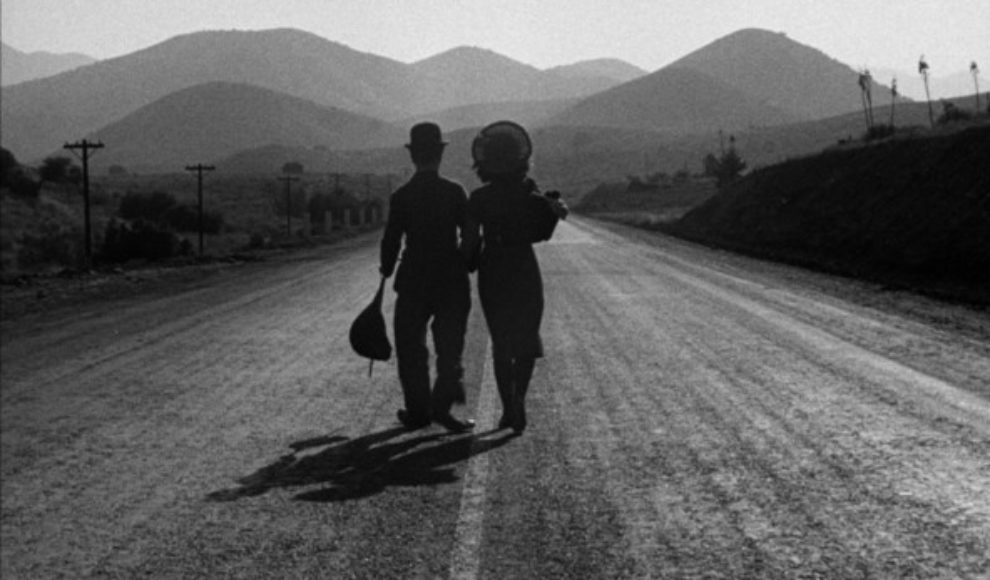
Directed by John Ford Directed by Peter Bogdanovich Written by Peter Bogdanovich 1971 (restored and updated 2006)/USA American Film Institute/California Arts Commission/Turner Classic Movies (2006 Restoration)
First viewing/American Documentary Film Festival
[box] I prefer the old masters, by which I mean John Ford, John Ford, and John Ford. — Orson Welles [/box]
The American Documentary Film Festival near us was having a retrospective of documentaries by Peter Bogdanovich and my husband and I caught this one. I enjoyed it immensely.
The documentary was restored and updated in 2006 to include contemporary interviews with directors influenced by Ford, including Scorcese, Speilberg, and Eastwood. The reminiscences of actors such as John Wayne, Jimmy Stewart, Henry Fonda, Harry Carey, Jr., and Maureen O’Hara were even better. What a cranky, difficult character Ford was! But everyone seemed to have loved him in the end.
Watching as Ethan Edwards returns from the war – The Searchers (1956)
Better than all the talking heads, however, were the wonderful clips. It was so awesome to see them on the big screen. Now my mouth is watering for a rewatch of Fort Apache which is coming up soon.
This is available on DVD and is highly recommended.
They Live by Night Directed by Nicholas Ray Written by Charles Schnee and Nicholas Ray from the novel “Thieves Like Us” by Edward Anderson 1948/USA RKO Radio Pictures
Repeat viewing/Film Noir Classic Collection, Vol. 4
Mr. Hawkins, Wedding Chapel Proprietor: I believe in helping people get what they want as long as they pay for it. I marry people ‘cos there’s a little hope they’ll be happy. But I can’t take this money of yours. No sir. In a way I’m a thief just the same as you are, but I won’t sell you hope when there ain’t any.
There are plenty of films about lovers on the lam. This one is more poignant than most and strikingly shot by Nicholas Ray.
Bowie (Farley Granger) has just escaped from prison, where he was serving a sentence for a murder that took place during a robbery he was involved in. The luckless boy was the only one the police could catch. Now he finds himself hiding out in a gas station with his much older felllow escapees, the alcoholic Chickamaw (Howard da Silva) and redneck T-Dub.
Bowie serves as getaway driver for a heist and is hurt in a crash. When a policeman comes to investigate the accident, Chickamaw shoots him. Keechie (Cathy O’Donnell), the station owner’s daughter, grudgingly nurses Bowie and the two fall in love. But now Bowie has been tagged for the murder and the two flee together with the robbery proceeds.
On a sudden impulse, the two get off the bus and marry at a truck-stop chapel. The justice-of-the-peace speaks suggestively of his contacts in Mexico but the two press on. Keechie falls pregnant and then everything goes to hell.
Although it is firmly in the noir style, They Live by Night is actually more a tragic love story than a crime film. O’Donnell gets a crack at a more complex character than usual for her, being hardbitten before she is tamed by love. I thought she was very good. Farley Granger is always Farley Granger to me. I don’t find him too convincing. The most notable aspect of the film are the awesome compositions and beautiful cinematography. Ray pioneered the use of a helicopter to film an action sequence in the opening.
This was Ray’s first feature. As was his wont, Howard Hughes put it on the shelf for two years before releasing it.
Key Largo Directed by John Huston Written by Richard Brooks and John Huston from the play by Maxwell Anderson 1948/USA Warner Bros.
Repeat viewing/Amazon Instant
[box] Frank McCloud: You don’t like it, do you Rocco, the storm? Show it your gun, why don’t you? If it doesn’t stop, shoot it.[/box]
Edward G. Robinson steals the picture right from under the noses of Bogart and Bacall. Claire Trevor helps him.
Frank McCloud (Humphrey Bogart) visits a hotel on one of the Florida keys to call on Nora (Lauren Bacall) and James (Lionel Barrymore) Temple, the widow and father of one of the soldiers who served under him in WWII. He doesn’t get a good reception on arrival when he finds out the entire place has been rented out to a bunch of thugs. Nora and James take to him immediately, though, and he is asked to stay.
Soon it emerges that the place has become the private domain of the notorious Johnny Rocco (Robinson) and his gang. Rocco has arrived in the keys from his hideout in Cuba to do a deal in counterfeit bills. He looks forward to a full-fledged return to America on that great day when Prohibition is reinacted. Rocco is a big bully, terrorizing the legitimate owners and guests. He is especially cruel to Gaye Dawn (Trevor), a pathetic lush and ex-nightclub singer who used to be his girl.
Rocco managed to time his arrival to coincide with a major hurricane. It is amusing to watch as the storm makes all the tough guys shiver. As soon as it is over, though, Rocco is back to his old ways and coerces Frank into skippering his boat back to Cuba. With Thomas Gomez as Rocco’s right hand man.
Robinson hasn’t been this mean since Little Caesar and he brings equal vitality and nuance to this part as he did fifteen years earlier. There was never anyone like him. I am hit or miss on Trevor. She is fantastic here. The scene where she is forced to sing in exchange for another drink is so real it is almost painful to watch. Bogart is back to playing his standard “I stick my neck out for nobody” hero in this one and Bacall kind of fades into the background in a fairly lady-like role. Not to say that they are bad by any means. Huston creates a really suspenseful hurricane. Recommended.
Claire Trevor won the Academy Award for Best Supporting Actress
The Treasure of the Sierra Madre Directed by John Huston Written by John Huston based on the novel by B. Traven 1948/USA Warner Bros. Repeat viewing/Warner Bros. DVD
#223 of 1001 Movies You Must See Before You Die
[box] Fred C. Dobbs: This is the country where the nuggets of gold are just crying out for you to take them out of the ground and make ’em shine in coins on the fingers and necks of swell dames.[/box]
John Huston’s tale of gold lust will never grow old.
Fred C. Dobbs (Humphrey Bogart) is a vagabond who has been reduced to soliciting hand-outs on the streets of Tampico, Mexico. He gets three windfalls in one day from the same American (memorably played by John Huston) and his luck appears to be changing. So much so that he takes a chance on purchasing 1/20 of a lottery ticket from a street urchin.
Eventually, Dobbs meets up with fellow-American Curtin (Tim Holt) and they get work as laborers. But their boss disappears with their wages and they end up sleeping in a flop house with old-time prospector Howard (Walter Huston). Howard tells them a cautionary tale about the effects of gold on men. When they finally recoup their money from the boss in a fight, they remember what the old man said and go to find him. Between their wages and the money Dobbs wins on his forgotten lottery ticket, they have the stake to go prospecting. They take Howard along for his expertise, figuring they will eventually have to carry him.
It turns out that Howard is in the best shape of all of them and the two younger men are unprepared for the long journey. Then they find a rich vein of gold and find they are in for months of back-breaking labor to mine it. As the gold piles up, Dobbs get increasingly paranoid about losing it. Early on, he demands that the men divide it equally at the end of each day.
The men are constantly in danger from rival prospectors and bandits. After they start back to civilization with their loot, however, it appears that the greatest danger is from each other. With Barton McLane as the crooked boss and Robert Blake as a street urchin.
This has to rank with the best screenplays ever written. The moral is clear early on but the psychology behind the greed is masterfully done. I love the way Dobbs starts referring to himself in the third person more and more as he slips into madness. This is the role Bogart should have won his Oscar for. It’s incredible he was not even nominated. Walter Huston is fantastic. He is unrecognizable without his teeth and even his distinctive voice is not much in evidence. A true classic. Very highly recommended.
The Treasure of the Sierra Madre won Academy Awards in the categories of Best Supporting Actor (Huston), Best Director, and Best Writing, Screenplay. It was nominated for Best Picture.
In 1948 movie news, a Supreme Court decision forced studios to divest themselves of their theater chains. Block booking, the system by which an exhibitor was forced to buy a whole line of films (both popular films and B films) from a studio was also deemed illegal. This marked the beginning of the end of the studio system, and was partially responsible for a major slump in business for all the studios in the late 1940s.
Maverick film producer, aviator, and eccentric industrialist Howard Hughes purchased RKO Studios. He led RKO during a long period of decline until the mid-1950s. Bela Lugosi (as Count Dracula) and Lon Chaney, Jr. (as The Wolf Man) portrayed their iconic horror characters for the last time in Abbott and Costello Meet Frankenstein. Hamlet was the first non-American film to win the Best Picture Oscar and the only film adapted from one of William Shakespeare’s plays to receive the award.
In U.S. news, Harry S. Truman defeated Thomas E. Dewey, the Republican nominee, in the biggest presidential election upset in the country’s history. Earlier in the year Truman ended racial segregation in the U.S. armed forces by executive order. The Supreme Court outlawed religious instruction in public schools. Alger Hiss was indicted for treason. The first monkey astronaut was launched into space. Tales of the South Pacific by James Michener won the Pulitzer Prize for Literature and Tennessee Williams’ A Streetcar Named Desire won for Drama. “Buttons and Bows” as sung by Dinah Shore topped the Billboard charts for 10 weeks. The song would go on to win the Oscar for Best Original Song.
On January 12, 1948, Mahatma Gandhi began a fast in an effort to stop communal violence in the Partition of India. He would be assassinated on January 30 by a militant Hindu nationalist. War raged between the State of Israel and a military coalition of Arab states and Palestinian Arab forces. Daniel François Malan was elected President of South Africa ushering in the era of apartheid. The Berlin Blockade began. The Olympics were held in London after an eight year haitus due to World War II.
***********************************************
I have previously reviewed the following 1948 releases on this site: ; ; ; ; ; ; ; and .
The list of films that I will select from can be found hereand here. Based on my current ratings of this very strong year, I would guess my top ten favorites to be, in no particular order: The Red Shoes; Oliver Twist; Hamlet; Red River; The Treasure of the Sierra Madre; Raw Deal; Bicycle Thieves; The Fallen Idol; Drunken Angel; and Force of Evil. I’m looking forward to seeing how these stand up to re-watches and against the “new” films available for the year.
What a great year for film noir it was! I have now seen 75 films that were released in 1947. A few shorts, documentaries, and B movies were reviewed only here. The total also includes a few I’ve seen before that were not easily available this time around. In that category, Raoul Walsh’s Pursued deserves special mention.As of the time I first watched it, it probably would have made the top half of my favorites list. It features gorgeous black-and-white cinematography by James Wong Howe and a cast that includes Robert Mitchum, Teresa Wright, and Judith Anderson. Another film I liked several years ago that I did not see this time was The Bachelor and the Bobby-Soxer with Cary Grant, Myrna Loy and Shirley Temple.
There were many, many films that could as easily have filled the bottom three slots on my top-ten list. The ones I selected mostly reflect my bias for film noir. As usual, the list represents my personal favorites and does not attempt to arrive at the “best” films of the year.
The Bishop’s Wife, Body and Soul, The Bachelor and the Bobby-Soxer and Pursued dropped out of my predicted favorites list to make way for They Made Me a Fugitive, Ride the Pink Horse, Crossfire, and Brighton Rock. All but Crossfire were new to me. The complete list of films I viewed for 1947 can be found hereand here.
The Paradine Case Directed by Alfred Hitchcock Written by David O. Selznick and Alma Reville from a novel by Robert Hichens 1947/USA Vanguard Films and The Selznick Studio
Repeat viewing/Netflix rental
Gay Keane: Well, nice people don’t go murdering other nice people.
This was David O. Selzncik’s last opportunity to interfere with Hitchcock’s movie-making and he went all out, even writing the screenplay. It’s not a terrible movie but it’s not classic Hitchcock. I also have a problem with attempting to sympathize with lawyers who commit malpractice right and left.
Barrister Anthony Keane (Gregory Peck) and his wife Gay (Anne Todd) are very happily married as the film begins. Then he gets a referral from solicitor Simon Flaquer (Charles Coburn) to defend the young and beautiful Mrs. Paradine (Alida Valli) who has been accused of poisoning her husband and stands to be sentenced to death. Unfortunately for all concerned, Keane is bewitched by his frosty client on first sight. At this point, good judgement goes completely out the window.
Although his marriage is in grave jeopardy, Keane is determined to acquit Mrs. Paradine at all costs. Against her explicit wishes, he begins to investigate the role of Mr. Paradine’s valet Andre LaTour (Louis Jourdan) in the crime. The rest of the story is mostly a courtroom drama and I will not reveal it any further. I will say that Keane makes several bone-headed mistakes including violating a key maxim of all good trial attorneys: “Never ask a witness a question if you do not know the answer.” With Charles Laughton as the judge, Ethel Barrymore as the judge’s wife, and Leo G. Carroll as the prosecutor.
This is an OK courtroom drama but not particularly Hitchcockian. Its defects can probably all be laid at the feet of Selznick starting with the casting which resulted in a hodgepodge of accents in its Hollywood London. It also moves at a sluggish pace, again due to Selznick’s omnipresence in the editing room.
Ethel Barrymore was nominated for an Oscar for Best Supporting Actress for her three minutes of screen time in The Paradine Case. Her part was originally bigger but several scenes were lost in Selznick’s extensive cutting of the film.
The Sin of Harold Diddlebock (AKA “Mad Wednesday”) Written and Directed by Preston Sturges 1947/USA California Pictures
First viewing/Internet Archive
[box] Harold Diddlebock: As soon as I have a minute, I’ll thank you for hours.[/box]
This Harold Lloyd come-back vehicle lacks some of the sophistication of the best Preston Sturges comedies but has its memorable moments.
The movie starts with a long sequence from Lloyd’s 1925 silent hit The Freshman. That’s the one where Harold sits sadly on the sidelines of the big game as a water boy but goes on to lead the team to victory. Following this triumph, he is given a job at the advertising firm of a big college booster. Segue to twenty years later and we find Harold has been working in the accounting department the entire time. His boss lets him go on the grounds that he is too old for the job. He bids adieu to the latest in the line of coworkers he has fallen in love with.
Luckily Harold has a little nest egg of payroll savings to fall back on. Naturally, the first person he runs into is Wormy (Jimmy Conlon), who is looking for a loan to bet on a horse. He is only too happy to oblige and the next thing we know Harold is taking his first drink and betting his whole wad on the same horse. But lo and behold, his horse wins and Harold is now able to paint the town red.
Somewhere along the line, Harold manages to acquire a circus. Expenses are high, especially to feed the 37 lions, and he is unable to unload this new burden. The highlight of the film has Harold on the ledge of a skyscraper a la Safety Last with one of the lions on the other end.
This has cameos from almost every one of the Sturges stock company and they are all in top form. But it is basically more Lloyd than Sturges. If you enjoy the comic’s physical humor, you will probably like this.
Clip – Edgar Kennedy mixes Harold his first drink – typical of the print quality available to me
It Happened on 5th Avenue Directed by Roy Del Ruth Written by Everett Freeman and Vick Knight; original story by Herbert Clyde Lewis and Frederick Stephani 1947/USA Roy Del Ruth Productions
Repeat viewing/Netflix Rental
[box] Michael J. ‘Mike’ O’Connor: Remind me to nail up the board in the back fence. He’s coming through the front door next winter.[/box]
1947 was the year for Christmas movies and here is another one. The many heartwarming messages in this one are probably best appreciated at Christmastime but the performances by some favorite actors from the 1930’s are good anytime.
Aloysius T. McKeever (Victor Moore) is a lovable tramp who has spent the last three winters holed up in the mansion of Michael J. O’Connor, second richest man in the world, while the family is vacationing in Virginia. This winter he gets an unexpected number of fellow lodgers. The first is Jim Bullock (Don DeFore) who has been evicted from his apartment so that the self-same O’Connor can raze the property for an office building. Then O’Connor’s daughter Trudy (Gale Storm) shows up, having run away from finishing school. She hides her identity in order to stay in the house with Jim, who she naturally falls for in a big way. Then Jim offers places to some fellow GIs who are down on their luck.
Finally Michael T. himself (Charles Ruggles) turns up looking for Trudy. She tells him of her love for Jim and persuades him to dress in rags in order to meet her intended. O’Connor tries some dirty tricks to get Jim out of the picture but the only effect is to send Trudy running home for mother Mary (Ann Harding). You guessed it – soon Mary is living in the house masquerading as a cook.
The rest of the film finds the fun in the situation while McKeever illustrates what “real riches” are to the wealthy and brings the estranged Mike and Mary together again.
It’s been awhile since I’ve caught up with Victor Moore, Charles Ruggles or Ann Harding and it is always a treat to see them do their stuff. The romantic leads are only so-so. This is a movie that would benefit from a dose of Christmas cheer to help the medicine go down but it’s not bad by any means.
It Happened on 5th Avenue was Oscar-nominated for Best Writing, Original Story.
Life with Father Directed by Michael Curtiz Written by Donald Ogden Stewart from the play Howard Lindsay and Russel Crouse based on a memoir by Clarence Day 1947/USA Warner Bros.
Repeat viewing/Netflix rental
[box] Miss Wiggins: Sir, before I can let any girl go from this establishment, I must know the character of the home in which she will be employed.
Father: Madam, *I* am the character of my home.[/box]
Dated sexual politics aside, this is an endearing domestic comedy with one of William Powell’s best performances.
Clarence Day Sr. (Powell) is a wealthy stockbroker. The man is all bluster, insisting on running every aspect of his household on a business basis and terrorizing the staff. His wife Vinnie (Irene Dunne) spends much of her time trying to smooth things for him. But she definitely has figured out how to get her own way. One of her methods to avoid arguments over her expenditures is through a kind of arithmetic that defies logic and leaves her husband helpless. Others stratagems nclude tears and a kind of charming passive aggression.
The Days have four sons. One day, Vinnie’s cousin (Zasu Pitts) comes to visit with a teenage protege Mary (Elizabeth Taylor). Clarence Jr. (Jimmy Lydon) is knocked for a loop by the young beauty. She likes him too but they soon discover that they go to different churches. Mary is Methodist and the Days are Episcopalians. Well, Vinnie and the children are faithful but Clarence is a very reluctant churchgoer who refuses to kneel. It soon develops that Clarence Sr. has never been baptized. Vinnie is horrified. Much of the story is devoted to her plots to get the situation rectified.
Other episodes include Clarence Jr.’s inability to court Mary in his father’s old suit and the boys’ money making scheme to sell a rather dodgy patent medicine door-to-door. With Edmund Gwenn as the local Episcopal priest.
My description does not make the movie sound as frothy and funny as it is. The Life with Father plot is the prototype for several TV sitcoms of the 50’s and 60’s but the original far surpasses any of its successors in its execution. Powell was never better than in this role, which is as far as could be imagined from the suave Nick Charles. He and Dunne have fantastic chemistry.
The film is in the public domain and I have only ever seen in it in a faded print with iffy sound quality. This deserves a restoration on a proper DVD.
Life with Father was nominated for Academy Awards in following categories: Best Actor; Best Cinematography, Color; Best Art Direction-Set Decoration, Color; and Best Music, Scoring of a Dramatic or Comedy Picture.
I’ve been a classic movie fan for many years. My original mission was to see as many movies as I could get my hands on for every year from 1929 to 1970. I have completed that mission.
I then carried on with my chronological journey and and stopped midway through 1978. You can find my reviews of 1934-1978 films and “Top 10” lists for the 1929-1936 and 1944-77 films I saw here. For the past several months I have circled back to view the pre-Code films that were never reviewed here.
I’m a retired Foreign Service Officer living in Indio, California. When I’m not watching movies, I’m probably traveling, watching birds, knitting, or reading.
Photographs and videos found in this blog, unless indicated, are not owned by me and are here only for the purpose of education and discussion. Media found here are not intended for any commercial purpose. Copyright infringement is not intended.
Written material belongs to me and is copyrighted by flickersintime.com