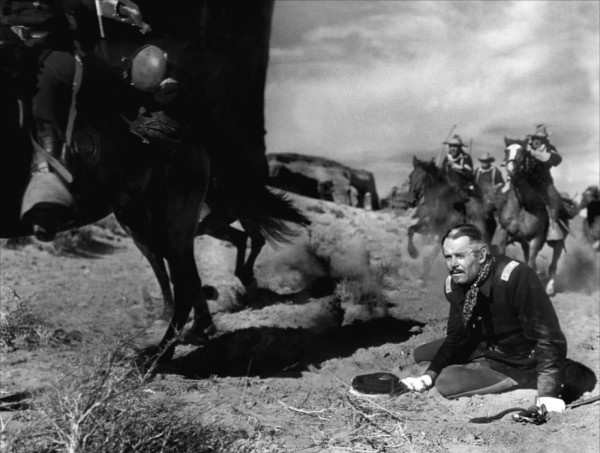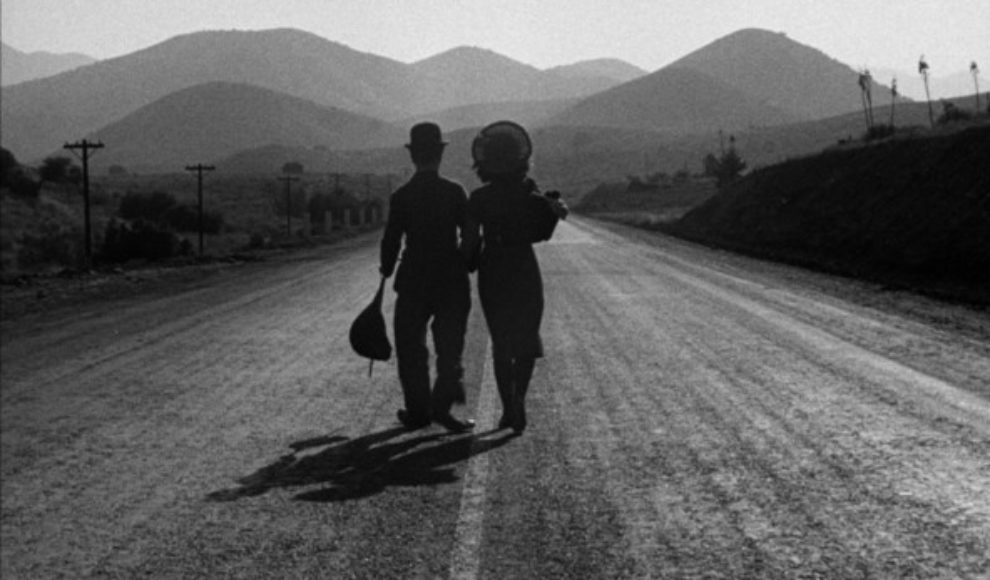
Category Archives: Movie Reviews

Reviews of movies I have seen.

She Wore a Yellow Ribbon (1949)

She Wore a Yellow Ribbon
Directed by John Ford
Written by Frank S. Nugent and Laurence Stallings from a story by James Warner Bellah
1949/USA
Argosy Pictures
Repeat viewing/Netflix rental


[box] Captain Nathan Brittles: Never apologize. It’s a sign of weakness.[/box]

This lacks the gravitas of the previous entry in Ford’s Cavalry Trilogy – Fort Apache – but it is very appealing, looks splendid, and contains one of John Wayne’s better performances.

Wayne plays Capt. Nathan Brittles, a forty-year man who is about to retire.  He clearly has mixed feelings about leaving his beloved cavalry.  His right-hand man Sgt. Quincannon (Victor McLaglen), a hard-drinking blustery Irishman, is also due to retire a couple of weeks after him.  Wayne is a crusty mentor to two young men who are coming up in the ranks, Lt. Flint Cohill (John Agar) and Second Lt. Ross Pennell (Harry Carey, Jr.).  These are vying for the affections of spunky Olivia Dandridge (Joanne Dru), niece of the fort commandant, Major Allshard (George O’Brien).

The victory of the Sioux at Little Big Horn has inspired the local Indians to band together to drive the white man out of their hunting grounds once and for all.  The major is anxious to get his wife (Mildred Natwick) and niece out of harm’s way and orders Brittles to take them along by wagon.  Brittles protests but obeys.  The presence of the women slows down the company and it proves impossible for Brittles to take them to the stage they are to catch.

By the time he gets back to the fort, Brittles has only a few hours remaining of his military career.  After a touching send off, he uses the time he has to try to defuse the crisis with the Indians.  With Ben Johnson as a fount of wisdom on Indian ways.

I had seen this before but remembered nothing about it.  Truth to tell, the plot is subsidiary.  Much time is devoted to the love triangle and to Victor McLaglen’s drunken antics, which are only too familiar from his playing the same character is just about every Ford film.

And yet there are many tender moments to savor.  The 42-year-old Wayne was outstandingly convincing playing a 60-year-old and his farewell scene is something to treasure.  Lots of the dialogue is sharp as well and the cinematography is breathtaking.  This is the film that contains the beautiful shots of the troops riding through a thunder storm.  Recommended.

She Wore a Yellow Ribbon won the Oscar for Best Cinematography, Color (Winton C. Hoch).

Trailer

Le silence de la mer (1949)

Le silence de la mer
Directed by Jean-Pierre Melville
Written by Jean-Pierre Melville from a story by Vercors
1949/France
Melville Productions
First viewing/Hulu Plus


[box] It is beautiful for a soldier to disobey orders which are criminal – Anatole France (from a clipping left for the officer)[/box]

After seeing many gorgeous stills from this film, I was convinced I would love it.  The visuals delivered but, unfortunately, I found the story pretty tedious.

The story takes place during the German Occupation.  An old man and his niece are ordered to share their house with a German Officer.  They decide to treat the man as if he were not there.  They neither speak to him nor respond in any way.  The officer happens to be a sensitive would-be composer and a Francophile.  He joins the two each night and tells them about his dream for a truly free France that will be restored to its former greatness when Germany wins the war.

Then one day the officer must travel to Paris.  He is excited about the possiblity of sharing his ideas with his friends.  He comes back completely disillusioned and soon volunteers to go to the front lines.  With Howard Vernon, Nicole Stephane, and Jean-Marie Robaine.

The film was  based on a novel that was clandestinely released in 1942 and which became the Bible of the French Resistance.  Melville did not have the author’s permission to film and finally agreed that he would burn the negatives if the author was unhappy with the film.  The author was satisfied so I guess we can assume that the film is faithful to the book.

The visuals are amazing – all the more so since this was made with almost no budget. The music track cost more to make than the entire film.  Otherwise, the film is almost entirely one long monologue by the officer accompanied by occasional narration from the old man.  Time passed really slowly for me.  Melville would do much better later.

Clip – Wordless views of Occupied Paris

The Third Man (1949)

The Third Man
Directed by Carol Reed
Written by Graham Greene from a story by Greene
1949/UK
Carol Reed’s Production/London Film Productions
Repeat viewing/Netflix rental
#230 of 1001 Movies You Must See Before You Die

[box] Calloway: [to Holly Martins] You were born to be murdered.[/box]

It’s films like this that inspired my love for classic movies,  I have seen it so many times that I can hardly write about it.  It retains its ability to excite and surprise from one viewing to the next, perhaps better than any other movie.

Pulp novelist Holly Martins (Joseph Cotten) arrives in occupied Vienna broke and in happy expectation of a reunion with his old friend Harry Lime who has offered him a job.  He calls on Harry only to discover that his friend was run over by a car and killed.  The funeral is to take place that very day.

Holly arrives in time for the burial at the cemetery.  There he meets Maj. Calloway (Trevor Howard) for the first time.  He also glimpses three of Harry’s European friends and the beautiful Anna Schmidt (Alida Valli).  Calloway offers Holly a ride into town.  Calloway, a British investigator, had been on Harry’s trail for quite some time.  He claims that Harry was one of the corrupt capital’s worst racketeers, his most notorious crime being robbery of penicillin from military hospitals and selling it back in a worthless, diluted form.  He tells Holly to go back home immediately and even offers him space on a military plane.

Holly, who distrusts policemen, thinks Calloway must be wrong about Harry.  He sets out to prove it when he fortuitously stumbles into a lecturing gig.  Holly’s meetings with the porter in Harry’s building and Harry’s colleagues begin to make him to suspect that the death was a murder.  His growing infatuation with the heart-broken Anna leads him to be drawn further and further into the case.

Holly is in way over his head.  The closer he comes to the truth the greater is his danger. Eventually, he is wanted for the murder of the hotel porter. Anna, a Czech carrying forged identity documents provided by Harry, retains her loyalty to her dead lover despite the increasing possibility that she will be turned over to the Russian military for repatriation to her home country.  Holly must wrestle with his own loyalties before the story is over.  With Orson Welles.

It is impossible to say anything new about this film.  To me it is perfect in every way from the breathtaking chiaroscuro lighting to the oddly fitting zither score.

The Blu-Ray DVD I rented came with an audio commentary by the Reed’s assistant, a continuity girl, and a Welles scholar.  I loved the war stories from the shooting.  Cotten was none too happy to be playing the part of a laughable American bumbler.  This view was shared by David O. Selznik, who cut 8 minutes out of the film and added an opening narration by Cotten for the American release.  I think both men missed the point of Greene’s screenplay.  In the end, Holly Martins is the one character of conscience and with a true morality.  There are also many stories about Welles. who was not about to set foot in any sewer.  See The Third Man before you die.  Preferably more than once.

Robert Krasker won an Academy Award for his awesome cinematography.  The film was also nominated in the categories of Best Director and Best Film Editing.

Trailer


1949 Here I Come

In 1949 …


Groucho, Chico and Harpo Marx made their final film appearance as a team in Love Happy.  The film debut of the comic duo of Dean Martin and Jerry Lewis was in My Friend Irma.  The pair would go on to make a total of  sixteen feature films together for Paramount until they broke up in 1956.  After a ten-year absence from the screen, Fred Astaire and Ginger Rogers were reunited for their tenth and final film together in MGM’s The Barkleys of Broadway. Wile E. Coyote, the Roadrunner and Mr. Magoo made their cartoon debuts.

Ingrid Bergman became pregnant by her lover – Italian Neo-Realist film-maker Roberto Rossellini.  Both were married to others at the time. The child was delivered out-of-wedlock in February of 1950, three months before their marriage in May.    She was denounced by US Senators, religious leaders, and citizens’ groups.  Eventually, the couple had three children together (Renato or “Robin”, and twin daughters Isabella and Isotta).  Bergman was not vindicated until making a comeback in Anastasia, for which she won a Best Actress Oscar.

Judy Garland, suffering from serious personal and health issues (suicide attempts, a nervous breakdown, and heavy doses of prescription drugs) and failing to report to the set and often late, was suspended from the title role (of sharpshooter Annie Oakley) during the making of the MGM musical Annie Get Your Gun.  She was replaced by Betty Hutton.

Aside from the anxieties supplied by the Red Scare and Cold War, Americans enjoyed a relatively uneventful year. In a horrible portent of things to come, Howard Unruh, a World War II veteran, killed 13 neighbors in Camden, New Jersey with a souvenir Luger to become America’s first single-episode mass murderer.

RCA perfected a system for broadcasting color television and the first Polaroid camera was sold.  Guard of Honor by James Gould  Cozzens won the Pulitzer Prize for Literature.  Virgil Thomson’s score for Louisiana Story won the Music prize and Arthur Miller’s Death of a Salesman won for Drama.  Frankie Laine had 14 weeks of back-to-back number one hits on the Billboard charts with “That Lucky Old Sun” and “Mule Train”.

The Allies continued the Berlin Airlift to deliver food and supplies to West Berlin to overcome a blockade initiated by the Soviet Union in 1948 so that West Germany could not communicate with its capital.   By May 12, 1949 the Soviet Union ended the blockade because it was clearly not successful in halting the Allies unification efforts in West Germany.  The Allies continued the airlift until September 30th, 1949 in order to stock up on supplies in West Berlin.

Communist leader Mao Zedong established the People’s Republic of China on October 1st, 1949 after the Nationalist leader Chang Kai-Shek fled to Taiwan. The nationalists and communists had been in an on and off civil war for control of the country since the late 1920s.   Britain recognized the independence of the Republic of Ireland.

************************************************************

I have previously reviewed the following 1949 movies on this site:  ; ; ; ; ; ; ; ; and .  The list of films I will select from can be found here and here.

Montage of stills from the Oscar winners

Right Back Where I Started From

If you are ever looking for gorgeous scenery, I can certainly recommend the Spanish mountains in springtime.  I came away with 634 photos to download.  Here are a couple.

Spain. Spring. Ditto

Que viva España!

I’m off to Spain for almost three weeks of birdwatching.  So excited!  We will start off at Doñana National Park where I am hoping to see hordes of these guys.

I’ll return home on May 10 and will get going on 1949 soon afterwards.  See you at the movies!

In English

… and Spanish

1948 Recap – 10 Favorite Films

treasure italian poster

I have now seen 63 films that were released in 1948. The complete list is here.  A few shorts, documentaries, and other movies were reviewed here. The total also includes a few I’ve seen before that were not easily available this time around.  This was a great year for movies.  I cut it a bit short so that I can start fresh on 1949 when I return from vacation.

I usually make my list from films I have rated 10/10 or 9/10 on IMDb.  This time there are too many 9/10 movies to include all of them in the top 10.  Also rans were:  Rope; Raw Deal; Red River; Force of EvilIt Happened in Europe; Pitfall; and He Walked by Night.

These basically could have been placed in any order, though Treasure of the Sierra Madre would always come out as my favorite of the year.

10.  All My Sons (directed by Irving Reis)

erano_tutti_miei_figli_edward_g_robinson_irving_reis_008_jpg_mayk

9.  Hamlet (directed by Laurence Olivier)

still-of-laurence-olivier-in-hamlet-(1948)-large-picture

8.  The Snake Pit  (directed by Anatole Litvak)

snake pit 2

7.  Fort Apache (directed by John Ford)

39_apache

6.  The Red Shoes (directed by Michael Powell and Emeric Pressburger)

redshoes1

5.  Oliver Twist (directed by David Lean)

oliver twist

4. Drunken Angel (directed by Akira Kurosawa)

968full-drunken-angel-screenshot

3.  Bicycle Thieves (1948, directed by Vittorio de Sica)

Bicycle Thieves (1948)2

2.  The Fallen Idol (directed by Carol Reed)

MCDFAID EC033

1.  Treasure of the Sierra Madre (directed by John Huston)

treas_sm82

The Pirate (1948)

The Pirate
Directed by Vicente Minnelli
Written by Albert Hackett and Frances Goodrich from a play by S.N. Behrman
1948/USA
Metro-Goldwyn-Mayer
First viewing/Netflix rental

[box] Manuela: Someday Macoco is going to swoop down upon me like a chicken hawk and carry me away.[/box]

Minnelli’s 1948 musical with wife Judy Garland was a notorious flop.  There were reasons for this but there are also real pleasures to be found here.

Manuela (Garland) is a sheltered lass living in a quiet village.  Her aunt (Gladys Cooper) has arranged her marriage to the much-older town mayor (Walter Slezak) but Manuela dreams of being swept of her feet by the notorious pirate “Black Mack” Macoco.  She talks her aunt into letting her go on one last trip to a nearby port city.  There she spots actor Serafin (Gene Kelly).  Initially she mistakes him for Macoco.  When she finds out his true identity, she wants nothing to do with him.  She sneaks into see his show anyway and he takes advantage of the opportunity to hypnotize her into revealing her true feelings.  They are for Macoco, not him.  In a trance, Manuela breaks into song to the wild applause of the audience  Now Serafin needs her as the headliner for his show.

Serafin follows Manuela back to her village.  He pretends to be Macoco and threatens to burn down the place unless Manuela is given to him unmarried.  Her fiance objects but it turns out Serafin is possession of a secret that allows him to carry on the charade.  For the time being …  With George Zucco as the viceroy.

The characters of Kelly and Garland are comically overacting for most of the film.  This was not what 1948 audiences wanted to see no matter how clever some of the dialogue might be.  The film also bogs down in places and the Cole Porter tunes, with one exception, are not his catchiest.  The movie is worth seeing, however, just for the number in which Gene Kelly dances with the Nicholas Brothers to “Be a Clown” and the song’s reprise with Garland.

The DVD includes an interesting commentary by a film historian outlining the film’s troubled and protracted production history.  Garland was about ready to implode at this time. Honestly, none of it shows up on the screen.

Lennie Hayton was nominated for an Oscar for Best Music, Scoring of a Musical Picture.

Trailer

Clip – “Be a Clown” – Cole Porter was sure a good sport when Freed ripped this off for “Make ‘Em Laugh’ in Singin’ in the Rain

All My Sons (1948)

All My Sons
Directed by Irving Reis
Written by Chester Erskine based on the play by Arthur Miller
1948/USA
Universal International Pictures
First viewing/YouTube


[box] “I know you’re no worse than most men but I thought you were better. I never saw you as a man. I saw you as my father.”
― Arthur Miller, All My Sons[/box]

Even in its sub-par YouTube version and in parts, this was a powerful and wonderfully acted drama.

During the war, Joe Keller (Edward G. Robinson) made a fortune churning out airplane parts for the government.  Later, both he and his partner were tried for delivering defective parts that resulted in the deaths of 27 men when their planes crashed.  The jury believed Joe’s testimony that he was home sick when his partner made the decision to ship the parts.  His partner and next door neighbor, Herbert Deever, was convicted and is now serving a long stretch in prison.

Joe and his family live in a storybook neighborhood in small town America.  Their son Larry, a pilot, was listed as missing in action three years ago.  His mother, Kate (Mady Christians), refuses to believe he is dead.  She suffers from insomnia and assorted nervous ailments and Joe treats her with kid gloves.  Their other son Chris (Burt Lancaster) lives at home and is being groomed to take over the factory.

Chris has just announced he intends to ask Ann Deever, Joe’s partner’s daughter and his brother’s ex-fiancee to marry him.  His mother is adamantly opposed to this since approving of the marriage would mean acknowledging that her other son is not coming home. In addition, there is resistance against having any member of the partner’s family around although this point is not pressed.  Ann and her brother have not visited the father in years out of shame.

Although Joe enjoys a cordial poker-playing relationship with his neighbors, it is privately believed by many that Joe knew all about the parts shipment.  After all, everybody at the plant always says “Ask Joe” if you have a question about anything at all.  Joe confronts it all with bluster and defiance.  Chris believes in his father.  Then Ann’s brother George (Howard Duff) arrives demanding to take her away.  He has finally visited his father and now believes  his father’s version of the events.  There is a massive confrontation and it looks like the engagement is off.

Heartbroken, Chris goes to visit Deever in jail.  Now he’s not so sure about his father any more.  Meanwhile, still in love with Chris, Ann shows up with a piece of information for his mother that will turn the Keller household upside down.  With Arlene Francis and Harry Morgan as neighbors.

Edward G. Robinson is genius in this movie.  His character must be ruthless, courageous, and kind all at once and this is definitely the actor to pull that mixture off spectacularly.  He must convey the tragedy of a man both betrayed by and betraying the American dream and has all the gravitas necessary for the part.  While it is totally incredible that Burt Lancaster could be his offspring, the younger actor’s power matches him well.  I also thought Mady Christians was superb.  I had never seen the play or the movie before and I thought the writing was up there with Miller’s Death of a Salesman.  Recommended.

Trailer

Clip

The Portrait (1948)

The Portrait (Shozo)
Directed by Keisuke Kinoshita
Written by Akira Kurosawa
1948/Japan
Shôchiku Company
First viewing/Hulu Plus


This is one of the best films by Kinoshita that I have seen.  The script by Akira Kurosawa probably helped.

The story takes place just after the end of World War II.  None of the character names, except for the female lead’s, is available to me.

Two middle-aged real estate brokers are able to buy a house very cheap because it is occupied by a family that no one has been able to evict thus far.  One of the men decides to move into the upper room with his much younger mistress, Midori, in hopes that they will crowd the family out.

The family cheerfully accepts anything that is thrown its way.  In fact, everyone in the family seems to get a tremendous kick out of the simplest things.  The father is a painter and offers to paint Midori’s portrait in lieu of paying the rent.  It is clear that no one could have the heart to throw these people out.

So Midori begins sitting for her portrait wearing an old kimono that her mother gave her.  The family has been allowed to believe that she is the boyfriend’s daughter.  As she sits for her portrait and observes the happy family life around her, Midori becomes more and more miserable.  Finally she is so unhappy that the portrait seems to be accusing her of living a lie and she is tempted to destroy it.

I really thought there was a lot of psychological truth behind this film.  The young woman’s struggle with her conscience and her way of life first makes her hard and drunken.  She has a friend that seems to be stuck in this mode.  But there is something in Midori, which the painter has caught, that is fundamentally honest and good.  The film moves right along, unlike many of Kinoshita’s lesser works, and there are many beautiful moments.  Recommended.

There are many films by this director available on Hulu Plus.  I have not bothered to review most of them here.  I keep on plowing through them, though, because about one in three proves to be a gem.

Clip – Dancing in the Moonlight (subtitles unnecessary)