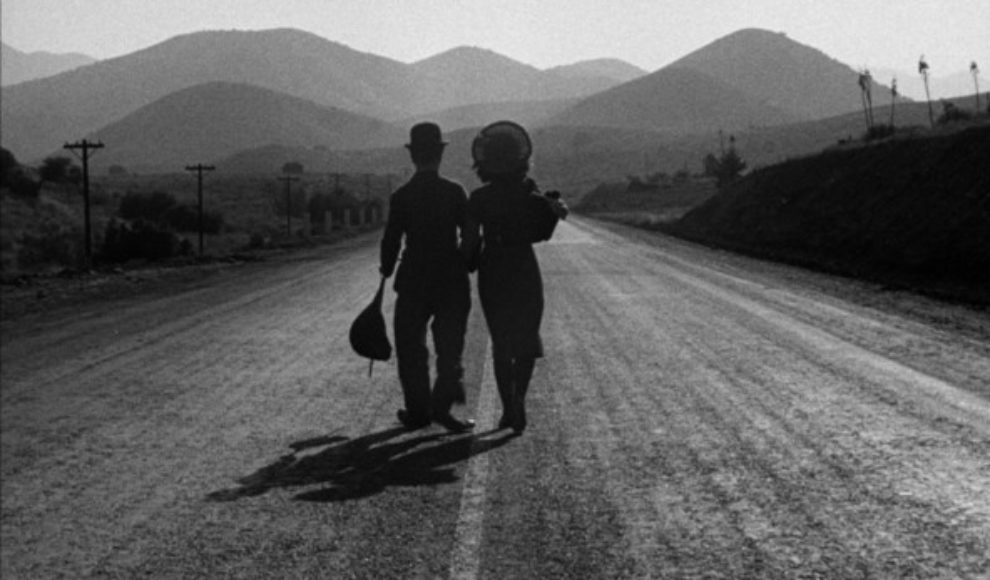
Ossessione Directed by Lucino Visconti
1943/Italy
Industrie Cinematografiche Italiane (ICI)
Repeat viewing
#165 of 1001 Films You Must See Before You Die
“Love, when you get fear in it, it’s not love any more. It’s hate.” ― James M. Cain, The Postman Always Rings Twice
This neo-realist work was Lucino Visconti’s first feature film and the second screen adaptation of James M. Cain’s novel The Postman Always Rings Twice, made after Le Dernier Tournant (1939) and before the 1946 Hollywood version. It stays fairly close to the story but with a flavor more of tragedy than of noir.
Handsome drifter Gino Costa (Massimo Girotti) lands at a sort of Italian truck stop/store on the back of a pickup and stays for lunch after he spots Giovanna (Clara Calmai), the young wife of the portly middle-aged owner Giuseppe Bragana. A passionate love affair ensues and, as Giovanna cannot bear to leave the security of the store and Gino tries but fails to live without her, they resort to murdering the husband. Gino’s guilt and fear, and Giovanna’s continued refusal to leave the store, threaten to destroy their relationship.
I find this to be grittier, and thus more faithful to the novel, than the Hollywood version. At the same time, there is a very Catholic sense of guilt and sin permeating the film – none of that hard-bitten wisecracking type dialogue here. The ending seems more operatic than ironic. I actually far prefer this version to the Hollywood version. The acting is better and I like all the details of everyday life and the emotional subtleties of the story. The only thing I would change about this would be to cut about 20-30 minutes. It clocks in at over 2 hours and drags in places.
Cat People Directed by Jacques Tourneur
1942/USA
RKO Radio Pictures
First viewing
#154 of 1001 Films You Must See Before You Die
Irena Dubrovna: I like the dark. It’s friendly.
I’ve been reading about this film so long it’s a wonder I haven’t seen it until now. It was certainly not a disappointment.
Simone Simon plays Serbian expatriate Irena Dubrovna, who has a fascination with cats. She meets architect Oliver Reed (Kent Smith) near the panther cage at the zoo and they fall in love and marry. Irena tells Oliver of her village’s legend about evil people who turn into vicious cats when aroused. She fears that her mother was one of these and that if her passions are raised by lovemaking, jealousy, or anger she also will turn into a cat. Oliver is at first remarkably patient. Irena agrees to see psychiatrist Dr. Judd (Tom Conway) but he makes little progress. In the meantime, Oliver grows closer to co-worker Alice Moore who admits her love for him. Irena’s fears are soon to be tested …
This is a beautiful and chilling film. It gave me the creeps even though I should have known better. Master of noir shadows Nicholas Masuraca lights the whole thing with incredible skill and director Jacques Tourneur creates hides his scares in those shadows masterfully. I also thought the story was touching. Simon , who looks a bit like a kitten, is sympathetic as well as sensuously menacing. Highly recommended.
Throne of Blood (“Kumonosu-jô”) Directed by Akira Kurosawa
1957/Japan
Toho Studios/Kurosawa Production Company
Repeat viewing
#320 of 1001 Movies You Must See Before You Die
IMDb users say 8.1/10; I say 9/10
[box] And oftentimes, to win us to our harm,/ The instruments of darkness tell us truths,/ Win us with honest trifles, to betray ’s/ In deepest consequence. (Macbeth, 1.3.132) [/box]
Kurasawa’s stylized Noh-inspired adaptation of Shakespeare’s Macbeth has always seemed to me somehow the most “foreign” of his films. The images are so beautiful that I can come back again and again despite the somewhat distancing acting and pacing.
The story takes place in 14th Century Japan. The great Toshiro Mifune plays Washizu, the Macbeth counterpart, with full-throttle bravado, exaggerating each emotion in what I assume is the best Noh style. Washizu and Miki, the Banquo counterpart, are returning to Spider’s Web Castle after victory in battle when they encounter an evil spirit in the forest. The spirit predicts that Washizu will be named master of the North Garrison that day and later will become Lord of the Castle. She predicts that Miki will now be named commander of the First Fortress and that his son will later be Lord of the Castle. The scene with the spirit is particularly creepy and effective.
Washizu and Miki are astonished when the Lord of the Castle appoints them to the positions predicted by the spirit. Not content to let fate take its course, Washizu’s cold and cruel wife Asaji, brilliantly played by Isuzu Yamamoto, spurs her husband on to murder the current Lord. The couple plots to frame a courtier named Noriyasu (Takashi Shimura) but fool almost no one. The childless Washizu has a final opportunity to claim the Lordship and salvage the situation by naming Miki’s son as his heir but this too is foiled by Asaji’s announcement that she is pregnant.
Wasaji’s doom is sealed when he is convinced to murder his former friend Miki and his son. Mifune’s horrified reaction to the vision of Miki’s ghost is unforgettable. Wasaji’s hired man lets Miki’s son escape and the son and Noriyasu join forces with the castle’s enemies against Wasaji. In the meantime, Asaji’s baby is stillborn and she goes mad from guilt over the murders.
By this time, Wasaji’s own men are losing faith in their commander. Wasaji goes back to the forest to consult the evil spirit. The spirit advises that he cannot be defeated until the trees of the forest advance on Spider Web Castle. Various warrior spirits appear to admonish Wasaji about the toll in blood his rise has cost. Wasaji rallies his worried men by telling them about this latest prediction. But when they see Noriyasu’s troops advancing on the castle under a protective cover of trees, Wasaji’s troops turn on him, killing him in a hail of arrows.
The end of Throne of Blood is one of the most spectacular in film history. The images of the huge trees moving through the fog and Mifune staggering, terrified, as one arrow after another pierces his body are mind-blowing.
The commentary on the Criterion DVD says that this is a film about fate. I see it more as a film about human nature. Nothing about the prediction said that Wasaji had to use bloodshed to ascend to the throne. It was his own ambition and hubris that spelled his doom. Perhaps that is the way evil spirits get the better of us all.
Murder, My Sweet (AKA “Farewell, My Lovely”) Directed by Edward Dmytryk
1944/USA
RKO Radio Pictures
Repeat viewing
#173 of 1001 Movies You Must See Before You Die
[box] Lindsay Marriott: I’m afraid I don’t like your manner.
Philip Marlowe: Yeah, I’ve had complaints about it, but it keeps getting worse.[/box]
This fun early noir is based on the novel Farewell, My Lovely by Raymond Chandler. The title was changed because studio executives worried that the film might be taken for a musical given Dick Powell’s starring role.
Marlowe (Dick Powell) is approached by thug Moose Malloy (Mike Mazurki) to locate an ex-girlfriend named Velma. Shortly thereafter, Lindsay Marriot hires Marlowe to accompany him to a remote spot to buy back a jade necklace that had been stolen from a lady friend. Marriot is murdered before the trade is made and Marlow is knocked out. The next day, Ann Grayle (Anne Shirley) leads him to the owners of the necklace, her father Mr. Grayle and his wife Helen (Claire Trevor). A series of twists and turns leads to the solution of both the missing-person and the murder case.
Philip Marlowe meets Moose Malloy
I think of this as “noir light” since it is short on the characteristic doom. All the actors do well in their parts. Claire Trevor makes a great femme fatal and Powell is particularly good at delivering Chandler’s sarcastic hard-boiled dialogue. It’s hard to believe that he’s the same guy that played the tenor in all those Busby Berkeley musicals. This is just a very entertaining detective story.
Diabolique (“Les diaboliques”) Directed by Henri-Georges Clouzot
1955/France
Film Sonor/Vera Films
Repeat viewing
#272 of 1001 Movies You Must See Before You Die
Alfred Fichet, le commissaire: The keys in the pool, the husband in the morgue! You dream too much about water in this house!
It is good to know as little as possible about this diabolical noir thriller before seeing it for the first time! Patrons were not admitted to theaters after the movie started and it ends with a plea for the audience not to reveal the ending. Far be it from me to break a promise.
The setting is a seedy boarding school in a Paris suburb, where all the main characters work. The owner is Christina Delassalle, a delicate Argentinian played by Vera Clouzot. She is dominated and abused by her sadistic, stingy husband Michel (Paul Meurisse). Lately, Michel has taken to beating his mistress Nicole (Simone Signoret) as well. The two women decide they have had enough. With Charles Vanel as a retired police commissioner.
The opening credits play over a shot of the scummy swimming pool at the school and establish the atmosphere of disgust and dread that pervades this excellent film. Clouzot is a master at manipulating audience emotion and horror is right up his alley. All the performances are spot on. The film is not quite as effective on a second viewing when the surprises have been revealed. Highly recommended.
The Postman Always Rings Twice Directed by Tay Garnett
1946/USA
Metro-Goldwyn-Mayer
First viewing
#185 of 1001 Movies You Must See Before You Die
Frank Chambers: With my brains and your looks, we could go places.
It’s back to a studio big-budget glamour noir for this noir month viewing. I can’t believe I hadn’t seen it until today. This was based on the 1934 novel by the same name by James M. Cain. The novel had previously been adapted in the neo-realist style as the Ossessione (1942), Luchino Visconti’s first feature film. I saw Ossessione several years ago and, although I don’t remember it vividly, the story was quite a bit different. I’m now curious to read the novel.
Frank Chambers is a drifter who lands on the door of a roadside diner/gas station run by Nick Smith and his much-younger wife Cora and gets a job as a mechanic. He rapidly falls for the beautiful blonde Cora and she for him. Soon the couple is looking for a way to get the kindly Nick out of the picture. This being a film noir nothing goes smoothly, to say the least. With John Garfield as Frank, Lana Turner as Cora, Cecil Kellaway as Nick, Leon Ames as a district attorney, and Hume Cronyn as a defense attorney.
I liked this film alright but it doesn’t have the bite of my favorite noirs. Part of the problem for me may be Lana Turner’s performance. I have a problem seeing Cora as a proper femme fatale – for one thing she doesn’t seem clever enough. I was surprised to see Cecil Kellaway in the role of the husband. I would never have imagined someone British as Nick. John Garfield is always good. Probably my favorite performance was Hume Cronyn as the sleazy defense attorney.
Sunset Blvd. Directed by Billy Wilder
1950/USA
Paramount Pictures
Repeat viewing
#229 of 1001 Movies You Must See Before You Die
IMDb users say 8.6/10; I say 10/10
Joe Gillis: [voice-over] You don’t yell at a sleepwalker – he may fall and break his neck. That’s it: she was still sleepwalking along the giddy heights of a lost career.
Billy Wilder’s caustic indictment of the Hollywood dream factory and human cupidity is a classic in every sense of the word. From the opening showing the title painted on a curb with fallen leaves in the gutter, you know you are in the presence of a master.
The film is narrated by small-time screenwriter Joe Gillis (William Holden) from the grave and tells the story of his last days. Joe is a true noir hero doomed by a moment of weakness and an underlying longing for the finer things. His fate is sealed when, in an effort to foil some men out to repossess his car, he drives into the garage of what at first appears to be an abandoned mansion.
Soon enough, Joe meets demented silent film star Norma Desmond (Gloria Swanson) who, having just lost her pet chimp, is looking for a replacement chump. Joe is not smart enough to figure this out, however, and thinks he has scored big time when Norma asks him to help her with the screenplay on her comeback vehicle Salomé. He barely bats an eye when without his knowledge Norma moves all his possessions to her home and installs him in an apartment over the garage.
Norma, alternately imperious and delusional, showers Joe with expensive presents but somehow doesn’t manage to keep him in spending money and allows his car to be repossessed. She is totally obsessed with her “return” to the silver screen and her memories of the glories of her day as one of the top stars in cinema. On New Year’s Eve, she declares her love and Joe flees to a friend’s party where he becomes acquainted with aspiring screenwriter Betty Schaffer (Nancy Olson), a close friend’s fiancée. A mixture of pity and guilt sends Joe back to the mansion, however, when Norma attempts suicide and a New Year’s Eve kiss signals that Joe has prostituted himself completely.
“All right Mr. DeMille, I’m ready for my close-up”
Norma’s comeback dreams are raised to a fever pitch when Cecil B. DeMille’s office, to whom she has mailed the Salomé script, calls and the director himself offers a few half-hearted words that she interprets as encouragement. Meanwhile, Joe and Betty have started working on their own script and Betty gradually falls in love with Joe. A chain of events has been set in motion that will soon coming crashing down on everyone involved.
Gloria Swanson’s performance as Norma Desmond was her finest hour. She manages to invest her character with mix of toughness, vulnerability, insanity, and determination that makes Norma pitiable and horrifying all at once. The rest of the cast is equally wonderful.
It was really difficult to choose a quote from this movie since the screenplay is razor sharp and endlessly quotable. The Franz Waxman score is one of the greats. In fact, the film is flawless as far as I am concerned. You really should see it before you die.
Praised by many critics when first released, Sunset Boulevard was nominated for eleven Academy Awards and won three (for Best Writing, Best Art Decoration, and Best Score). Deemed “culturally, historically, or aesthetically significant” by the U.S. Library of Congress in 1989, Sunset Boulevard was included in the first group of films selected for preservation in the National Film Registry.
Gun Crazy Directed by Joseph H. Lewis
1950/USA
King Brothers Productions
Repeat viewing
#216 of 1001 Movies You Must See Before You Die
Bluey-Bluey: It’s just that some guys are born smart about women and some guys are born dumb.
Bart: Some guys are born clowns.
Bluey-Bluey: You were born dumb.
The roots of film noir are in low-budget pictures – those shadows and locations disguise shoestring sets. Gun Crazy is one of the classics coming from outside the studio system. It was selected for the National Film Registry in 1998.
Bart Tare has been obsessed with guns since he was a child. The mania extends only to shooting – he cannot kill a living thing. He finally succumbs to the temptation to steal a revolver when he is an adolescent and is caught and put in reform school. After serving a stint in the military as a shooting instructor, Bart returns to his home town. He meets up with his childhood friends – now a reporter and a sheriff – and they go to a carnival where they see a shooting exhibition by the lovely Annie Laurie Starr.
It is love at first sight for Bart and Laurie, who flirt while they compete at target shooting. The couple soon marry and Laurie immediately starts agitating to exploit their expertise in stick-ups. Bart is the more timid of the two but he is hooked on Laurie and afraid to lose her so he agrees. So begins a life of crime reminiscent of Bonnie and Clyde. With John Dall as Bart, Peggy Cummins as Laurie, and Russ Tamblyn as the young Bart.
Peggy Cummins is the standout in this movie. She is resembles a wild cat in heat as the femme fatale who tempts Bart to his doom and when she is frightened she is like a caged animal. The visuals, lit by cinematographer Russell Harlan, are gorgeous. So are the compositions director Joseph H. Lewis comes up with. The script is serviceable, if not brilliant or particularly hard-boiled. One of the screenwriters was “Millard Kaufman”, a front for Dalton Trumbo who was a blacklisted member of the Hollywood Ten.
I had not noticed before how often John Dall appears to squint. Odd in a supposed sharp-shooter!
Mildred Pierce Directed by Michael Curtiz
1945/USA
Warner Bros.
First viewing
#176 of 1001 Movies You Must See Before You Die
[box] Ida: Personally, Veda’s convinced me that alligators have the right idea. They eat their young.[/box]
To start off the film noir fest with a bang, here is a studio big-budget effort that garnered Joan Crawford a long-awaited Best Actress Oscar, along with six other Academy Award nominations. In 1996, the film was deemed “culturally, historically, or aesthetically significant” and selected for preservation in the United States Library of Congress National Film Registry.
The story is based on James M. Cain’s novel of the same name. There are some key differences from the book. Mildred Pierce is a middle-class housewife who makes money on the side baking cakes and pies. She lives for her two daughters Veda and Kay and tries especially hard to placate her difficult, grasping elder daughter Veda. Mildred and her husband Bert separate amicably after arguing about his visits to a lady friend and Mildred’s child-rearing style.
Mildred finds work as a waitress and struggles to satisfy the increasingly spoiled Veda’s demands for the finer things in life by selling pies. When Veda finds her mother’s waitress uniform and accuses her of being a peasant, Mildred decides she must have more money and opens a restaurant, with the help of perpetual suitor Wally. Along the way, she meets the equally entitled shiftless socialite Monte and it looks like she will be burdened by two ungrateful whiners for life. A darker fate perhaps awaits … With Joan Crawford as Mildred, Ann Blyth as Veda, Jack Carson as Wally, Zachary Scott as Monte and Eve Arden as Mildred’s wise-cracking friend Ida.
I thought this was pretty terrific. A little bit of Joan Crawford goes a long way with me but here she was remarkably restrained with the old eyebrows. It may be her best performance. Ernest Haller’s cinematography is beautiful, particularly the night scenes. The script is tight and it moves right along. I love Eve Arden and was delighted to see her at her best here, in an Oscar-nominated performance. Of the men, I was most impressed with Jack Carson.
This is not quite what I think of as noir. There is a lot of high key lighting, glamour, and a lack of grim city streets. However, it does have that expressionist lighting. My definition of noir for this exercise is basically any film that is included in Michael F. Keaney’s Film Noir Guide. Keaney came up with 745 films from the period 1940-1959 made in the “noir style” in any of several different genres, including melodrama. Keaney sees the “noir themes” in Mildred Pierce as betrayal, obsession, and greed.
Grave of the Fireflies (“Hotaru no haka”) Directed by Isao Takahata
1988/Japan
Shinchosha Company/Studio Ghibli
Repeat viewing
#787 of 1001 Movies You Must See Before You Die
IMDb users say 8.4/10; I say 9/10
[box] Setsuko: Why must fireflies die so young?[/box]
Memorial Day is a fitting time to reflect on all the lives lost to war, including those of the most innocent. American should give thanks that civilians have not suffered the horrors of world war on our shores. This animated film poignantly brings home the cost of war to children in other parts of the world.
The date is September 25, 1945. The place is Japan. The narrator informs us that he died today. His name is Seita and he is a young adolescent boy, between about 12 and 14. The film tells his story and that of his pre-school age sister Setsuko.
Their mother is killed at a shelter in a fire bombing; father is away at war. The children head for an aunt’s house. The aunt takes them in but increasingly makes it clear that they are an inconvenience. Furthermore, she constantly nags Seita about his failure to work in the war industry or fight fires during the air raids. Eventually, she starts withholding the best of the food from the children on the ground that they are not pulling their weight.
Disgusted, Seita decides the children will be better off on their own and takes his sister to an abandoned shelter in the country. At first, they live a kind of carefree life but rapidly the struggle for survival takes over. Seita resorts to stealing but even that is not enough.
It is fortunate that this film is animated. A live action film detailing the hardships these poor children must suffer would be just too hard to take. This is sad enough as it is. The animation is extremely beautiful, as is the music. The relationship between the brother and sister is very touching and kind. The film is not totally downbeat. There are many lovely scenes of the children playing together.
I’ve been a classic movie fan for many years. My original mission was to see as many movies as I could get my hands on for every year from 1929 to 1970. I have completed that mission.
I then carried on with my chronological journey and and stopped midway through 1978. You can find my reviews of 1934-1978 films and “Top 10” lists for the 1929-1936 and 1944-77 films I saw here. For the past several months I have circled back to view the pre-Code films that were never reviewed here.
I’m a retired Foreign Service Officer living in Indio, California. When I’m not watching movies, I’m probably traveling, watching birds, knitting, or reading.
Photographs and videos found in this blog, unless indicated, are not owned by me and are here only for the purpose of education and discussion. Media found here are not intended for any commercial purpose. Copyright infringement is not intended.
Written material belongs to me and is copyrighted by flickersintime.com