Category Archives: 1001 Movies You Must See Before You Die

Reviews of movies included in the book 1001 Movies You Must See Before You Die

Mr. Deeds Goes to Town (1936)

Mr. Deeds Goes to TownMr_Deeds_Goes_to_Town Poster
Directed by Frank Capra
Written by Robert Riskin based on a short story by Clarence Budington Kelland
1936/USA
Columbia Pictures Corporation

Repeat viewing
#98 of 1001 Movies You Must See Before You Die


Louise “Babe” Bennett: That guy is either the dumbest, stupidest, most imbecilic idiot in the world, or else he’s the grandest thing alive. I can’t make him out.

I found that I liked this film much better when I viewed it as a fairy tale.

The story begins in the small town of Mandrake Falls where Longfellow Deeds (Gary Cooper) owns the tallow works, writes verses for greeting cards, and plays tuba in the town band.  Lawyers suddenly descend on the town to tell Deeds he has inherited $20 million from an uncle.  They scoot Deeds off to New York where a throng of would-be hangers-on have their hands out for a piece of the action.  Although he is taken for a rube, Deeds has uncommon sense and resists all efforts to part him from his money.

Ace reporter Babe Bennett (Jean Arthur) is assigned to get a story on Deeds, who is well protected by a press agent (Lionel Stander).  She pretends to collapse from hunger in front of his mansion and Deeds, who has been waiting for a damsel in distress to come along, is rapidly smitten with her.  This enables her to print stories labelling Deeds “The Cinderella Man” and paint him as a sap.  Deeds falls in love with Babe.  The only thing that rescues him from a deep depression when he discovers her identity is a plan to use his money to help down and out farmers.  This is the only cue the vultures need to try to wrest control of the fortune by having Deeds found incompetent.  Anyone familiar with Capra will have a fair idea how this all plays out.

Mr Deeds Goes to Town 1

This has always seemed to me one of the corniest of the Capra oeuvre.  But if you look at it as a fable or fairy tale about a truly good and honest man prevailing over the forces of evil, it comes off much better.  The film certainly has some very funny bits and a charming goofy sweetness about it.  I think Cooper was fine here.  He must be the sexiest man in a three-piece suit ever.

One thing I thought about was the number of times Deeds socked someone who made him mad in the jaw.  This is taken as completely normal and even humorous by the film. There are absolutely no consequences.  I wonder whether this was a sign of the times or is part of the fairy tale.

Frank Capra won his second Academy Award for Directing for Mr. Deeds Goes to Town, while Cooper received the first of his five nominations for Best Actor. The film was also nominated for Best Picture, Best Screenplay, and Best Sound Recording.

Trailer


Das Boot (1981)

Das Boot (“The Boat”)Das-Boot-1981 Poster
Directed by Wolfgang Petersen
Screenplay by Wolfgang Petersen from a novel by Lothar B. Buchheim
1981/West Germany
Repeat viewing
#670 of 1001 Films You Must See Before You Die
IMDb users say 8.4/10; I say 9/10

Captain: [looking at one of the LI’s pictures] Funny. I haven’t seen snow in years.

This movie had my heart pumping vigorously for 149 minutes and me wishing that I was watching the 209 minute directors cut.

It is autumn 1941 and the war for control of the Atlantic is turning against the Germans. This is the story of the voyage of u-boat U-96 which set out from La-Rochelle, France.  It is seen through the eyes of a young military journalist who is along for the ride.  The crew of the U-96 endures boredom, celebrates strikes against the enemy, and struggles to survive hits on its boat.

Das Boot 2

I have seen this film at least twice before – once in the theater in what I assume was the theatrical cut and once on DVD in the director’s cut.  The version I rented this time was the theatrical cut.  The theatrical cut is gripping and well-acted and edited, with amazing special effects.  However, I really had the sense that the story suffered from the cuts.  There were several awkward gaps and the ending was extremely abrupt.  One minute they were surfacing after the Gibraltar episode and the next minute they were in La Rochelle.  I also think this is the kind of thing that is best seen fresh the first time.  I kept asking questions about little details when I should have been caught up in the action.

Don’t get me wrong.  I highly recommend this film to anyone looking for a well-made action adventure.  It is one of my very favorite war films.


German trailer (no subtitles but really not needed)


Modern Times (1936)

Modern TimesModern Times Poster
Directed by Charles Chaplin
1936/USA
Charles Chaplin Productions

Repeat viewing
#95 of 1001 Movies You Must See Before You Die


A gamin: [Last lines] What’s the use of trying? A factory worker: Buck up – never say die. We’ll get along.[/box]

Chaplin and his Little Tramp fight the Great Depression in this masterpiece.

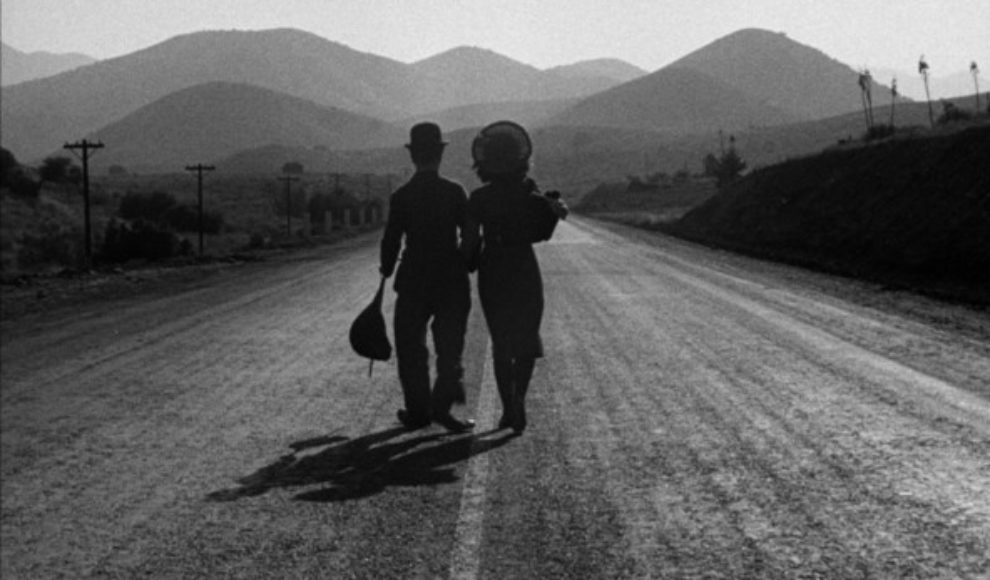
A Factory Worker (Charles Chaplin) is driven to madness by his job on the assembly line. After stints in the hospital and jail, Chaplin attempts to rescue a Gamin (Paulette Goddard) who is caught stealing a loaf of bread.  The two set up a kind of housekeeping, battle authorities, and walk off into the sunset.

Modern Times 1

This was the first and last time the Little Tramp’s voice was heard.  I think it is so fitting that his one song with words is in no language or any language.  After all, he belonged to the whole world.  The delights of this movie are too many to mention.  I think Chaplin’s great talents were as a mime and a kind of dancer and this film shows them off to the full. It’s too bad he didn’t go on making semi-silent films.  In my opinion, all his subsequent work suffers from preachiness,

Clip – conclusion


Dodsworth (1936)

DodsworthDodsworth Poster
Directed by William Wyler
1936/USA
The Samuel Goldwyn Company

Repeat viewing
#101 of 1001 Movies You Must See Before You Die


Sam Dodsworth: Love has got to stop some place short of suicide.

This intelligent drama is one of my favorite movies of any time.  I always forget just how much I love it until I see it again.

Sam Dodsworth (Walter Huston) has made a fortune as an automobile tycoon.  He retires and his somewhat younger wife Fran (Ruth Chatterton) has her heart set on beginning life over on a long European holiday.  Sam plunges into playing tourist but Fran is more interested in putting on airs, hobnobbing with people she thinks are “society”, and proving her continued desirability to men.  Sam loves Fran dearly but clearly this state of affairs cannot continue indefinitely.  When Fran decides to throw in with a young Austrian baron, Sam finds solace with expatriate Edith Cortright (Mary Astor).  With Maria Ouspenskaya as the baron’s mother and David Niven and Paul Lukas as two of Fran’s “conquests.”

Dodsworth 1

This is a fairly straightforward domestic drama but it is richly rewarding.  There is an undercurrent that explores the differences between manners in the Old and New Worlds, with the New World coming off pretty well for a change.  It is also one of the few movies of the Golden Age to explore the breakdown of a long marriage.  The acting is all brilliant.  I don’t think Ruth Chatterton gets enough credit.  Her role is unsympathetic and fairly ridiculous. It must have been difficult to play a deluded woman past her prime but she gave it her all.  I don’t think Mary Astor was ever more beautiful than in this picture.  I always root for her Edith — she is so smart and sensible.  Highly recommended.

Dodsworth was nominated for seven Academy Awards, including for Best Picture, and won for Best Art Direction.  In 1990, it was selected for preservation in the United States National Film Registry.


Clip

Camille (1936)

CamilleCamille Poster
Directed by George Cukor
1936/USA
Metro-Goldwyn-Mayer

First viewing
#99 of 1001 Films You Must See Before You Die


Marguerite: When one may not have long to live, why shouldn’t one have fancies?

I wasn’t particularly looking forward to this but it won me over almost immediately.  I wonder whether Garbo was ever lovelier or more appealing than in MGM’s glossy adaptation of the La Traviata story.

Marguerite Gautier (Greta Garbo) is a carefree Parisian courtesan, trading on her beauty to live an extravagant lifestyle between bouts of consumption.  One night at the theater, dressmaker Prudence (Laura Hope Crewes – Aunt Pittipat in Gone with the Wind) introduces her to fabulously wealthy Baron de Varville (Alan Mowbray) who can keep her well supplied with gowns and jewels.  At the same time, Marguerite is coincidentally introduced to Armand (Robert Taylor), an adoring young lawyer.  Marguerite starts a liaison with the Baron but her path crosses that of Armand repeatedly.  Finally, Marguerite falls hopelessly in love with Armand and accompanies him for some idyllic weeks in the country.  She must decide between Armand’s long-term prospects and her own happiness when Armand’s father (Lionel Barrymore) comes to beg her to leave his son.  With Jessie Ralph as Marguerite’s faithful maid.

CAMILLE1

 I am often quite resistant to Garbo’s acting but she captivated me here.  The gorgeous gowns only accentuated her stunning beauty and her smile was all the acting chops she really needed.  This movie also benefitted by an outstanding supporting cast, lavish set decoration, and beautiful score.  I think if the leading man had been a tad bit more sympatico – not that Taylor was bad – this film would have been just about perfect for the type of film it is.  As it was, I had tears in my eyes at the end.  Quite an achievement for Cukor.

Clip – second meeting

Things to Come (1936)

Things to ComeThings to Come Poster
Directed by William Cameron Menzies
1936/UK
London Film Productions

First viewing
#102 of 1001 Movies You Must See Before You Die


Raymond Passworthy: Oh, God, is there ever to be any age of happiness? Is there never to be any rest?

I have mixed feelings about this lavish but heavy-handed anti-war science fiction yarn.

The story begins in Everytown (evidently London) at Christmas, 1940.  The population is blithely celebrating while the headlines scream warnings of war and John Cabal (Raymond Massey) worries that another war will destroy civilization.  Suddenly the air raid sirens go off and an unprovoked aerial bombardment and gas attack of the city begins.  The enemy is unnamed.

A montage follows the war through its conclusion in 1966.  By 1970, the people of Everytown are living in medieval conditions.  A plague spread by enemy bombs causes a fatal contagious “Wandering Sickness” to break out.  A man becomes The Boss (Ralph Richardson) by insisting that sufferers be shot.  He consolidates power by continuing war against his neighbors.

John Cabal has gone on to become the leader of a technocracy in the Mediterranean called Wings of the World.  Cabal visits Everytown in his modern airplane, vowing to “cleanup” the city if it does not forsake war.  The Boss imprisons him.  The Boss cannot conceive of the might of Cabal’s organization or its “peace gas.”

Fast forward to 2036, when people live in sleek underground cities and prepare for space travel.  Scientists must still face the forces of reaction and jingoism in the form of Theotocopulos (Cedric Hardwicke) who incites the masses to revolt against any further progress.

Things to Come 1

Director Menzies was much better known as an art director and the design of this film (by Vincent Korda) is certainly striking.  His work with actors was not as successful.  Much of H.G. Wells’s dialogue sounds like it is being read from a book of sermons and the usually reliable Massey and Hardwicke are not able to do much with it.  Only Richardson manages to bring life to his character.  His Boss is a foolish bombastic bully and a lot of fun.

As usual with H.G. Wells’s material, I had a hard time following the logic.  This is supposed to be an anti-war story and yet the beginning of the war in the film would seem to be an argument for a strong army of defense.  “Peace gas” also seems somewhat oxymoronic.

This is a unique film and prescient of the catastrophe that was to overtake Europe a year earlier than predicted by the story.  I’m glad I saw it but I don’t see any reason to revisit it.

Trailer


My Man Godfrey (1936)

My Man GodfreyMy Man Godfrey Poster
Directed by Gregory La Cava
1936/USA
Universal Pictures

Repeat viewing
#97 of 1001 Movies You Must See Before You Die


Alexander Bullock: All you need to start an asylum is an empty room and the right kind of people.


This wacky comedy still makes me laugh out loud after numerous viewings.

The wealthy Bullock family is full of eccentrics.  The females of the group are participating in a scavenger hunt in which they must bring back a “forgotten man”.  Cornelia Bullock (Gail Patrick) takes the search to a city dump where she offers a tramp named Godfrey (William Powell) $5 to be her prize.  He refuses and pushes her into an ash heap.  Nutty sister Irene (Carole Lombard) chats Godfrey up and he agrees to go with her.  This leads to the smitten Irene inviting Godfrey to be the family’s butler and her protegé.  Mass hilarity ensues.  With Eugene Palette as Alexander Bullock, the father; Alice Brady as Angelica Bullock, the mother; and Mischa Auer as Angelica’s protegé.

My Man Godfrey 2

I don’t think any of the cast members involved ever did better work.  Powell and Lombard were nominated for Best Actor and Actress Oscars and Brady and Auer were nominated for Best Supporting Actor and Actress – the first time a film was nominated for acting awards in all four categories and the only time such a film failed to win an award.

I can imagine that the comedy might be over the top for some but I love it.  Once again, the part where Auer imitates an ape to cheer Lombard up had me howling.  Eugene Palette is also fantastic as the harassed pater familias.  Patrick makes a great villainess.  Powell and Lombard had been married and were now apparently amicably divorced as Powell insisted Lombard was the only actress to play the part of Irene.  The chemistry between the two is certainly there in spades.

Clip – the scavenger hunt


Swing Time (1936)

Swing Timeswing time Poster
Directed by George Stevens
1936/USA
Radio Pictures

Repeat viewing
#96 of 1001 Movies You Must See Before You Die


John “Lucky” Garnett: Now, eh… how did you say that last step went? Eh… oh, yes!

This might not be my favorite of the Astaire/Rogers films in terms of the comedy and story but it does have some of the best dance routines and wonderful standards by Jerome Kern.

John “Lucky” Garnett (Fred Astaire) is a hoofer who makes most of his money at the gambling table.  He is tricked by Pop Cardetti (Victor Moore) and the rest of his vaudeville team into missing his own wedding.  The bride’s angry father finally agrees to reconsider the union if Lucky returns with $25,000.  So Lucky and Pop hop a freight train to New York.

Lucky almost immediately runs into dance instructress Penny (Ginger Rogers) and through a number of misunderstanding infuriates her.  But this turns to love once they are in each other’s arms on the dance floor.  Pop and Penny’s pal Mabel (Helen Broderick) also become chummy. Can love triumph through the many obstacles this plot presents for the dancing duo?  With Eric Blore as the owner of the dance studio, Betty Furness as Lucky’s fiancée, and Georges Mexata as a pompous band leader who is in love with Penny.

Swing Time 2

This is the film in which Ginger Rogers is allowed to love Fred back and might be her best performance in one of their pictures.  Her yearning in the scene before she sings “A Fine Romance” is palpable.  The movie also features the iconic “The Way You Look Tonight” sung by Astaire while Rogers is shampooing her hair and a really fun routine set to “Pick Yourself Up.”  None of my regular readers will be surprised that I come back to this again and again despite the half hour of danceless, silly scenes at the beginning.

Despite the brilliance of the tapping in Astaire’s blackface “Bojangles in Harlem” number, I have never understood why a living and working artist, Bill “Bojangles” Robinson, needed this “tribute”.  While I can cut the times some slack, I just find the whole thing extremely odd.

Dance – “Waltz in Swing Time”

Enter the Dragon (1973)

Enter the DragonEnter-the-Dragon--(1973)-movie-poster
Directed by Robert Clouse
1973/Hong Kong/USA
Concord Productions Inc./Golden Harvest Company/Sequoia Productions/Warner Bros.
First viewing
One of 1001 Movies You Must See Before You Die
IMDb users say 7.6/10; I say 7.5/10

Lee: You have offended my family and you have offended the Shaolin Temple.

I am in the wrong demographic for this combo of James Bond spectacular and Hong Kong martial arts movie but enjoyed it nonetheless.

Lee (Bruce Lee) has many reasons to attend a martial arts tournament on the mysterious island of Han.  First, Han studied at the Shaolin Temple and has disgraced it.  Second, the British Government needs evidence to convict Han of heroin trafficking and murder. Finally, Han’s henchmen attempted to gang rape his sister (in an awesome martial arts battle featuring Angela Mao) who committed suicide rather than submit.

Lee is joined on the island by wise cracking Roper (John Saxon) and defiant soul brother Williams (Jim Kelly).  The three are first tempted by Han’s hospitality and many voluptuous drug-addicted mistresses.  They defeat all comers at the tournament and take on hordes of guards single-handedly.  But can any of them defeat the evil Han, who has turned his artificial hand into a blade wielding deadly weapon?

12_enter_the_dragon_bluray

This may be the first martial arts movie I have seen.  Although I have no basis on which to rate Lee’s skill, he certainly impressed me.  I loved all his facial expressions as well.  It was interesting to see how much havoc can be wrought with the human body alone. His co-stars are lots of fun as well.

I was pleased to learn in the commentary that my old friend Keye Luke (No. 1 Son in the Charlie Chan movies) over-dubbed the actor portraying Han.

Trailer

I Walked with a Zombie (1943)

I Walked with a ZombieI Walked with a Zombie Poster
Directed by Jacques Tourneur
1943/USA
RKO Radio Pictures

First viewing
#161 of 1001 Movies You Must See Before You Die
IMDb users say 7.2/10; I say 7.5/10


Paul Holland: Everything good dies here. Even the stars.

This superbly shot and lit psychological horror film from the Val Lewton shop at RKO falters in the story department.

Sugar mill owner Paul Holland (Tom Conway) hires a young Canadian nurse (Frances Dee) to care for his catatonic wife on a Caribbean island.  Paul’s half-brother Wesley believes that Paul caused the wife’s illness when he prevented Wesley and her from running away together.  But voodoo culture pervades the island….  Could Jessica be a zombie?

MARTIN SCORSESE PRESENTS: VAL LEWTON- THE MAN IN THE SHADOWS

This film is absolutely beautiful.  There is something to savor in almost every frame.  I especially like the way many of the scenes feature light streaming through blinds, leaves, or ironwork creating a kind of dappled effect.  The one islander zombie in the film, played by Darby Jones, adds an element of horror merely by standing and staring.  Unfotunately, I couldn’t get emotionally invested in the love triangle between the brothers and the wife nor in the budding relationship between Paul and the nurse.  I’m glad I saw the film but I doubt I will watch it again.

The only film I’ve seen Francis Dee in before is the 1933 Little Women.  It was hard for me to believe either her terror or her yearning.  She seems really grounded for a fantasy film.

Trailer