Rope Directed by Alfred Hitchcock Written by Arthur Laurents; adapted by Hume Cronyn from a play by Patrick Hamilton 1948/USA Warner Bros./Transatlantic Pictures
Repeat viewing/Netflix rental
#221 of 1001 Movies You Must See Before You Die
[box] Rupert Cadell: Brandon’s spoken of you.
Janet Walker: Did he do me justice?
Rupert Cadell: Do you deserve justice?[/box]
I can’t help thinking that this one doesn’t take itself seriously enough to rank with one of the Master’s better films. Still, it’s lots of malicious fun.
The entire film takes place in real time in Brandon’s (John Dall) apartment. It begins with Brandon and his close friend Phillip (Farley Granger) strangling a prep school classmate with a rope. Both apparently conceived the crime as a lark designed to highlight their superiority over mere mortals and their artistry in carrying out the perfect murder. But Phillip gets cold feet immediately after the deed is done and is a nervous wreck for the rest of the story.
Brandon is so confident that he has invited the victim’s parents and fiancee, and the fiancee’s ex-boyfriend, to a party that very evening. He relishes the prospect of serving supper from the very chest in which they have stashed the body. Brandon also has gleefully invited Rupert Cadell (James Stewart) , the boy’s headmaster at prep school, to covertly gloat that he has brought Cadell’s Nietzschian philosophy to its ultimate triumph. But the party takes several turns that Brandon could not anticipate.
Hitchcock certainly had a lot of fun meeting the technical challenges of filming in a single location in what looks like a single take. This fun is transmitted to the audience along with several sly self-referential winks. (I especially like the dialogue about Cary Grant and Ingrid Bergman appearing together in a movie called Something Something — or was that just Something?) The whole thing is just a little too gimmicky for me to give my heart to, however.
The Red Shoes Directed by Michael Powell and Emeric Pressburger Written by Michael Powell and Emeric Pressburger from a story by Hans Christian Andersen 1948/UK The Archers/Independent Producers
Repeat viewing/Netflix rental
#222 of 1001 Movies You Must See Before You Die
[box] Boris Lermontov: Why do you want to dance?
[Vicky thinks for a short while] Victoria Page: Why do you want to live?[/box]
This movie is very beautiful but very sad.
Boris Lermantov (Anton Walbrook) runs a leading ballet company in London. It is his life. Dancing is Victoria Page’s life. She has already danced principal parts elsewhere in the city. They meet courtesy of Victoria’s wealthy aunt and he brings her in as a kind of lady-in-waiting to the corps de ballet. At around the same time, he meets a young composer named Julian Coster (Marius Goering) when he comes in to complain that his music teacher lifted material from Coster’s own work for his ballet score. Lermantov is an astute judge of talent and hires him as an orchestra coach.
When Lermantov finally sees Vicky dance he is enchanted. She is selected to go to Paris with the troupe. Then Lermanov’s prima ballerina decides to get married. Lermantov does not believe that women can concentrate on more than one thing at once and fires her. When the troupe arrives in Monte Carlo, Lermantov is inspired to build a brand new ballet, “The Red Shoes”, around Vicky. He engages Julian to write the score. Because Lermantov apparently does not understand people too well, he decides the best thing for Vicky would be to have every meal in Lermantov’s office while Julian plays the score for her.
The ballet is a great triumph and Vicky is a rising star. Predictably, during all that dining, Julian and Vicky have fallen in love. For Lermantov, this is a major betrayal. He fires Julian. Vicky refuses to stay without Julian, so she is let go as well. The two young people marry. None of this changes the fact that Vicky was born to dance. While Julian is preparing his latest composition for performance in London, Lermantov seduces Vicky back into is grip with an offer to dance “The Red Shoes”, which had been retired from the repertoire upon her departure.
Julian ditches the premiere of his concert to beg Vicky to come back to him on the night of her first performance of the ballet. The two selfish men in her life decide to force her decide between her career as a dancer and her future as a woman. This results in tragedy for everyone, particularly Vicky.
This movie is absolutely exquisite in every respect, particularly during the ballet sequences. The color cinematography may never have been surpassed and the art direction is endless in its invention. It also explores the process of creation in a really profound way. The film is a jewel and should be seen by every film lover and every fan of the performing arts.
Somebody on the commentary says that Michael Powell saw the moral of the story as “Art is worth dying for.” While that may or may not be the case, I find this troublesome in the context of the story of The Red Shoes. It just seems unbearably tragic and unfair that a woman should be limited to either her art or her love life. Surely a man was never expected to make that trade-off. I hope those days are gone for good.
The Red Shoes won Academy Awards in the categories of Best Art Direction-Set Decoration, Color and Best Music, Scoring of a Dramatic or Comedy Picture. It was nominated in the categories of Best Picture; Best Writing, Motion Picture Story (Pressburger); and Best Film Editing.
The Treasure of the Sierra Madre Directed by John Huston Written by John Huston based on the novel by B. Traven 1948/USA Warner Bros. Repeat viewing/Warner Bros. DVD
#223 of 1001 Movies You Must See Before You Die
[box] Fred C. Dobbs: This is the country where the nuggets of gold are just crying out for you to take them out of the ground and make ’em shine in coins on the fingers and necks of swell dames.[/box]
John Huston’s tale of gold lust will never grow old.
Fred C. Dobbs (Humphrey Bogart) is a vagabond who has been reduced to soliciting hand-outs on the streets of Tampico, Mexico. He gets three windfalls in one day from the same American (memorably played by John Huston) and his luck appears to be changing. So much so that he takes a chance on purchasing 1/20 of a lottery ticket from a street urchin.
Eventually, Dobbs meets up with fellow-American Curtin (Tim Holt) and they get work as laborers. But their boss disappears with their wages and they end up sleeping in a flop house with old-time prospector Howard (Walter Huston). Howard tells them a cautionary tale about the effects of gold on men. When they finally recoup their money from the boss in a fight, they remember what the old man said and go to find him. Between their wages and the money Dobbs wins on his forgotten lottery ticket, they have the stake to go prospecting. They take Howard along for his expertise, figuring they will eventually have to carry him.
It turns out that Howard is in the best shape of all of them and the two younger men are unprepared for the long journey. Then they find a rich vein of gold and find they are in for months of back-breaking labor to mine it. As the gold piles up, Dobbs get increasingly paranoid about losing it. Early on, he demands that the men divide it equally at the end of each day.
The men are constantly in danger from rival prospectors and bandits. After they start back to civilization with their loot, however, it appears that the greatest danger is from each other. With Barton McLane as the crooked boss and Robert Blake as a street urchin.
This has to rank with the best screenplays ever written. The moral is clear early on but the psychology behind the greed is masterfully done. I love the way Dobbs starts referring to himself in the third person more and more as he slips into madness. This is the role Bogart should have won his Oscar for. It’s incredible he was not even nominated. Walter Huston is fantastic. He is unrecognizable without his teeth and even his distinctive voice is not much in evidence. A true classic. Very highly recommended.
The Treasure of the Sierra Madre won Academy Awards in the categories of Best Supporting Actor (Huston), Best Director, and Best Writing, Screenplay. It was nominated for Best Picture.
Secret Beyond the Door Directed by Fritz Lang Screenplay by Silvia Richards; story by Rufus King 1947/USA Diana Production Company
First viewing/Olive Films DVD
#214 of 1001 Movies You Must See Before You Die
Of all of Fritz Lang’s American films, the authors of The Book select this one??? Incomprehensible.
Long stretches of the film are accompanied by the whispered interior monologue of Celia Lamphere (Joan Bennett). Celia inherits a fortune when her older brother dies of a heart attack. Safe, steady Bob, who has been appointed to help administer the money, loves Celia and says he will propose when the time is right.
Celia travels to Mexico to forget her grief. There, she witnesses a couple of thugs fight with knives in the street over a woman. This awakens her inner animal. Mark Lamphere (Michael Redgrave), another bystander, is similarly inspired. He soon makes Celia forget all about Bob and they are married without futher ado. But on their honeymoon, Mark suddenly departs for New York when Celia playfully locks the door to their hotel room.
Celia is elated when Mark finally sends for her and rushes to his family manse in upstate New York but his sister Caroline (Anne Revere) is the one who meets the train. Mark turns up the next day, his odd behavior undiminished. To add to that, Celia discovers her husband had a first marriage and a young son he didn’t tell her about. The son and Mark are not on speaking terms. Furthermore, a Miss Robey is living there as his assistant. She lurks mysteriously, one half of her face always obscured by a scarf.
We gradually learn that Mark, an architect, has a real problem with female authority figures. Among other quirks, he collects rooms. That’s right, entire actual rooms complete with their authentic furnishings. He is especially fixated on rooms in which murders took place. One of these rooms is ominously locked. Celia cannot resist finding out what is the Secret Behind the Door.
To start with the good points, this movie is visually gorgeous with the typical Fritz Lang Expressionistic flare and all the actors do their best with the rather pretentious script. For me the good points end right there. I find the interior monologue (as opposed to standard voice-over narration which I quite like) to be an irritating gimmick and here it is delivered in such hushed tones that I had a hard time following it. The story, which is loaded with Freudian symbolism and Oedipal complexes, is a mess. The ending abruptly abandons all the many established plot strands and makes little sense.
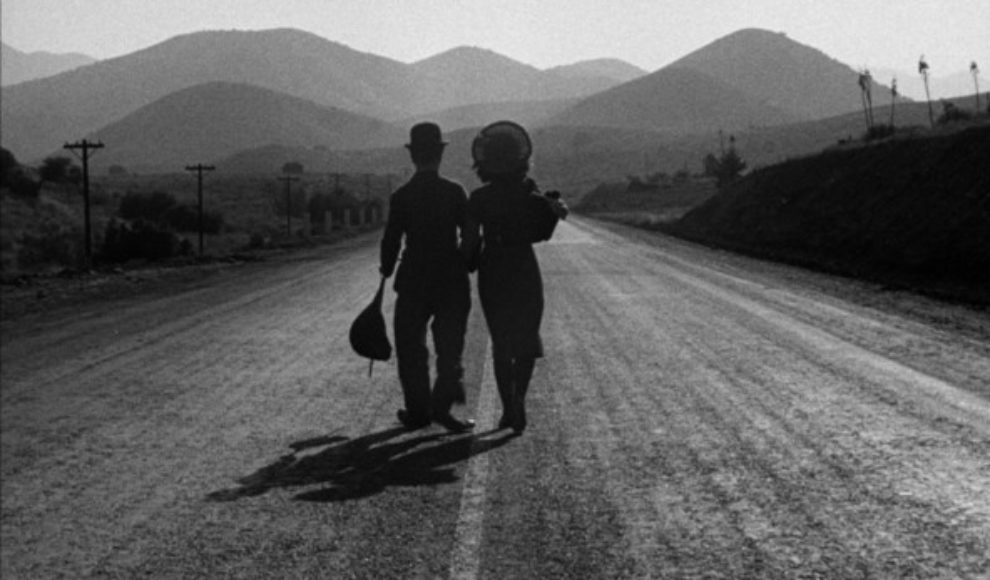
Monsieur Verdoux Directed by Charles Chaplin Written by Charles Chaplin based on an idea by Orson Welles 1947/USA Charles Chaplin Productions
Repeat viewing/from DVD Collection
#209 of 1001 Movies You Must See Before You Die
[box] Henri Verdoux: Business is a ruthless business, my dear.[/box]
Chaplin never should have started talking.
Henri Verdoux (Chaplin) is fired by a cruel bank after 30 years of employment. So he decides to support his crippled wife and adorable little son by committing bigamy and serial wife murder of wealthy widows. What other choice did he have? Then, despite his contempt for big business, he invests all the money in the stock market.
One of his wives, Annabella Bonheur (Martha Raye), is an annoying loud mouth with a mind of her own. She might just be immortal. During his frolic, Monsieur Verdoux befriends a beautiful young ex-con and is captivated by her innocence and belief in love. This does not stop him from his life of crime however.
Finally, Verdoux is apprehended and sentenced to the guillotine. He does not go there, unfortunately, until he delivers a heartfelt speech explaining how serial murder is no worse than war.
Balderdash. There are a few mildly funny bits, as when Chaplin counts money, and Martha Raye is always a treat. Mostly, though, this strikes me as a vanity project designed to give Chaplin a soapbox and I find it very irritating. I know I’m in the vast minority in feeling as I do. I think Chaplin was a genius but got very self-indulgent later in life.
Monsieur Verdoux was nominated for an Academy Award for Best Writing, Original Screenplay.
The Ghost and Mrs. Muir Directed by Joseph L. Mankiewicz Written by Philip Dunne from the novel by R.A. Dick 1947/USA Twentieth Century Fox Film Corporation
Repeat viewing/Netflix rental
#211 of 1001 Films You Must See Before You Die
[box] Lucy Muir: He took me unaware!
Captain Gregg: [laughs] My dear, since Eve picked the apple, no woman’s ever been taken entirely unawares.[/box]
This classic is perhaps a bit more beloved by most people than by me. Even so, the male contingent is strong and it looks gorgeous as only an A product of the studio era can.
The story takes place in England at the turn of the last century. Lucy Muir (Tierney) is a young widow with a little daughter (Natalie Wood) who works up the courage to leave the stifling confines of her mother-in-laws home. She intends to move to the seacoast and live on the dividends from her deceased husband’s gold shares.
She looks for a house to rent and despite a lot of discouragement from the estate agent sets her heart on Gull Cottage. When she tours the house, it becomes obvious that it is haunted but Lucy is undeterred. Not even a personal appearance by the resident ghost, Capt. Daniel Gregg (Rex Harrison), can chase her away. As the captain gets to know the spunky, beautiful Lucy he no longer wants her to go. The two become confidants.
Then Lucy’s goldmines dry up and it looks like she will have to move back to London with the in-laws. The captain comes up with the idea of dictating his memoirs to Lucy as a means of earning her some money. Despite his salty language, the two work well together. On a visit to a publisher, Lucy meets smooth operator Miles Farley, a children’s author. Capt. Gregg takes an instantaneous dislike to the oily womanizer but Lucy is intrigued. Lucy sells the book and the Captain, deciding that Lucy must be left to her own devices, departs. Before he does, he implants a message that he was only a dream and Lucy the sole author of the book.
Faithful readers will know that, for reasons unknown even to myself, I am not a Gene Tierney fan. Here she seems particularly smug and insufferable to me. Luckily, this cannot dim the beauty of the images or the fine performances of Harrison and Sanders. The film is also blessed with a gorgeous, evocative Bernard Herrmann score. Every classic film buff should see it at least once.
Charles Lang was Oscar-nominated for Best Cinematography, Black-and-White.
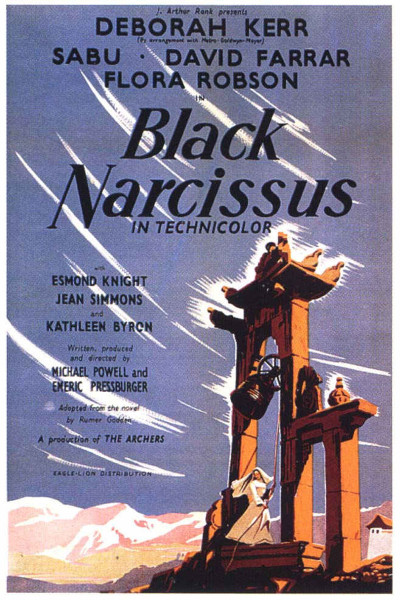
Black Narcissus Directed by Michael Powell and Emeric Pressburger Written by Michael Powell and Emeric Pressburger from the novel by Rumer Godden 1947/UK The Archers
Repeat viewing/Netflix rental
#194 of 1001 Films You Must See Before You Die
[box] Sister Clodagh: Well I really don’t know what to do.
Mr. Dean: What would Christ have done?[/box]
I have seen this more times than I can count and each time I am more enchanted each time by the beauty of its images and astounded that it could possibly have been shot on the studio lot in England. Coincidence that this was made just as Britain was poised to lose the jewel in its colonial crown? I think not.
A “working” order of Episcopal nuns, bound only by annual vows, prepares to open a school and clinic high in the Indian Himalayas courtesy of a local General/Maharaja. Against the Mother Superior’s better judgement, young Sister Clodagh (Deborah Kerr) is appointed to lead the small contingent sent to staff the convent. For some reason, Mother decides to select Sister Ruth (Kathleen Bryan), a “problem case” for this arduous duty as well.
When the nuns arrive, they find they are to be housed in a castle in which the General’s father kept his many women. The castle is decorated with erotic frescos of pleasure gardens. The General has paid the populace to fill the school and hospital. The scent of Black Narcissus perfume, and later of tropical flowers, fills the air. Native drums beat day and night and the wind blows incessantly.
Worst, studly Mr. Dean (David Farrar) is the nuns’ only link with the Western world and he has gone fairly native himself. It doesn’t help that he runs around bare chested and in short shorts all the time. Soon the nuns are having a hard time keeping their minds on their work as long suppressed desires start flooding back. With Flora Robson as one of the nuns, Sabu as the general’s son and Jean Simmons as a wild young local girl.
This is a simply gorgeous movie. Cinematographer Jack Cardiff was a student of classical art and uses color like a painter. To add to the glory, the film benefits from some of the best matte paintings ever done. It took me a couple of viewings to get into the overblown plot but the visuals were immediately captivating. The horror story that takes over in the final act is another kind of visual delight.
In one sense, this is a story of the futility of the colonial enterprise, if not of its immorality. The nuns might just as well have been sent to live on another planet for all the understanding they were able to develop of the people. And vice versa of course. The difference is that nobody asked the nuns to go there.
One niggle. Does anyone else think David Farrar looks like a small boy riding that tiny pony in those little shorts and funny hat? I don’t think Powell and Pressburger could have found a better way to make him anti-sexy. Then again, as soon as they focus on his face and eyes, he does quite well in that department.
Black Narcissus won Academy Awards for Best Cinematography, Color and Best Art Direction-Set Decoration, Color.
Odd Man Out Directed by Carol Reed Written by F.L. Green and R.C. Sherriff 1947/UK Two Cities Films
Repeat viewing/Amazon Instant
#200 of 1001 Films You Must See Before You Die
[box] Inspector: In my profession there is neither good nor bad. There is innocence and guilt. That’s all.[/box]
After a lapse of several years, I was only more impressed with this film on repeated viewing. I think it is almost the equal Reed’s better known The Third Man.
Johnny McQueen (James Mason) is the Chief of “The Organization” (clearly a stand in for the Irish Republican Army) in a North Ireland city. He has been in hiding for six months in the flat of an old woman and her granddaughter Kathleen. Kathleen is in love with Johnny but he is devoted only to the cause. Currently, he is planning the holdup of a mill. This will mark his return to active duty as a member of the robbery gang. Neither his henchmen nor Kathleen think he is up to the task. But Johnny is not deterred.
The heist goes terribly wrong and shots are exchanged. Johnny kills a guard and is in turn badly wounded, Then he hesitates entering the getaway car. A combination of missteps and basic cowardice on the part of the driver result in Johnny being left to run away alone.
The rest of the story follows the encounters of the gang members with the rest of the Northern Irish populace as they struggle to escape the police. It is a story of betrayal, greed, mercy, and fear. The last half of the film focuses on Johnny, the lone survivor, as he goes from place to place slowly bleeding to death. With Robert Newton as a mad painter.
The poster tag line bills this as “the most exciting film ever made.” I wouldn’t go quite that far but it is one of the most beautiful. For me, this is more a study of human nature than of Johnny’s specific plight. The members of the organization and the people that they encounter on their flight exhibit most of the faults and some of the virtues we all are heir to. Then again, James Mason is mesmerizing as the hunted Johnny McQueen and it is hard not to focus on him. Robert Krasker’s camera knows no limit in its Dutch angles and chiaroscuro magic. Highly recommended.
Odd Man Out was Oscar-nominated for Best Film Editing.
Notorious Directed by Alfred Hitchcock Written by Ben Hecht 1946/USA RKO Radio Pictures
Repeat viewing/Criterion Collection DVD
#193 of 1001 Films You Must See Before You Die
[box] Madame Sebastian: Wouldn’t it be a little too much if we both grinned at her like idiots?[/box]
If I had a gun held to my head and was forced to name my favorite Alfred Hitchcock film, there could be only one answer. This one.
After the arrest of her father as a Nazi traitor, Alicia Huberman (Ingrid Bergman) becomes a party girl and budding alcoholic. One night. a tall, dark, handsome stranger, Devlin (Cary Grant), crashes one of her parties. She is immediately attracted, then repelled when she discovers he is one of the many “cops” who are tailing her. It turns out he has a proposition to make. The U.S. government wants her help in rooting out some Nazis in South America. She is more attracted than repelled by Devlin and he appeals to her patriotism, so she agrees.
After they leave for Rio, the two rapidly become an item. Alicia is unabashed in her love but Devlin has evidently been burned before and keeps his emotions tightly in check. It turns out that the job Devlin’s superiors have in mind for Alicia is basically to prostitute herself to get close to Nazi cell leader Alexander Sebastian (Claude Rains). Devlin, not trusting in Alicia’s redemption by love, neither puts up a fight with the authorities nor discourages Alicia from taking on the assignment. Broken hearted, Alicia agrees to take on the job. She is successful beyond anybody’s wildest dreams in that Alex asks her to marry him.
Devlin continues to be Alicia’s handler and their meetings continue to stick the knife into Alicia’s heart. Meanwhile, Alicia is informing on all of Alex’s associates and some suspicious circumstances surrounding the wine cellar. Matters come to a head when she gets Devlin invited to a big bash at the house so that she can slip him the stolen key to the cellar. With Madame Konstantine as the mother-in-law from Hell.
I have no problem in pronouncing this movie perfect. It combines a lush and beautiful romance with some serious suspense. No matter how many times I see it, I still get a little nervous in that wine cellar. Devlin’s conflicted feelings give the romance its own suspense. And just looking at Grant and Bergman as photographed by by Ted Tetzlaff is pleasure in itself. This time around, I focused especially on Claude Rains’ performance. The movie would not have worked as well as it does if he had not been able to make us feel pity for his situation. My highest recommendation.
Claude Rains was nominated for Best Supporting Actor for his performance in Notorious. Although non-professional-actor winner Harold Russell was very good in The Best Years of Our Lives, I think Rains got robbed. The film was also nominated for Best Writing, Original Screenplay.
The Blu-Ray DVD contains two commentaries by film historians, one on the context of the making of the film and one on the film itself. I really enjoyed learning about the history of RKO, the history of David O. Selznik and the collaboration of the two on Notorious.
Trailer – talk about a trailer that gives away the whole plot!
The Best Years of Our Lives Directed by William Wyler Written by Robert E. Sherwood from a novel by MacKinlay Kantor 1946/USA The Samuel Goldwyn Company
Repeat viewing; DVD in collection
#194 of 1001 Movies You Must See Before You Die
[box] Fred Derry: How long since you been home?
Al Stephenson: Oh, a couple-a centuries.[/box]
I have seen this coming home story so often it seems like an old friend — one that it is always a pleasure to catch up with. I can’t think of a single thing I would change about the film.
By chance, de-mobilized service men Al Stephenson (Fredric March), Homer Parrish (Harold Russel), and Fred Derry (Dana Andrews) hitch a ride on the same military plane to their home town of Boone City. The men could not be more different. The highest ranking of the three is Fred, who is a captain and ex-Air Force gunner. Al was a sergeant in the infantry and Homer is a lowly seaman returning home from the hospital after having lost his hands during the bombing of his ship. They are all united by their war experience and their common anxiety about what awaits them at home.
As the men return to their homes we learn that they are as different by class as they are by rank. Derry comes from the wrong side of the tracks and was a soda jerk before the war put him in a fancy uniform and allowed him to win his blonde bombshell wife (Virginia Mayo). Homer is solidly middle class and all-American returning to his family who live in a house with a white picket fence. Al is an ex-banker who is dropped off at a swanky apartment to reunite with Milly (Myrna Loy), his wife of twenty years, and two children, Peggy (Theresa Wright) and Rob.
All three men are troubled by their reception the very first day. Al gets a lecture from his son, who is sympathetic with the Japanese after the atom bomb, and he has trouble breaking the ice with the women folk. Fred finds his wife has moved out of his parents home and gone back to work at a nightclub. Homer can’t bear the pity of his family. All of the men end up drinking away their sorrows at the bar owned by Homer’s uncle Butch (Hoagy Carmichael). Al has dragged Milly and Peggy along and Peggy and Fred are drawn to each other.
The men’s readjustment is slow and painful. Al develops quite the drinking problem as he tries to get used to being a conservative banker. Homer has trouble opening up to anybody and it looks like he will let his engagement to Wilma (Cathy O’Donnell) slip by the wayside. Fred, lacking any applicable skills, is forced to take a job working under the man who formerly assisted him at the drugstore. His wife has little use for him without his uniform or money and Al puts the kabosh on a budding extramarital relationship with Peggy. We follow the men until each gradually comes to terms with civilian live.
I have absolutely no complaints about anything in this movie and I love it as well so I guess I can call it perfect. It is amazing how fast the three hours flies. It seems to just take that long for us to get to know the characters well enough for their fates to matter. I always cry at different points. It usually begins with the scene where Milly is serving Al his breakfast in bed, carries on through Wilma putting Homer to bed, and culminates in a big way when Fred is sitting in the war surplus bomber.
Myrna Loy amazingly was never even nominated for an Oscar. She is the equal to the Oscar-winning Fredric March in this film and was robbed. There was never anyone better at playing a well-loved wife and she exceeded all expectations here.
The Best Years of Our Lives won Academy Awards for: Best Picture; Best Actor (March); Best Supporting Actor (Russell); Best Director; Best Writing, Screenplay; Best Film Editing; and Best Music, Scoring of a Dramatic or Comedy Picture (Hugo Friedhofer). It was nominated for Best Sound, Recording. Harold Russell won an Honorary Award for: “For bringing hope and courage to his fellow veterans through his appearance in The Best Years of Our Lives.” I agree with all these awards, though it would have been nice if the Academy could have been satisfied with giving Russell the Honorary Award and saved the Supporting Actor statuette for Claude Rains in Notorious.
I’ve been a classic movie fan for many years. My original mission was to see as many movies as I could get my hands on for every year from 1929 to 1970. I have completed that mission.
I then carried on with my chronological journey and and stopped midway through 1978. You can find my reviews of 1934-1978 films and “Top 10” lists for the 1929-1936 and 1944-77 films I saw here. For the past several months I have circled back to view the pre-Code films that were never reviewed here.
I’m a retired Foreign Service Officer living in Indio, California. When I’m not watching movies, I’m probably traveling, watching birds, knitting, or reading.
Photographs and videos found in this blog, unless indicated, are not owned by me and are here only for the purpose of education and discussion. Media found here are not intended for any commercial purpose. Copyright infringement is not intended.
Written material belongs to me and is copyrighted by flickersintime.com