Category Archives: 1001 Movies You Must See Before You Die

Reviews of movies included in the book 1001 Movies You Must See Before You Die

Singin’ in the Rain (1952)

Singin’ in the Rain
Directed by Stanley Donen and Gene Kelly
Written by Adolph Green and Betty Comden
1952/USA
Metro-Goldwyn-Mayer
Repeat viewing/My DVD collection
#256 of 1001 Movies You Must See Before You Die

[box] Let the stormy clouds chase/
Everyone from the place/
Come on with the rain/
I’ve a smile on my face – Lyrics by Arthur Freed[/box]

By some miracle, a lot of very talented people reached their peak at the same time and created magic.

Don Lockwood (Gene Kelly) and Lina Lamont (Jean Hagen) are big silent movie stars, having cranked out one swashbuckler after another.  They are a hot romance according to the fan magazines.  Lina believes her own PR but Don can hardly tolerate her.  Don’s best friend and constant companion is pianist Cosmo Brown (Donald O’Connor), whom he grew up with.  One day, Don meets cute with young Kathy Selden (Debbie Reynolds).  It is love at fist sight.  Naturally, Lina gets her fired from her job as soon as possible.

But eventually Don and Kathy reunite and begin dating.  At about this time, The Jazz Singer comes out.  Monumental Productions decides it will rejigger the latest Lockwood and Lamont romance as its first talkie.  This is a disaster on many levels, mostly due to Lina’s horrible speaking voice and inability to take direction.  Don can see his career going through the tubes as well.  Then Cosmo gets the brilliant idea of making the picture over into a musical and getting Kathy to dub Lina’s voice.  With Millard Mitchell as probably the most sympathetic studio head ever put on film and Cyd Charisse as a vamp.

My plot synopsis does not begin to convey how funny this movie is.  Indeed, I believe that it is so popular among musical haters because it works so well as a comedy – perhaps one of the best ever.  Then there is all that glorious singing and dancing.  To me, Kelly’s “Singin’ in the Rain” number perfectly conveys the essence of giddy new love.  Even the concluding “ballet” works for me.

I have now finally decided that when anyone asks me what my all-time favorite movie is, it will be this one.  Whenever I am looking for a boost I know right where to turn.  It was one of the first movies I saw in a revival theater on the big screen and has not faded over years of repeated viewing.  I saw it on Blu-Ray this time and it looked just gorgeous.

Singin’ in the Rain was nominated for Academy Awards in the categories of Best Supporting Actress (Hagen) and Best Music, Scoring of a Musical Picture.  I think Hagen was robbed.

Trailer

The Golden Coach (1952)

The Golden Coach “La Carosse dór”
Directed by Jean Renoir
Written by Jean Renoir, Jack Kirkland et al, inspired by “Le Carrosse du Saint-Sacrement” by Prosper Merimee
1952/France/Italy
Repeat viewing/My DVD collection
#261 of 1001 Movies You Must See Before You Die


[box] Aubergiste: How do you like the New World?

Don Antonio: It will be nice when it’s finished.[/box]

This film is Jean Renoir’s valentine to actors and the theater.

It is the Eighteenth Century somewhere in South America.  An Italian comedia dell’arte troupe has arrived after a long sea voyage to perform in a ramshackle theater in the capital.  Camilla (Anna Magnani), the actress who plays Columbine, has already won the heart of Don Antonio, an expert swordsman and fellow passenger.  She promptly proceeds to captivate a bullfighter and the world-weary young viceroy of the colony. Camille’s first love is her audience.

The viceroy is so smitten with her that he decides to present her with his splendid golden coach, which arrived on the same ship as the troupe and in which Camilla slept during the voyage.  This meets with disapproval from the local aristocracy which looks down on anything so common as actors.  The last act includes a showdown between Camilla’s three suitors.

This is enjoyable for the sheer spectacle of the thing and Magnani’s performance.  She seems to be having a fine time in the role alternating between her stiffer stage performances and her off-stage self.  Somehow, though, I find it lacks sufficient “oomph” in a way I can’t quite put my finger on.

Trailer

Ikiru (1952)

Ikiru (To Live)
Directed by Akira Kurosawa
Written by Akira Kurosawa, Shinobu Hashimoto, and Hideo Oguni
1952/Japan
Toho Company
Repeat viewing/My DVD collection
#258 of 1001 Movies You Must See Before You Die

[box] Kanji: I can’t afford to hate people. I don’t have that kind of time.[/box]

This is surely on my non-existent Top Ten Films list and maybe the most personally meaningful of them all.

Kanji Watanabe (Takeshi Shimura) has worked for the Department of Public Affairs for almost thirty years.  About all he has to show for it is a couple of certificates of appreciation and a perfect attendance record.  He has risen to the job of Section Chief. This seems to consist solely of stamping mountains of papers so they can be shuffled off to another section.

He causes quite a stir when he fails to report to work one day.  His stomach has been bothering him and he goes to see a doctor at the hospital.  Before he can be seen, one of his fellow patients kindly informs him of the symptoms of stomach cancer.  He has every one of them.  The doctors tell him he is suffering from a “mild ulcer” but he knows better.

Watanabe-san returns home where he lives with his son Mitsuo and Mitsuo’s wife.  But he is really all alone.  He is haunted by the idea that he may die before he has really lived.  So he sets about blowing a substantial portion of his savings on a drunken spree with a cooperative author.  This doesn’t help much.  The next day he is hunted down by a young subordinate who needs to have her resignation papers stamped.  He latches on to her, attracted by her sheer youth and health.  But she feels increasingly uncomfortable with his attentions.  She agrees to see him one last time.  During their last meeting, Watanabe-san sees a way to give his life some meaning.

The film then flashes forward to Watanabe-san’s funeral, attended by his fellow bureaucrats.  During the proceedings, which move from formality to a drunken wake, we learn, through flashbacks, how Watanabe spent his final days.

This film is both a biting critique of post-war Japanese bureaucracy and a philosophical look at what it means to live.  What it is not is maudlin in any way.  In fact, there are heaping helpings of humor.  Shimura is beyond superb in his portrayal of the dying man. The whole thing is beautifully shot.

The film is almost 2 1/2 hours long.  In previous viewings I have wondered if it is too long.  I have concluded that it is just long enough.  I think the shifting points of view during the wake and flashbacks is a brilliant way of removing any sentimentality from the story.  If we had it in chronological order it would probably have become a real weeper.  I watched this less than a month ago and then again yesterday.  There are few films I would risk that with. Most highly recommended.

Trailer


Umberto D (1952)

Umberto D
Directed by Vittorio De Sica
Written by Cesare Zavattini
1952/Italy
Rizzoli Film/Produzione Films Vittorio de Sica/Amato Films
First viewing/My DVD collection
#259 of 1001 Movies You Must See Before You Die

[box] A graceful and honorable old age is the childhood of immortality. — Pindar [/box]

I think only De Sica could pull off such a non-saccharine look at a poor old man and his dog.

Umberto Domenico Ferrari (Carlo Battisti) seems to have been comfortably middle-class when he worked 30 years for an Italian government ministry.  Now he is retired and his post-war pension is not enough to keep body and soul together.  The movie begins with his participation in a demonstration protesting inadequate pensions.

Umberto’s immediate problem is that his awful landlady is threatening to evict him unless he pays up all his back rent.  Her main interest is in reclaiming his room so that she can remodel following her upcoming marriage.  Umberto sells off a watch and some prized books but only comes up with about one-third of the amount due.

Umberto has only two friends in the world.  One is his beloved and loyal little dog Flick. The other, who is much a co-conspirator as a friend, is Maria (Maria Pia Casilia), the teenage maid that works for the landlady.  She defies her boss to bring Umberto leftover food and the thermometer and in return uses his window to signal to one of her two boyfriends.  She is pregnant by one of these men and her tenure in the household is limited.

As Umberto’s situation grows increasingly precarious, he tries various strategies.  These include getting himself admitted to a hospital and attempting to beg or borrow money.  His eviction grows ever closer.  Eventually, it seems that his greatest problem will be how to ensure Flick’s welfare.

I have been dreading this film for a long time.  The plot summary made it sound like it would either be unbearably maudlin or just too sad to take.  Fortunately, De Sica handles the sad story with his characteristic slightly humorous touch.  The screenplay is also genius.  Both Umberto and Maria are made to be very human and thus flawed.  So while our sympathy goes out to them we can see how part of their situation is of their own making.  The movie is beautifully shot and really should be seen.

Umberto D. was nominated for an Academy Award for Best Writing, Motion Picture Story.

Re-release trailer

The Quiet Man (1952)

The Quiet ManThe Quiet Man
Directed by John Ford
Written by Frank S. Nugent from the story by Maurice Walsh
1952/USA
Argosy Pictures
Repeat viewing/My DVD collection
No. 253 of 1001 Movies You Must See Before You Die

Michaleen Flynn: [on seeing the broken bed] Impetuous! Homeric!

It gets harder with every year that passes to put the dubious sexual politics aside, but if you can this is still a very romantic and enjoyable film.

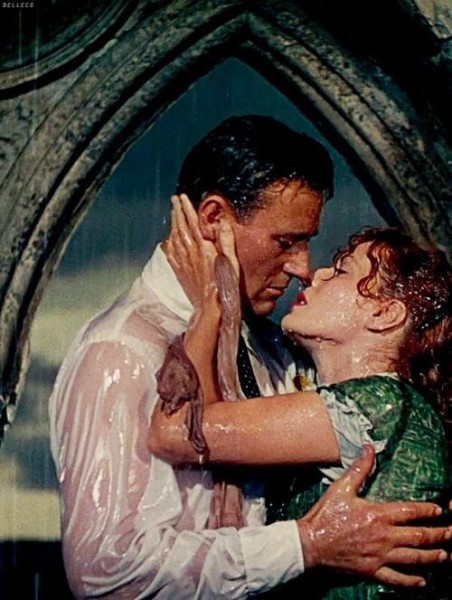
Sean Thornton (John Wayne) was born in Ireland and left as a very young child.  After he retires from boxing, having killed an opponent in the ring, he returns to his ancestral village of Inisfree.  He manages to buy his parents’ old cottage from the widow (Mildred Natwick) who owns it, thus beginning a war of sorts with “Red” Will Danaher (Victor McLaughlin) who has been trying to acquire it and the widow for years.  Of course, immediately thereafter Sean falls in love at first sight with Danaher’s fiery sister Mary Kate (Maureen O’Hara).

Danaher is naturally against any match between Sean and his sister but is tricked into relenting with a false promise that the widow will surrender as soon as he gets his sister out of his house.  Sean engages pixie local character Michaleen Flynn (Barry Fitzgerald) to fill the traditional role of chaperone and matchmaker.  The courtship doesn’t last long as the passion between these two won’t wait.  They are married shortly thereafter.

quiet man

When Danaher discovers he has been had, he retaliates by refusing to give Mary Kate the money and furniture that is her inheritance.  Sean doesn’t care about the money but Mary Kate cannot rest until she has what is hers.  She refuses to sleep with him until he wins it for her. The cultural gap is wide.  He thinks her acquisitive and she believes he is a coward for not fighting her brother.  The rest of the film is devoted to the resolution of this issue, ending with a grand donnybrook.  With most of Ford’s stock company including Arthur Shields and Ward Bond as the local pastor and priest and a host of Irish supporting players.

the-quiet-man-1952-17

The plot is relatively simple, allowing Ford to concentrate on presenting the most romantic possible vision of Ireland.   It’s a pity that the friction between Sean and Mary Kate is solved by returning to gender role stereotypes but it is all handled in a fairly light and amusing way.  Wayne and O’Hara have a powerful chemistry and she may never have been more beautiful.  I’ve seen this film many times and it never grows old.  I suppose that’s what makes a classic.

The Quiet Man won Academy Awards for Best Director and Best Cinematography, Color. It was nominated in the categories of Best Picture; Best Actor in a Supporting Role (McLaughlin); Best Writing, Screenplay; Best Art Direction-Set Decoration, Color; and Best Sound, Recording.

Trailer

Irish actor Gabriel Byrne on The Quiet Man – he says this is a feminist film??!!

The Bad and the Beautiful (1952)

The Bad and the Beautiful
Directed by Vicente Minnelli
Written by Charles Schnee, story by George Bradshaw
1952/USA
Metro-Goldwyn-Mayer
Repeat viewing/Amazon Instant
#257 of 1001 Movies You Must See Before You Die


[box] James Lee Bartlow: Yes, this is James Lee Bartlow… Paris?… Mr. Shields!… is Mr. Shields paying for this call?… All right, put him on… Hello, Jonathan? Drop dead.[/box]

Classic Hollywood certainly wasn’t afraid to show its dark side.  This is a lot of fun and contains probably my favorite performance from Dick Powell.

The film is framed by sequences in which studio head Harry Pebbel tries to sell a director, actress, and screenwriter who have all been shafted by broke producer Jonathan Shields (Kirk Douglas) on working on his next project. The story begins with the funeral of Jonathan’s father.  He has taken his father’s last ten cents to hire mourners.  Nobody loves a producer in Hollywood when his luck turns bad it seems.  One of the mourners is Fred Arniel (Barry Sullivan), who has been making a precarious living as the assistant director of B-films.  The two men bond.  Jonathan is determined to follow his father’s footsteps straight to the top and invites Fred to come along.

The first thing Jonathan does is to visit the mansion formerly owned by a deceased actor. He discovers his teenage daughter, Georgia Lorrison (Lana Turner), has set up residence in the attic.  Georgia has been following her own father’s footsteps in the drinking department. The next stop for Jonathan is the office of Harry Pebbel (Walter Pidgeon), the penny pinching producer of B-movies.  He gives Jonathan a job producing such low-budget flicks as “The Cat Men” with Fred as director.  This last film (a la Val Lewton’s Cat People) shows that a critical and box-office success can be made of a horror film. When he gets only projects such as “Return of the Cat Men”as a reward, Jonathan quits the studio, taking Harry with him.

Fred has long had a dream project which he has shopped around town with no success. Jonathan decides to champion this.  He manages to get the big budget he wants for the film, but only by hiring an established director.  Disgusted, Fred breaks with him but goes on to become a famous director himself.

He decides to give Georgia Lorrison, now working as an extra, a screen test for a part in one of his movies  He sees star quality and hires her as his picture’s leading lady.  Things get off to a rocky start.  Then Georgia reveals she is in love with Jonathan and he romances her into giving a star-making performances.  But on the night of the premier, Georgia discovers Jonathan’s ruse.  She is heartbroken but goes on to be a big star.

For his next project, Jonathan tackles a best-selling novel.  He gets at the author James Lee Bartlow (Powell) through his star-struck wife Rosemary (Gloria Grahame) and convinces him to come to Hollywood to write a treatment for the film.  But Bartlow cannot concentrate on his writing assignment with his sexy, flighty wife’s constant interruptions.  So Jonathan secretly sets her up with aging Latin lover “Gaucho” (Gilbert Roland) and spirits Bartlow away to an isolated writing retreat.  This maneuver ends in tragedy but gets Jonathan his screenplay.  Bartlow cannot forgive Jonathan but goes on to write a Pulitzer Prize-winning novel based on his wife’s fate.

As the movie ends, Harry is explaining to Jonathan’s former friends how he actually made their careers for them.  The outcome of the sales talk is left open.

If one is not familiar with Hollywood lore, this will probably come off as a grand melodrama.   For those familiar with their film history and celebrities, the story will be deliciously funny as well as melodramatic.  Minnelli and the studio spared no expense in providing us with the most lavish and glamorous settings and costumes they could come up with.  The acting is all very good and Douglas is magnetic as the unscrupulous boy-genius Jonathan.

The Bad and the Beautiful won Academy Awards in the following categories:  Best Supporting Actress (Grahame); Best Writing, Screenplay; Best Cinematography, Black-and-White; Best Art Direction-Set Decoration, Black-and-White; and Best Costume Design, Black-and-White.  Kirk Douglas was nominated for Best Actor. The film holds the record for most Academy Awards won by a film not nominated for Best Picture.

Trailer

High Noon (1952)

High Noon
Directed by Fred Zinnemann
Written by Carl Foreman from the magazine story “The Tin Star” by John W. Cunningham
1952/USA
Stanley Kramer Productions
Repeat viewing/Netflix rental
#260 of 1001 Moview You Must See Before You Die

[box] Judge: This is just a dirty little village in the middle of nowhere. Nothing that happens here is really important.[/box]

There is not a single thing I would change about this classic.

The story takes place in real time in a small town in the Old West.  It is the wedding day of Marshall Will Kane (Gary Cooper) and Amy Fowler (Grace Kelly).  The bride is a Quaker and has inspired Kane to turn in his badge and become a shopkeeper.  They are about to depart on their honeymoon when the town learns that Frank Miller has been pardoned from his murder sentence.  Kane apprehended Miller, who formerly ran their town, and he has sworn vengeance.  He is expected on the noon train and three members of his gang are already waiting at the train station to meet him.  All Kane’s friends advise him to get out of town as soon as possible and he begins to before deciding that he cannot abandon the town or keep on the run from the insane Miller for the rest of his life.

Kane is severely tested.  First, Amy demands that they leave and avoid violence.  When Kane refuses she simply walks out on him.  Then his jealous deputy Harvey Pell (Lloyd Bridges) demands that his support for the Marshall job and also abandons him when Kane refuses.  Finally, the time ticks down while all the townsfolk who had been so grateful to Kane for restoring law on order find one reason or another for refusing to help him by joining a volunteer posse. Kane stays strong and the movie ends with a showdown between him and the Miller gang. With Katy Jurado in a strong performance as the former girlfriend of Miller, Kane and Pell, Lee Van Cleef in his film debut as a member of the Miller gang, and Lon Chaney Jr, Harry Morgan, Thomas Mitchell, and Otto Krueger as pillars of the community.

I watched the Blu-Ray edition of this film and never has the sparse cinematography looked so beautiful to me.  I’ve loved this movie for as long as I have had an interest in classic movies and it never disappoints.  I love it in its talky moments and during the action sequences.  The acting is absolutely first rate, the writing is powerful, and this is one of my favorite movie scores.  Surely a must see.

The Blu-Ray I rented had a good “making of” documentary with Leonard Maltin featuring interviews with a great many of the principals, including Zinnemann, producer Kramer, Cooper, and Bridges.  I had not know prior to watching it that this was Bridges’s last major film prior to being blacklisted for several years.  He continued to work in B movies and in television.

High Noon won Academy Awards in the categories of Best Actor, Best Film Editing, Best Music, Original Song (“High Noon ‘Do Not Foresake Me, Oh My Darlin'”) and Best Music, Scoring of a Dramatic of Comedy Picture.  It was nominated in the categories of Best Picture, Best Director, and Best Writing, Screenplay.

Trailer

Clip – The Ballad of High Noon (opening credits)

An American in Paris(1951)

An American in Paris
Directed by Vicente Minelli
Written by Alan Jay Lerner
1951/USA
Metro-Goldwyn-Mayer
Repeat viewing/Amazon Instant
#246 of 1001 Movies You Must See Before You Die

[box] In time the Rockies may tumble, Gibraltar may crumble/ They’re only made of clay/ But our love is here to stay — “Love Is Here to Stay”, lyrics by Ira Gershwin [/box]

A couple of previous viewings had me thinking that An American in Paris had not held up well.  Then I caught it yesterday and it had regained all its magic for me.

Jerry Mulligan (Gene Kelly) is an ex-GI who is starting out as a painter in Paris.  He’s still having a problem selling his work even on the sidewalk.  In his building lives Adam Cook (Oscar Levant) a struggling composer and concert pianist.  Adam has written some songs for his friend Henri Baurel (Georges Guetary), a famous music hall composter.  Henri reveals early on that he has fallen in love with his ward Lise (Leslie Caron).

Milo Roberts, an American sophisticate, stops by to admire Jerry’s paintings and soon starts admiring Jerry himself.  She promises to promote him and get him an exhibition but it is clear she expects more from him that gratitude.  But this is not to be.  Jerry falls more or less in love at first sight with Lise when he sees her dining with friends at a restaurant.

Soon Jerry and Lise are arranging rendevous.  But when Henri asks Lise to marry him her gratitude for his help during the war threatens to override her love for Jerry.

This viewing moved the film back from “flawed” to the practically perfect category. I will admit that the concluding ballet kind of stops the film it its tracks, but it is so splendid in conception and execution that I cut it a lot of  slack.  It’s enough for me just to soak in the beautiful colors, Paris, and the glorious George Gershwin score.  Kelly does some pretty fantastic dancing as well.

An American in Paris won Oscars in the following categories:  Best Picture; Best Writing, Story and Screenplay; Best Cinematography, Color; Best Art Direction-Set Decoration, Color; Best Costume Design, Color; and Best Music, Scoring of a Musical Picture.  It was nominated for Best Director and Best Film Editing.

Trailer

The African Queen (1951)

The African Queen
Directed by John Huston
Written by James Agee and John Huston from the novel by C. S. Forester
1951/USA
Romulus Films/Horizon Pictures
Repeat viewing/Amazon Instant
#248 of 1001 Films You Must See Before You Die

[box] Rose Sayer: Nature, Mr. Allnut, is what we are put in this world to rise above.[/box]

This is a fun classic and I think Humphrey Bogart deserved his Oscar despite the competition from Brando.

Rose Sayer (Katharine Hepburn) has been assisting her brother Reverend Samuel Sayer (Robert Morely) as a missionary in German East Africa for the past ten years.  Charlie Allnut (Bogart) visits them regularly to deliver their mail.  One day, he advises that his visits may become less regular since war has broken out in Europe and Germans in the colony will be eager to requisition his boat, The African Queen.  As soon as Charlie departs, the mission is descended on by Germans.  The native people are impressed as soldiers and their huts burned.  Samuel dies soon after, apparently of grief and Rose is left alone.

Fortunately, Allnut returns to the mission on the same day and rescues Rose.  She comes up with the brainstorm of using the African Queen to blow up a German ship that is blocking the way of a British advance into the colony.  Despite all of Allnut’s warnings about the raging rapids on the river leading to the lake and the mechanical state of the boat, Rose cannot be moved.  She uses her considerable will to more or less bully Allnut into agreeing to her plan.

The rest of the film follows the pair’s adventures en route to the lake and their blossoming romance.

I have watched this film a number of times.  This time I found Hepburn’s character extremely irritating in the first half.  Fortunately, the romance came along to bring back all the good feelings of prior viewings.  This may not be Bogart’s best performance but it is an excellent  one and in a role outside his usual range.  This is just an exciting, humorous adventure story made by the best craftsmen in Hollywood.

Someday I really must read Hepburn’s book about the making of the film, The Making of the African Queen: How I Went to Africa with Bogart, Bacall, and Huston and Almost Lost My Mind.

Humphrey Bogart won the Academy Award for Best Actor.  The film was nominated in the categories of Best Actress, Best Director, and Best Writing, Screenplay.

Trailer


Diary of a Country Priest (1951)

Diary of a Country Priest
Directed by Robert Bresson
Written by Robert Bresson from a novel by George Bernanos
1951/France
Union Generale Cinematographique
Repeat viewing/Netflix rental
#251 of 1001 Movies You Must See Before You Die

[box] Curé d’Ambricourt: [God] is not the master of love. He is love itself. If you would love, don’t place yourself beyond love’s reach.[/box]

This has all the necessary ingredients to make a great film yet somehow I just don’t connect with it.

A young priest (Claude Leydu) writes a diary about his spiritual life and attempts to ministert to his flock in an isolated French village.  He is an outsider and all the villagers and gentry view him with suspicion and not a little contempt.  Complicating matters, the priest has some sort of stomach ailment which is causing him to subsist on bread and wine.  All the wine drinking causes rumors that he is a drunkard.

Despite all this, the priest soldiers on and even manages to provoke a religious awakening in a countess shortly before her death.  This backfires agains him as well when her malicious daughter tells the world he actually upset her mother so much as to provoke her death.  After the priest passes out in the street covered in his vomited blood, he is forced to seek medical help in a nearby town.  He lives the remainder of his short life there with a seminary school mate who lost his faith.  Nothing can shake that of our priest.

This film is undeniably stunningly beautiful to look at and has a great score.  The acting is good as well.  Stories about spiritual struggles often resonate with me.  Something about Bresson’s cool detachment from his story make this less than compelling, though.

Montage of clips set to “Knockin’ on Heavens Door” sung by Bob Dylan