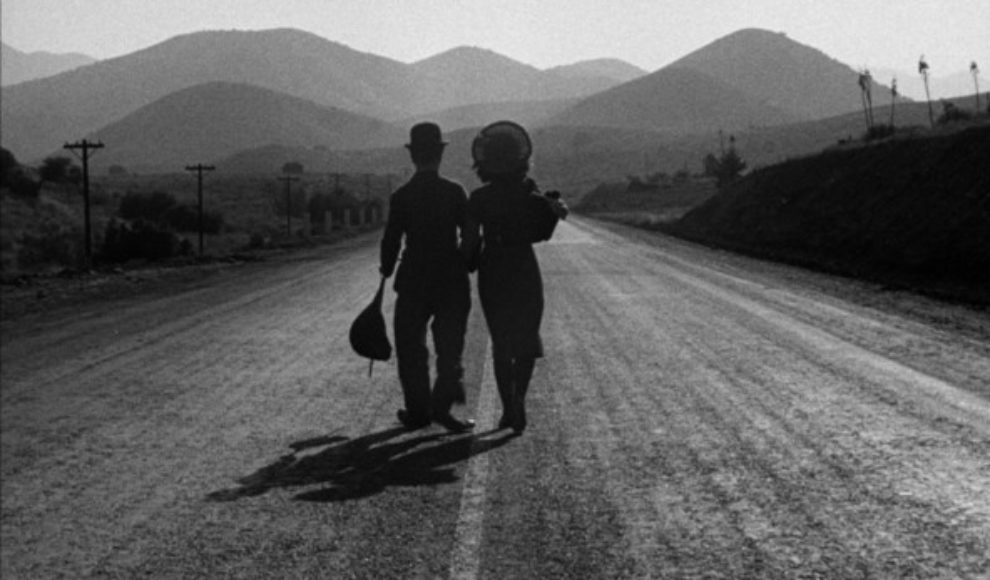
Hud (1963)

Hud
Directed by Martin Ritt
Written by Irving Ravetch and Harriet Frank Jr. from a novel by Larry McMurtry
1963/USA
Paramount Pictures/Salem-Dover Productions
Repeat viewing/Amazon Prime Instant Video
#419 of 1001 Movies You Must See Before You Die


[box] Alma Brown: No thanks. I’ve done my time with one cold-blooded bastard, I’m not looking for another.

Hud Bannon: Too late, honey, you already found him.[/box]

From the spare, stunning black-and-white photography to the pitch-perfect performances, it is hard to imagine how Hud could possibly be improved.

Orphan Lonnie Bannon (Brandon De Willde) has been raised by his grandfather Homer (Melvyn Douglas) on a cattle ranch in Texas.  Housekeeper Alma (Patricia Neal) does the family’s cooking and cleaning.  Homer is feuding with his son Hud (Paul Newman), whom he sees as an irresponsible, amoral embarrassment.  Hud continuously proves that Homer is absolutely right.

Despite all his faults, or maybe because of them, Lonnie kind of looks up to the hard-drinking Hud, who is handy at stealing wives and winning fights.  Lonnie starts tagging along with his uncle to town and enjoys his first hard liquor and bar fight.  But Lonnie is a dreamy, introspective teenager to whom riotous living does not come naturally.  Both Lonnie and Hud lust after Alma.  Hud is constantly making lewd remarks and crude propositions to Alma but she is having none of it.

Disaster, in the form of hoof-and-mouth disease hits the ranch.  Hud wants his father to get rid of his cattle before the diagnosis is proved but Homer refuses.  He also refuses to sell oil leases on his land.  Hud starts talking about incompetency proceedings.  Lonnie must decide his future for himself.

Paul Newman is so dynamic (and sexy) as the title character that it would be easy to see Hud as the (anti-) hero of this story.  On this viewing, it seemed clear to me that this film is actually Lonnie’s coming-of-age story.   I had also forgotten how bleak the film is.  It gets even more bleak with age when we ponder the work of a lifetime – here gone in an afternoon.  I like the fact that, while Hud is shown to have reasons for his rebellion, the writers make no excuses for him in the end.  He just doesn’t care about other people.

I had not been so familiar with Melvyn Douglas’s work of the 1930’s when I saw this before and it was extra fun to see the leading man in his old age.  He richly deserved his Academy Award.  Patricia Neal is incredible.  She is so strong and vulnerable at the same time and has such great chemistry with Newman.  Highly recommended.

Hud won Academy Awards in the categories of Best Actress, Best Supporting Actor (Douglas), and Best Cinematography, Black-and-White (James Wong Howe).  It was nominated in four additional categories:  Best Picture; Best Director; Best Writing, Screenplay based on material from another medium; and Best Art Direction-Set Decoration, Black-and-White.

Clip – Paul Newman and Patricia Neal – acting at its finest


Holy Matrimony (1943)

Holy Matrimony
Directed by John M. Stahl
Written by Nunnally Johnson from a play by Arnold Bennett
1943/USA
Twentieth Century Fox Film Corporation
First viewing/20th Century Fox Film Archives DVD

[box] Single women have a dreadful propensity for being poor. Which is one very strong argument in favor of matrimony. — Jane Austen [/box]

I enjoyed this oft-made story about a reclusive artist who finds love when he poses as his own valet. I preferred His Double Life (1933), starring Roland Young and Lillian Gish, however.

Priam Farll (Monty Woolley) is a world-renowned artist who, scorning publicity, has lived in the most remote parts of the world with his faithful valet Henry Leek (Eric Blore) for 25 years.  He reluctantly returns to London to receive a knighthood.  Shortly after he arrives, Leek contracts pneumonia and dies.  The doctor assumes the man he treated was the painter and Farll does not disabuse him of that notion.  Farll plays along and even watches “his” funeral followed by a burial in Westminster Abbey from the organ loft.

Leek had been corresponding through a matrimonial bureau with Alice Chalice (Gracie Fields).  She locates the false Leek and they fall in love and marry.  Farll continues to paint for his own pleasure.  The jig could be up when Alice surreptitiously starts selling the paintings for a song.   With Laird Cregar as an art dealer, Una O’Connor as Leek’s estranged wife, and Franklin Pangborn as Farll’s cousin.

This film is amusing, if not laugh out loud funny, with some good performances.  I thought Monty Woolly was miscast.  The part requires someone that is reticent with people. Woolly’s painter likes nothing better than to boss them around.  Roland Young was perfect.  I can also imagine Charles Laughton in the part.

Holy Matrimony was nominated for an Academy Award for Best Writing, Adapted Screenplay

Trailer


Lady of Burlesque (1943)

Lady of Burlesque
Directed by William A. Wellman
Written by James Gunn from the novel by Gypsy Rose Lee
1943/USA
Hunt Stromberg Productions
First viewing/Netflix rental


[box] Biff: What’s the matter with comics?

Dixie: I went into show business when I was seven years old. Two days later the first comic I ever met stole my piggy bank in a railroad station in Portland. When I was 11 the comics were looking at my ankles. When I was 14 they were…just looking. When I was 20 I’d been stuck with enough lunch checks to pay for a three-story house. Naw, they’re shiftless, dame-chasing, ambitionless…[/box]

This is a reasonably entertaining low-budget mystery/comedy with the always excellent Barbara Stanwyck in the title role.

Dixie Daisy (Stanwyck) is the newest headliner in a pretty sedate burlesque show.  She has grander ambitions and a life-long grudge against comics.  Naturally, she is pursued by one, Biff Branigan.  When Dixie is attacked back stage and other burlesque artistes start being strangled with their own G-strings, she and Biff become allies in solving the crimes.

This one has a little bit of everything – snippets of burlesque acts (the camera discretely changes focus during the bumps), plenty of backstage banter and catfights, romance, and of course the mystery.  Stanwyck is good as the hard-nosed Dixie.  She’s an enthusiastic dancer if not the world’s greatest singer.

Lady of Burlesque was nominated for an Academy Award for Best Music, Scoring of a Dramatic or Comedy Picture.

Stanwyck and company sing and dance to “The G-String Song”

Son of Dracula (1943)

Son of Dracula
Directed by Robert Siodmak
Written by Eric Taylor from a story by Curt Siodmak
1943/USA
Universal Pictures
Repeat viewing/Netflix rental


[box] Count Dracula: [as his coffin is burning] Put it out! Put it out, I tell ya’![/box]

First we get Bela Lugosi as Frankenstein’s Monster.  Now it’s Lon Chaney, Jr. as Dracula. What were they thinking?

Katherine Caldwell (Louise Albritton) is a “morbid” believer in the occult.  She is eagerly expecting a visit from Count Alucard (Chaney) to her Southern plantation home. Everybody associated with her, including fiance Frank, takes an instant disliking to him.   Katherine marries him any way.  Her family hires vampire expert Prof. Lazlo (J. Edward Bromberg) to help out.  Double crosses and mild horror ensue  With Evelyn Ankers as Katherine’s sister.

The highlight of this film is some excellent low-key shots by future film noir master Siodmak.  Otherwise, it is pretty lame.  Chaney is even more unlikely as Hungarian count that he was a the son of an English lord.

Trailer

Fires Were Started (1943)

Fires Were StartedFires_Were_Started
Directed by Humphrey Jennings
Written by Humphrey Jennings
1943/UK
Crown Film Unit
Repeat viewing/Amazon Prime Instant Video (included in a package called “Britain Is Calling”)
#167 of 1001 Films You Must See Before You Die


I can think of no more stirring symbol of man’s humanity to man than a fire engine. ~Kurt Vonnegut

This docu-drama is a touching testimonial to the brave firemen who battled against terrible odds during the Blitz.

The story is a slice of life showing one day at an East Side London fire house during the early days of the Blitzkrieg before a national fire service was organized.  We basically follow   a new man joining this company as he is shown around, participates in off-hour activities, and later goes to help put out a massive riverside fire caused by the bombing of a warehouse holding explosives.

fireswerestarted4900x506The fire was a reconstruction but the roles were played by real fireman and the whole thing is grittily authentic.  For me, the most touching part was when the men were standing around the piano at the firehouse right before the alarm rang singing “Please Don’t Talk About Me When I’m Gone”.  It is amazing to think that these men lived through danger like that and had to do it all over again the next night.  Jennings and his crew also captured some hauntingly beautiful images.  Recommended.

Clip

Thank Your Lucky Stars (1943)

Thank Your Lucky Stars
Directed by David Butler
Written by Norman Panama, Melvin Frank and James V. Kern from an original story by Everett Freeman and Arthur Schwartz
1943/USA
Warner Bros.
First viewing/Warner Bros. Homefront Collection DVD


[box] I’m either their first breath of spring/ Or else, I’m their last little fling/ I either get a fossil or an adolescent pup/ I either have to hold him off/ Or have to hold him up/ The battle is on, but the fortress will hold/ They’re either too young or too old – “They’re Either Too Young or Too Old,” lyrics by Frank Leosser [/box]

Yet another all-star variety show from 1943.  It’s a mixed bag, with a bit too much framing story, but some of the numbers are unmissable.

Producer/MC Farnsworth (Edward Everett Horton) and composer/conductor Dr. Schlenna (S.Z. Sakall) are putting on the “Cavalcade of Stars” as a benefit for the war effort.  Dr. Schlenna is desperate to get Dinah Shore in the show.  Unfortunately, she is managed by Eddie Cantor and he won’t let her participate unless he does.  Very reluctantly,  the two allow Cantor to be Honorary Chairman of their Committee.  He immediately makes a complete nuisance of himself.  (Cantor makes himself the butt of every joke throughout.)

In the meantime, Pat Dixon (Joan Leslie) is looking for someone to perform the very bad song she wrote called “Moon Dust”.  She chances upon aspiring singer Tommy Randolph (Dennis Morgan) who is trying, without success, to get a contract to sing on Cantor’s radio show.  He makes such a bad impression on Cantor that the two resort to kidnapping the star and substituting him for a look-alike Hollywood tour bus driver (also Cantor) who saves the day.

George Tobias with Olivia De Havilland and Ida Lupino

Other than the Leslie-Morgan songs in the framing story (which are pretty bad), the bulk of the film is devoted to numbers from famous Warner Bros. movie stars in either the dress rehearsal or the benefit gala.  Among them are John Garfield, Ann Sheridan, Alan Hale, Jack Carson, Bette Davis, Olivia De Havilland, Errol Flynn, Hattie McDaniel, Willie Best, Ida Lupino, Spike Jones and His City Slickers, and Humphrey Bogart.

John Garfield and some of the others demonstrate why they didn’t make it as musical comedy stars but some of the acts are surprisingly good.  Bette Davis has trouble carrying a tune as well but she has so much screen presence that her song ends up being really enjoyable.  Hattie McDaniel, Willie Best, and many more sing and dance delightfully to “Ice Cold Katy”.  (I always love it whenever Hattie McDaniel is allowed to sing.)  I think my favorite act was Errol Flynn sending up his heroic image in the British music hall style number “That’s What You Jolly Well Get”.  The man seemingly could do anything.  I haven’t had much exposure to Cantor before but I thought he did quite well.

Arthur Schwartz and Frank Loesser were nominated for an Academy Award for Best Music, Original Song for their song “They’re Either Too Old or Too Young”

Errol Flynn sings “That’s What You Jolly Well Get”

L’éternel retour (1943)

L’éternel retour (“Love Eternal”)
Directed by Jean Delannoy
Written by Jean Cocteau
1943/France
Films André Paulvé
First viewing/Hulu Plus


[box] Tristram: Soft – who is that, stands by the dying fire?

The Page: Iseult.

Tristram: Ah! not the Iseult I desire. — Matthew Arnold, Tristram and Iseult[/box]

Jean Cocteau was at his best in getting at the mythic beating heart of fairy tales and legends, here a modern version of the ancient story about the adulterous love between Tristan and Isolde.

Patrice (Cocteau’s partner and muse Jean Marais) is visiting his wealthy uncle Marc.  The chateau is also occupied by Gertrude, the sister of Marc’s deceased wife, her husband, and their son Achille.  The entire Frossin clan is the stuff of nightmares but Achille, a grown-up dwarf whom his mother treats as a young child, is particularly evil.  They are all obsessed with jealousy of Patrice.

Patrice takes them in his stride.  He decides what Marc needs is a wife.  He finds an ideal candidate on an island in the form of the young, very blonde Nathalie (Madeleine Solonge), who is being terrorized by her drunken boyfriend.  Nathalie agrees to leave with Patrice. Her protector Anne provides a bottle of love potion marked “Poison” for Nathalie to use if she cannot work up enthusiasm for the middle-aged Marc.

Marc likes Nathalie at once and a wedding quickly follows.  He encourages the teasing friendship between Nathalie and Patrice.  One night when they are back from one of their athletic endeavors, Patrice suggests that they get drunk.  Achille secretly dumps the contents of the bottle in their glasses.

The two are now overtaken by a passion that remains unconsummated.  The Frossins make sure Marc finds out about this and Patrice is exiled.  He steals Nathalie away but she is found out and meekly returns to the chateau.  Patrice takes up with a brunette, also named Nathalie.  But nothing can prevent the lovers’ tragic reunion.

The filmmakers managed to come up with the blondest and most square-jawed actors in all of France for this.  It is astounding how Teutonic they look.  The villains are all brunettes. Perhaps no deeper meaning should be read into all this.  At any rate, it is a visually beautiful telling of the story, with less flourishes than La belle et la bête but some of the same fairly tale feeling.  The characters were a bit too symbolic to be fully engaging.

Montage of clips – no subtitles but little dialogue

Bataan (1943)

Bataanbataan poster
Directed by Tay Garnett
Written by Robert Hardy Andrews
1943/USA
Metro-Goldwyn-Mayer
First viewing/Amazon Instant Video


“The War Department in Washington briefly weighed more ambitious schemes to relieve the Americans on a large scale before it was too late. But by Christmas of 1941, Washington had already come to regard Bataan as a lost cause. President Roosevelt had decided to concentrate American resources primarily in the European theater rather than attempt to fight an all-out war on two distant fronts. At odds with the emerging master strategy for winning the war, the remote outpost of Bataan lay doomed. By late December, President Roosevelt and War Secretary Henry Stimson had confided to Winston Churchill that they had regrettably written off the Philippines. In a particularly chilly phrase that was later to become famous, Stimson had remarked, ‘There are times when men have to die.” ― Hampton Sides, Ghost Soldiers: The Epic Account of World War II’s Greatest Rescue Mission

This is a dark story of a ragtag band of soldiers in a doomed effort to defend their position as the Japanese take over the Philippines.  It turned out to be my favorite combat movie in a year filled with such fare.bataan 1The film is dedicated to the Filipino soldiers who fought side-by-side with Americans and died defending their homeland.  After Manila is bombed, a group of survivors from different units and services is assigned to blow up a bridge and repair a plane on Bataan. Among them are Sgt. Bill Dane (Robert Taylor), a hardened career NCO; pilot Steve Bentley (George Murphy); New Yawker Jake Feingold (Thomas Mitchell); Latino Felix Ramirez (Desi Arnez); and young sailor Leonard Purkett (Robert Walker in his feature film debut), who can hardly wait to kill his first Jap.  A special thorn in Dane’s side is a corporal who calls himself  Barney Todd (Lloyd Nolan), but whom Dane recalls as a criminal who broke free of his escort.

These men display incredible heroism as they doggedly follow their orders in the jungle, despite constant attrition due to disease and attacks by the Japanese.

bataan2

This has all the elements of its genre, down to the ethnic composition of the unit.  It transcends cliches however due to the fine acting, intelligent screenplay and unrelenting portrayal of the horrors of war.  Despite his matinee idol good looks, Robert Taylor is never better than as a tough guy and shines here.  Nolan is his match in the acting department.  Walker is always good but he appeared to still be finding his way at this point.  The special effects are great, with some amazing matte painting effects.  For more on matte effects in combat films of this era, including Bataan, see here.

Trailer


Frankenstein Meets the Wolf Man (1943)

Frankenstein Meets the Wolf Man
Directed by Roy William Neill
Written by Curt Siodmak
1943/USA
Universal Pictures
First viewing/Amazon Instant Video


[box] Maleva: He is not insane. He simply wants to die.[/box]

Bela Lugosi looks positively geriatric as Frankenstein’s monster in this Universal horror not-so-classic.

Larry Talbot (Lon Chaney, Jr.) is still trying to find a way to die and escape the monthly nightmare of his transformation into the Wolf Man.  He locates gypsy woman Maleva (Maria Ouspenskaya).  She says Dr. Frankenstein had the secrets of both life and death. He awakens the monster (Legosi) from its entombment in an ice block while trying to find the scientist’s records.

In the meantime, the Wolf Man has already killed.  Dr. Frank Mannering is on his trail.  He locates Talbot in the quaint Tyrolean village near the castle, where Frankenstein’s grandniece Elsa (Ilona Massey) is enjoying some folk dancing.  The monster makes an appearance.  Mannering and Elsa agree to help Talbot.  They find Frankenstein’s diary which explains how the undead can be made to die.  But the villagers aren’t waiting for science to take a hand in destroying the monster and there is something about that laboratory that drives men mad …  With Lionel Atwill as the mayor and Dwight Frye as a villager.

This has all the great production values of the classic Universal horror films of the ’30’s.  Chaney Jr. is actually better in this than he was in The Wolf Man, probably because we are not asked to believe that he is the son of an English lord.  Poor Lugosi totters around pathetically and the climactic fight is necessarily truncated by another disaster, bringing the movie to an abrupt halt.

Trailer

This Is the Army (1943)

This Is the Army
Directed by Michael Curtiz
Written by Casey Robinson and Claude Binyon
1943/USA
Warner Bros
First viewing/Netflix rental


[box] This is the Army, Mister Jones/ No private rooms or telephones/ You had your breakfast in bed before/ But you won’t have it there anymore. — “This Is the Army”, lyrics by Irving Berlin [/box]

Variety show movie musicals were all the rage in 1943.  This might be the most patriotic of them all, with its chorus of soldiers and tunes by Irving Berlin.

The story is centered around two musical reviews Berlin wrote for the Broadway stage, Yip, Yip Yaphank (1918) and This Is the Army (1942), both largely casted with active-duty servicemen, of which Berlin was one in 1918.

Jerry Jones (George Murphy) is a talented singer and dancer.  He and his buddies are all drafted while they are putting on a show.  They go on to star in Yip Yip Yaphank as a morale-building exercise before being shipped off to France.  Jerry loses a leg but keeps his spirits up and becomes a successful businessman.

We segue to 1942 and Johnny Jones (Ronald Reagan) is preparing to head overseas.  A running theme is his reluctance to marry long-time girlfriend Eileen (Joan Leslie), fearing that would be unfair as he might be killed.  Instead of combat, however, Johnny’s active duty is as stage manager of This Is the Army.  With Alan Hale as a drill sergeant during both wars and specialty numbers by Frances Langford and Kate Smith and Berlin croaking out “Oh, How I Hate to Get up in the Morning”.

I suspect This Is the Army was a bit old-fashioned even for 1943.  A cast member says as much about the blackface ministrel number performed to “Mandy”.  We also have a strictly segregated show with the black soldiers all tapping in the number “That’s What the Well-Dressed Man in Harlem Will Wear”.  There is much too much drag for my taste as well.  I enjoyed a few of the numbers any way.

This Is the Army won the Academy Award for Best Music, Scoring of a Musical Picture (Ray Heindorf).  It was nominated in the categories of Best Art Direction-Interior Decoration, Color and Best Sound, Recording.

Clip – finale