Lifeboat (1944)

Lifeboat
Directed by Alfred Hitchcock
By John Steinbeck, Screenplay by Jo Swerling
1944/USA
Twentieth Century Fox Film Corporation
Repeat viewing/Netflix rental


[box] Gus Smith: A guy can’t help being a German if he’s born a German, can he?

John Kovac: [referring to Willie] Neither can a snake help being a rattlesnake if he’s born a rattlesnake! That don’t make him a nightingale! Get him out of here![/box]

Hitchcock made other one-set movies but none as restrictive as this story of nine people floating at sea on a lifeboat.  No one could have done more to keep the action moving but this lacks enough scope to be counted among the Master’s greatest works.

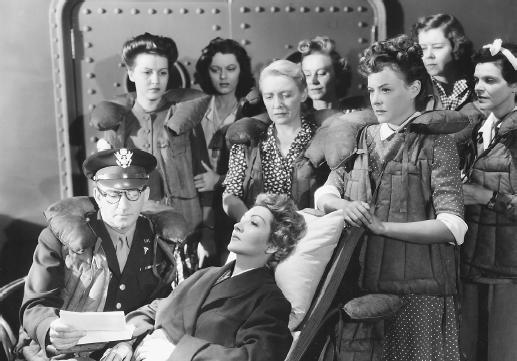
After their freighter is torpedoed a motley cross-section of humanity is stranded on a lifeboat.  The people range from an industrial tycoon (Henry Hull) and a Connie, a ritzy journalist (Tallulah Bankhead) through several crew members (William Bendix, Hume Cronyn, Canada Lee, and John Hodiak) to a nurse and a young mother carrying a dead baby.  Into this volatile mix comes Willy (Walter Slezak), a German survivor of the sinking of the submarine that torpedoed the ship.  The German clearly has a more advanced knowledge of navigation and the others squabble over whether he can be trusted or should even be fed from their scant supplies.  Connie, already unpopular due to her snooty ways, is the only member of the Allied group that can communicate with Willy in his own language.  The situation goes from bad to worse as food and water begin to run out.

I like but don’t love Lifeboat.  The acting is the big plus.  Talullah Bankhead, despite her notorious picadillos on the set, is excellent.  I believe this is the only movie I have seen her in.  I like Slezak more and more each time I see him.  He makes a nasty but affable Nazi. The problem I have is that it’s impossible believe that Connie could have presented herself perfectly groomed and toting a well-stocked handbag and a typewriter into this situation.  Hitchcock had to resort to other lapses of logic to keep his story moving. There’s a bit more propaganda than might have been called for as well.

Lifeboat was nominated for Academy Awards in the following categories:  Best Director; Best Writing, Original Story; and Best Cinematography, Black-and-White (Glen MacWilliams).  I’m surprised it didn’t get a nod for its special effects.

Clip – “The Lord is my Shepard”


Hail the Conquering Hero (1944)

Hail the Conquering Hero
Written and directed by Preston Sturges
1944/USA
Paramount Pictures
Repeat viewing/Netflix rental


[box] Woodrow Lafayette Pershing Truesmith: I knew the Marines could do almost anything, but I never knew they could do anything like this.

Bugsy: You got no idea! [/box]

Eddie Bracken manages to salvage a shred of his dignity in another madcap wartime comedy from writer-director Sturges.

Woodrow Lafayette Pershing Truesmith (Bracken) comes from a long line of Marines including a father who died in battle shortly after he was born.  So Woodrow was devastated when he was discharged from the Marines after only one month for chronic hayfever.  He went to work in a shipyard to hide his shame from his mother.  Woodrow is drowning his sorrows in a bar when six marines drop in, having lost all their money gambling.  He treats them to a round of drinks and tells his sad story.   Sgt. Heppelfinger (William Demerest) gets a brilliant idea to call Woodrow’s mother and tell her he has been discharged for injuries suffered on Guadalcanal.

Woodrow reluctantly returns to his small town with the Marines in tow.  Nobody counted on a mother’s pride and Woodrow is appalled with his huge reception at the station.  All the big wigs have come out to make speeches, three different bands are playing, often at the same time, and Woodrow’s ex-girlfriend Libby (Ella Raines) is there to greet him with a kiss.  The Marines are delighted with this and keep building up Woody’s achievements, over his strenous objections, to the point where he is drafted as the reform candidate for mayor.

It was perhaps a mistake to watch this and The Miracle of Morgan’s Creek back-to-back. Hail the Conquering Hero is funny with some pointed satire of American politics but does not quite reach the heights of hilarity of the other film for me.  Maybe it is the comparative lack of slapstick or the very slightly more serious theme.  Bracken does quite well without a stutter and with a little more oomph than he had as Norval Jones.  (I just notice the man has no forehead or chin!)  I liked the orphan soldier who was so solicitous of Woodrow’s mother’s feelings.   Raines was quite OK but plays her character as a conventional ingenue.

Preston Sturges was nominated for an Academy Award for Best Writing, Original Screenplay for Hail the Conquering Hero, making two nominations in the same category for Sturges in 1944.  The other was for the screenplay of The Miracle on Morgan’s Creek.

Clip


Gaslight (1944)

Gaslight
Directed by George Cukor
Written by John Van Druten, Walter Reisch, and John H. Balderston from the play “Angel Street” by Patrick Hamilton
1944/USA
Metro-Goldwyn-Mayer
Repeat viewing/Netflix rental
#179 of 1001 Movies You Must See Before You Die

[box] Gregory Anton: Jewels are wonderful things. They have a life of their own.[/box]

A gorgeously mounted thriller with an Oscar-winning performance by Ingrid Bergman.

A beautiful opera singer is murdered in her London townhouse.  The body is discovered by her devastated young niece Paula.  Paula (Bergman) is sent to Italy to study singing.  Years pass and the murder is not solved.  Paula’s teacher begins to notice that Paula’s heart is not in her music.  That is because it has been given to suave Continental pianist Gregory Anton (Charles Boyer).  They marry soon thereafter.  Paula, the trauma of her aunt’s death having been overcome by love, is persuaded to move with her new husband to her aunt’s house in London.

Gregory wastes no time in isolating Paula from the rest of the world.  He then begins a course of verbal abuse.  This, coupled with mysterious noises coming from overhead and the flickering of the house’s gaslights, begins to convince Paula that she is really going insane.  On one of the couples rare excursions, policeman Brian Cameron (Joseph Cotten) recognizes Paula from her resemblance to her aunt whom he greatly admired as a boy. Brian opens the closed case file on the aunt’s murder and starts working it.  Meanwhile, things go from bad to worse in the Anton household, Gregory having found an ally in the saucy young housemaid Nancy (Angela Lansbury in her film debut).  With Dame May Whitty as a nosy neighbor.

Ingrid Bergman goes from rosy cheeked enthusiasm to pallid distress during the course of the film, demonstrating a range unexplored in her previous work.  Boyer’s interpretation takes few risks with his suave persona but he does look like someone a woman could plausibly both love and fear.  I preferred Anton Walbrook’s more brutal portrayal of the role in the 1940 British version of the story. Angela Lansbury was fantastic right out of the box, taking every nuance of her rather small part and making her character sleazy, cheeky and totally memorable.  The claustrophobic Victorian sets are a thing of beauty as are Bergman’s costumes.

Ingrid Bergman won the Oscar for Best Actress for Gaslight, which also won the award for Best Art Direction-Interior Decoration, Black-and-White.  The film was nominated in the categories of: Best Picture; Best Actor (Boyer); Best Supporting Actress (Lansbury); Best Writing, Screenplay; and Best Cinematography, Black-and-White (Joseph Ruttenberg).

Trailer (spoilers)

The Miracle of Morgan’s Creek (1944)

The Miracle of Morgan’s Creek
Written and Directed by Preston Sturges
1944/USA
Paramount Pictures
Repeat viewing/Amazon Instant Video


[box] Norval Jones: Ignatz Ra-ra-ratzkywatzky. That – that fits alright.

Trudy Kockenlocker: Oh, phooey! [/box]

Preston Sturges, how do I love thee?  Let me count the ways …

Dippy teenager Trudy Kockenlocker (Betty Hutton) is the peppiest girl in town with a weakness for servicemen.  She lives with her widower father Edmund (William Demerest), the Town Constable, and younger sister Emmy (Diana Lynn), a practical sort who is handy with the wisecracks.  Norval Jones (Eddie Bracken) has been in love with Trudy since grade school.  His greatest regret is that he has been declared 4-F by every branch of the military for high blood pressure.  When Norval gets excited or nervous he sees “spots.”

When her father refuses to let her go to a dance for servicemen about to go overseas, Trudy cons Norval into “taking her to the movies”.  She asks him to wait and then departs in his car to the dance.  She doesn’t return until 8 a.m.  By then she has had a few too many “lemonades”.  When Norval takes her home, her father assumes the worst.

Trudy has only hazy memories of her evening.  Gradually, she dimly remembers getting married to someone with a funny name, something like “Radzkiwadzki”.  She used a false name at the ceremony and has no proof of anything.  Later, a positive pregnancy test gives her all the proof she needs.

Norval may be the answer to her prayers.  But, after he proposes, she can’t go through with it and develops a true affection for him.  Despite everything, Norman is true blue and the two cook up a ridiculous scheme to get a marriage certificate in the names of Trudy Kockenlocker and Ignatz Radzkiwadzki so they can divorce and remarry under their right names.  Needless to say, the course of true love never did run smooth.  Sturges ties the whole thing up with a happy ending that must be seen to be believed.   With Brian Donlevy and Akim Tamiroff reprising their roles as The Governor and The Boss from The Great McGintey in the framing sequences and a host of Sturges regulars.

This movie is one gag after another.  If you didn’t like the last pratfall, wait 10 seconds and you will get a brilliant one-liner.  The performances are superb.  I especially like Eddie Bracken and I’m not big on comic stutterers.  Diana Lynn is a calm of deadpan humor in the hurricane of hysteria that surrounds her.  Sturges might have made better pictures but he never made a funnier one.  Highly recommended.

Preston Sturges was nominated for an Academy Award for Best Writing, Original Screenplay.

Trailer


To Have and Have Not (1943)

To Have and Have Not
Directed by Howard Hawks
Written by Jules Furthman and William Faulkner from the novel by Ernest Hemingway
1943/USA
Warner Bros.
Repeat viewing/Netflix rental
#178 of 1001 Movies You Must See Before You Die

[box] Slim: You know you don’t have to act with me, Steve. You don’t have to say anything, and you don’t have to do anything. Not a thing. Oh, maybe just whistle. You know how to whistle, don’t you, Steve? You just put your lips together and… blow.[/box]

Humphrey Bogart and Lauren Bacall have so much chemistry that it’s easy to forget how good the other elements of this film are.

The lead-in is a lot like that of Casablanca with the map pinpointing the exotic island of Martinique, governed by the Vichy French in the days before the U.S. joined the war. Harry (“Steve”) Morgan (Bogart) hires out his boat for deep-sea fishing excursions.  He is so short on cash that he has to get paid up front for the gas.  His constant companion, whom he cares for like a mother, is goofy drunkard Eddie (Walter Brennan).

The bar owned by Frenchy (Marcel Dalio) seems to be the main gathering place for expatriates on the island.  Into this mileu walks Marie (“Slim”) Browning (Bacall).  Slim is a young woman far from home and also down to her last few dollars.  She might be a waif if it weren’t that she could so clearly take care of her self.  The sparks fly as soon as Slim and Steve set eyes on each other.  Piano player Cricket (Hoagy Carmichael) gets her a job singing at the bar.

Steve’s political alliance is “minding his own business” but when his last customer stiffs him, and wanting to help Slim, he is persuaded by a few thousand francs to smuggle a French resistance fighter on his boat and back to Martinique.  Nothing goes particularly well and Steve has an opportunity to rise to the occasion.

This is a film with many pleasures.  The dialogue is fantastic throughout, not just during the famous love scenes.  I always forget how good Walter Brennan is until the next time I see him.  He is quite versatile when you get down to it, despite his distinctive voice and manner.  It’s fun to watch his little bits of business.  I think we would have been able to guess that the leading man and woman were giddy with new love even if we didn’t know it.  Bogart can’t suppress a silly grin at many points during his fine performance.  I picked out two new favorite parts.  The first is when Hoagy Carmichael sings “The Hong Kong Blues”.  The second is at the very end when Slim does a kind of samba out the door of the bar and Eddie echoes it with a little dance step of his own.  Recommended.

Amazingly, this film was ignored by the Academy at nominations time.  Michael Curtiz remade the Hemingway novel’s story, perhaps with greater fidelity, as  in 1950 with John Garfield and Patricia Neal.  I can recommend that film as well.

Clip – that scene

Moving on to 1944

Hollywood continued to operate under war-time restrictions but movie attendance was never higher.  Film noir became well and truly entrenched in 1944, although nobody thought it was anything special at the time.    The so-called “Havilland decision,” ruled that that Warner Bros. had to release actress Olivia de Havilland after her seven-year contract term expired and could not add time to the term for periods the actress was on suspension.  The ruling proved to be of great benefit to the many actors who took a break from their film work to serve in the Armed Forces.  Barry Fitzgerald became the first – and only – actor to receive two Academy Award nominations, Best Actor and Best Supporting Actor, for the same role in the same year – as St. Dominic’s stubborn, yet loveable old priest Father Fitzgibbon in Going My Way (1944). Swimmer Esther Williams starred in her first Technicolor aqua-musical in the MGM production of Bathing Beauty (1944).

The war dominated U.S. news in 1944 while the home fires burned.  The people decided not to change horses in the middle of the stream and Franklin D. Roosevelt was reelected to a fourth term in November.  On December 18, 1944, the Supreme Court of the United States unanimously declared that loyal citizens of the United States, regardless of cultural descent, could not be detained without cause, paving the way for the release of all internees in January 1945. Tennessee Williams’ play The Glass Menagerie debuted.  Bing Crosby’s “Swinging on a Star” was the number one hit single of the year and went on to win the Academy Award for Best Original Song.  The novel that won the Pulitzer Prize was Journey in the Dark by Martin Flavin.  Smokey the Bear started advising Americans that “Only You Can Prevent Forest Fires.”

Hard fighting lay ahead but the news from the front was mostly good. The Allies invaded France on D-Day, June 6, 1944, in the largest amphibious operation in history, and had liberated Paris by August 25.  General Douglas McArthur made good his promise to return to the Philippines when he waded ashore at Leyte on October 20.

 My working list of films for possible viewing can be found here.  I reviewed several of the 1944 films noir as part of Noir Months 2013 and 2014. They were:  ; ; ; ; and .

Montage of stills from films that won Academy Awards

Montage of stills from all films nominated for Academy Awards

1943 Recap — Ten Favorite Films

day-of-wrath-movie-poster-1943-1020433862

I watched 84 films that were released in 1943, including some shorts, documentaries, and “B” movies that were not reviewed here.  You can see the full list on IMDb here or at Letterboxd, with some short reviews not published on the blog, here. 1943 was the first year in a long time, maybe ever, that I was able to view all the nominees in the major categories (Picture, Director, four Acting categories, and 3 Writing categories).

After a long hiatus, I thought I’d bring back my Top Ten list.  For purposes of this exercise, I have considered both Casablanca and In Which We Serve to be 1942 films.

Here are my favorite films of 1943 in reverse order.

10.  So Proudly We Hail! (directed by Marc Sandrich)

SoProudlyWeHailStill9.  Ossessione (directed by Lucino Visconte)

ossessione

8.  The More the Merrier (directed by George Stevens)

more-the-merrier-159

7.  Hangmen Also Die! (directed by Fritz Lang)

Hangmen-Also-Die-17015_13

6.  The Song of Bernadette (directed by Henry King)

song of bernadette

5.  Shadow of a Doubt (directed by Alfred Hitchcock)

Shadow of a Doubt

4.  The Life and Death of Colonel Blimp (directed by Michael Powell and Emeric Pressburger)

life and death of colonel blimp

3.  The Ox-Bow Incident (directed by William A. Wellman)

oxbow_incident1

2.  Le Corbeau: The Raven (directed by Henri Georges Clouzot)

le-corbeau_359310_39706

1.  Day of Wrath (Directed by Carl Theodor Dryer)

day of wrath


The Man in Grey (1943)

The Man in Grey
Directed by Leslie Arliss
Written by Doreen Montgomery, Margaret Kennedy, and Leslie Arliss
1943/UK
Gainsborough Pictures/The Rank Organization
First viewing/Amazon Instant Video
#172 of 1001 Movies You Must See Before You Die


[box] Lord Rohan: [after Hester bites him. Aroused with excitement] I never thought I’d find a woman with a spirit as willful as mine. You take what you want and the devil with the consequences. So do I![/box]

I certainly could have died without having seen this Regency romance bodice-ripper.

The story is told in flashback after two of the character’s descendents meet at an auction of goods from the Rowan estate.

Lovely, sweet Clarissa (Phyllis Calvert) attends a finishing school in Bath.  She alone befriends the charity student who joins their midst, Hester Shaw (Margaret Lockwood). Hester runs away with some sort of scoundrel and leaves Clarissa for several years.  In the mean time, their families arrange a “suitable” match between Clarissa and the haughty, cruel Lord Rowan (James Mason).  They care nothing for each other, Rowan having married to produce an heir, and live as separately as possible.

Clarissa happens to see an advertisement for a play Hester is appearing in in St. Albans. On her way to the performance, the coach is highjacked by a handsome rascal Peter Rokeby (Stewart Granger) who poses as a highwayman to get the vehicle to stop.  He hitches a ride and steals a kiss at goodbye.  Clarissa is surprised to see that he is playing Othello to Hester’s Desdemona in a very poor offering of that work.  She is so delighted with finding her friend that she offers Hester a job as governess to her young son.  Rowan refuses to hire Hester in that capacity but agrees that she can stay on as companion to Clarissa.

As we have previously learned, Hester is a manipulative, deceiving trollop and was made for the surly Rowan.  They begin an affair but Hester has marriage on her mind.  After another chance meeting between Clarissa and Rokeby, she decides that the best way to get Clarissa out of the picture is to bring her and Rokeby together.  Hester succeeds in kindling the fire of love between the two but is forced to resort to more drastic measures to get rid of Clarissa.

Hollywood “women’s” pictures have nothing on this one for intrigue and innuendo. Indeed, it seems specially designed to appeal to the mildly sado-masochistic fantasies of part of its target audience. I found it rather turgid myself.  If you are coming for Mason, he has been much, much better elsewhere and basically has a supporting role, the meaty stuff having been reserved for the ladies.

This film also has the unfortunate distinction of being the most racially-problematic British film I have seen yet.  Clarissa has a small Black page boy who, though somewhat heroic, is the butt of every one of the rare jokes.

Trailer

The Fallen Sparrow (1943)

The Fallen Sparrowthe-fallen-sparrow-1943
Directed by Richard Wallace
Written by Warren Duff from a novel by Dorothy B. Hughes
1943/USA
RKO Radio Pictures
First viewing/Warner Archive DVD


 John ‘Kit’ McKittrick: [First Lines] [Thinking, not speaking out loud] All right. Go on. Let’s have it. Can you go through with it? Have you got the guts for it? Or have they knocked it out of you? Have they made you yellow?

This early film noir had potential but never quite clicked.  Maureen O’Hara was not cut out to be a femme fatale.

“Kit” McKittrick (John Garfield) has returned from the Spanish Civil War, having suffered Torture by fascists for two years as a POW.  He still has nightmarish flashbacks from his ordeal (and talks to himself a lot).  When he returns to the city after a rest cure, he discovers that his best friend, who rescued him from captivity, fell from the balcony of a high-rise apartment. The police have ruled the case a suicide but Kit is sure it was murder.  He starts a one-man investigation and vendetta.

fallen sparrow

He traces all the people that were at the party the night his friend fell.  They include Dr. Christian Skaas (Walter Slezak), a wheelchair-bound “Norwegian” who delights in describing modern torture techniques, and his son Otto (a blond Hugh Beaumont).  The lovely lady that was sitting with the friend at the time of his fall is Toni Donne (O’Hara), with whom Kit falls in love of course.  As Kit sensed, it develops that he is the prime target of the people who murdered his friend.  Some attempted plot twists follow but in the end it turns out just as one would have predicted.

fallenspar4

I was paying attention and I still had to stretch to write a plot summary.  The story is all over the place.  There are tons of characters whose reason for existence is never made clear.  The goal of the spies either is so slight as not even to qualify as a McGuffin or is not sufficiently developed.

I now understand why the first-person narrator became a film noir staple.  This film conveys the protagonist’s thoughts through several interior monologues addressed to the character himself (see quote) and it just doesn’t work.  Much better to allow the character to speak to the audience.

The Fallen Sparrow was nominated for an Academy Award for Best Music, Scoring of a Dramatic or Comedy Picture (Roy Webb and C. Bakaleinikoff).

Best Cartoon Nominees of 1943

I like to save some of the best for last..  Here again are the Academy Award Nominees for Best Short Feature, Cartoon, for 1943.  Enjoy!

Yankee Doodle Mouse – The winner!
Director: Joseph Barbera and William Hanna
Metro-Goldwyn Mayer

Tom and Jerry do battle with ordinary household items like lightbulbs, eggs, a cheese grater, … and dynamite!


The Dizzy Acrobat 
Walter Lantz Productions

Woody Woodpecker creates havoc at a circus.


Can be seen here (dubbed into Portuguese but give it a try, it’s mostly sight gags):

The 500 Hats of Bartholomew Cubbins
Directed by George Pal
Paramount Pictures

The Dr. Seuss story told with Puppetoons.

Greetings Bait
Directed by Friz Freleng
Warner Bros.

This looks like it would be pretty good but I can’t find a full-lenghth version.  I don’t get the connection with a draft notice.


Clip

Imagination
Directed by Bob Wickersham
Columbia Pictures Corporation/Screen Gems

A little girl’s ragdolls defeat a roly-poly masher in her imagination.

Reason and Emotion
Walt Disney Studios

Disney explains that, in war time, we all need to get our emotions under control.  An example is made of Nazi Germany where Hitler played on the people’s emotions.

Cartoon follows introduction by Leonard Maltin