Les visiteurs du soir (1942)

Les visiteurs du soir (“The Devil’s Envoys”)visiteurs du soir poster
Directed by Michel Carné
Written by Jacques Prevert and Pierre Laroche
1942/France
Productions André Paulvé

First viewing/Hulu Plus


This will surprise you, but I don’t know if I had a vocation – whether I was really mad about the cinema. When I thought of working on films, I thought of being an assistant director or set manager. Or, in moments of great vanity, a production manager. But I didn’t think of directing at the time. – Michel Carné

I waited in vain for this movie to make a point.

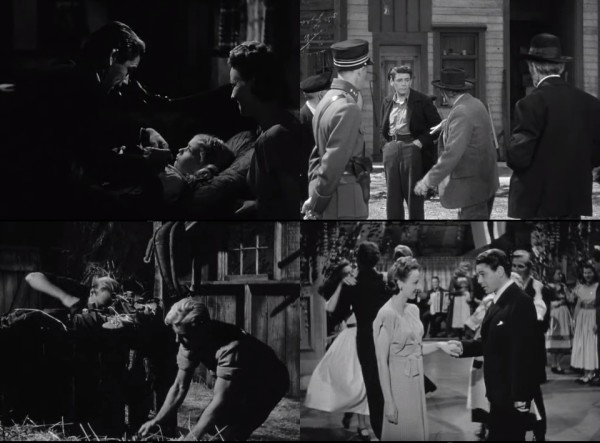
The story is set in the 15th Century.  Minstrels Gilles (Alain Cuny) and Dominique (Arletty) have been sent out into the world by the Devil (Jules Berry) to sow despair.  In this case, as so many others, the Devil’s strategy is to make people fall in love.  The ministrels arrive at a feast celebrating the upcoming marriage of Renaud and Anne.  Gilles easily conquers the pure Anne’s heart.  Dominique, after revealing her disguise as a boy, goes after both Renaud and Anne’s father.

visiteurs-du-soir-1942 1

Dominique is wildly successful.  However, Anne is so truly in love that she wins over Gilles to her side.  The Devil is concerned enough that he makes a personal visit to further screw things up.

visiteurs-du-soir 2

This movie is two hours along and I felt every minute of it.  If the message is that love conquers all, and I’m not 100% sure it was, it took Carne much too long to get there.  The screen comes alive whenever Berry appears on it.  Unfortunately he doesn’t show up until the last third of the movie.  Until then, there are way too many scenes of long meaningful glances between the lovers.

The film was hugely popular in France on release, in large part because people saw it as an allegory of France under occupation with the Devil representing Hitler and the lovers representing the still beating heart of France.  Carne denied that this was his intention until his death.

Trailer (no subtitles)

Saludos Amigos (1942)

Saludos Amigos
Directed by Wilfred Jackson, Jack Kinney, Hamilton Luske, and Bill Roberts
Written by Homer Brightman, Ralph Wright, et al
1942/USA
Walt Disney Studios
Repeat viewing/Netflix rental

[box] [first lines] Narrator: Here’s an unusual expedition: artists, musicians and writers setting out for a trip through Latin America to find new personalities, music and dances for their cartoon films. So, adios, Hollywood, and saludos, amigos.[/box]

Made to boost the U.S. Good Neighbor Policy during World War II, this shortish feature cartoon is a kind of travelogue of South America with some funny bits by Disney characters to liven things up.

This is a compilation of several short cartoons that were originally intended to be released separately, linked by live footage that gives information about each country.  The cartoon segments are:  1) Donald Duck takes a perilous journey by llama in the Peruvian Andes; 2) Pedro, the baby airplane, fills in for his parents to take the mail from Chile to Argentina over the Andes (a la Only Angels Have Wings); 3)  Cowboy Goofy is transformed into a gaucho and transported to the Argentinian pampas; 4) Joe Carioca the parrot shows Donald Duck around Rio de Janeiro.  The film ends with a Fantasia-like animation set to the song “Brasil”.

I’ve spent a bit of time in South America and really enjoyed this film.  It could have gone so wrong but ended up hitting just the right note, I thought.  If “Brasil” had been written for this movie, it would have received my vote for best song.

Charles Wolcott and Ned Washington were nominated for an Academy Award for their original song “Saludos Amigos”.  The film was also nominated for Best Sound, Recording and Best Music, Scoring of a Musical Picture.

Clip – “Brasil”

Crossroads (1942)

Crossroads
Directed by Jack Conway
Written by Guy Trosper; John H. Kafka and Howard Emmett Rogers
1942/USA
Metro-Goldwyn-Mayer

First viewing/Warner Archive DVD

[box] Any girl can be glamorous. All you have to do is stand still and look stupid. — Hedy Lamarr[/box]

[box] “It’s about time”, in reference to her 1996 Electriconic Frontier Foundation award for the invention (with composer George Anthiel) of frequency hopping, a technology now widely used in cellular phones  — Hedy Lamarr[/box]

This is a nice little noirish thriller with some beautiful atmospheric cinematography by Joseph Ruttenberg.

Years ago, French diplomat David Talbot (William Powell) received severe head injuries in a train crash that left him with total amnesia.  After 13 years of treatment by neurologist/psychiatrist Dr. Tessier (Felix Bressart), everything is looking up for Talbot.  He has been married for just three months to the ravishing Lucienne (Hedy Lamarr) and looks certain to get an appointment as French ambassador to Brazil.

Then out of nowhere, a man appears claiming that Talbot is really Jean Pelletier and owes him one million francs.  At Talbot’s trial for this debt, Pelletier is revealed to have been a murderer and thief.  The man’s claim is backed by a Mme. Allain from Pelletier’s past (Claire Trevor).  However, at the last minute, Henri Sarrou (Basil Rathbone) saves the day by testifying that Pelletier died in the train wreck.

But the trial testimony is but a prelude to an elaborate and ruthless blackmailing campaign by Sarrou, assisted by Mme. Alland who claims to have been Pelletier’s mistress.  The rest of the story details Talbot’s efforts to keep his wife in the dark while dealing with the increasingly dire threats coming from Sarrou.

 The ending is a bit too abrupt and pat but the film is an enjoyable watch with a particularly menacing performance by Rathbone.  The cinematography is the equal of anything done by the multiple Academy Award winning Ruttenberg.

Crossroads

Sherlock Holmes and the Voice of Terror (1942)

Sherlock Holmes and the Voice of Terror
Directed by John Rawlins
Written by Lynn Riggs, John Bright, and Robert Hardy Andrews based on the story “His Last Bow” by Arthur Conan Doyle
1942/USA
Universal Pictures
First viewing/Netflix rental

[box] [first lines] Voice of Terror: [off-screen] Germany broadcasting. Germany broadcasting. People of Britain, greetings from the Third Reich. This is the voice you have learned to fear. This is the Voice of Terror. Again, we bring you disaster: crushing, humiliating disaster. It is folly to stand against the mighty wrath of the Fuhrer. Do you need more testimony of his invincible might to bring you to your knees? …[/box]

This is an OK war-time entry in the Sherlock Holmes series.

“The Voice of Terror” emerges on the radio from some unknown source to predict with unerring accuracy calamities to be visited upon the British by the Nazis.   The “Intelligence Inner Council” calls in Holmes (Basil Rathbone) to root out the culprits.  With the help of Watson (Nigel Bruce) and a patriotic London low-lifer (Evelyn Ankers), Holmes gets to work but not fast enough to satisfy naysayers on the council.  When “The Voice” uncharacteristically predicts an attack on the Scottish coast in the future, all begin to fear that an invasion of the island is at stake.  With Reginald Denny as a council member and Thomas Gomez as a Fifth Columnist.

I thought this was one of the better entries in the Rathbone-Bruce Sherlock Holmes cycle, though that doesn’t make it a must see except for fans.


Best Original Song Nominees of 1942

Winding down on 1942, I give you another collection of different versions of the Best Original Song Oscar nominees from the year.

White Christmas” by Irving Berlin from Holiday Inn

from the movie White Christmas (1954)

Alway in My Heart” by Ernesto Luacona and Kim Gannon from Always in My Heart

Walter Huston singing the song in the film

Dearly Beloved” by Jerome Kern and Johnny Mercer from You Were Never Lovelier

1942 Billboard charting version sung by Johnnie Johnston (no video)

How About You?” by Burton Lane and Ralph Freed from Babes on Broadway

Frank Sinatra version (no video) – so good!

It Seems I’ve Heard That Song Before” by Julie Styne and Sammy Cahn from Youth on Parade

as sung in the film, dubbed by Margaret Whiting

I’ve Got a Gal in Kalamazoo” by Harry Warren and Mack Gordon from Orchestra Wives

As performed in the film by the Glen Miller Orchestra with Tex Beneke (Betty Hutton with the Modernnaires), stick around for some fantastic dancing at the end by The Nicholas Brothers

Love Is a Song” by Frank Churcill and Larry Morey from Bambi

from the film

Pennies for Peppino” by Edward Ward, Chet Forrest, and Bob Wright from Flying with Music

[Coming up empty on this one!]

Pig Foot Pete” by Gene de Paul and Don Raye from Hellzapoppin

sung by Martha Raye (no audio)

IMDb notes: This nomination is a mystery. Both the nominations list and the program from the Awards dinner list the song as being from ‘Hellzapoppin’,’ a 1942 release for Awards purposes. The song does not appear in that film, but did appear in Keep ‘Em Flying, a 1941 release from the same production company and studio, and was therefore ineligible for a 1942 nomination.

There’s a Breeze from Lake Louise” by Harry Revel and Mort Greene from The Mayor of 44th Street

from the film

The Spoilers (1942)

The Spoilers
Directed by Ray Enright
Written by Lawrence Hazard and Tom Reed from a novel by Rex Beach
1942/USA
Universal Pictures/Frank Lloyd Productions/Charles K. Feldman Group
First viewing/Netflix rental

[box] Cherry Malotte: What you win, you can keep.[/box]

This solid, entertaining Western was the most successful of the five movies adopting the novel about the Alaska Gold Rush.

The story is set in 1900 Nome, Alaska.  Cherry Malotte (Marlene Dietrich) runs the local saloon.  We learn early on that outsiders have started to make false claims on the informally organized mines.

Cherry is awaiting the return of her lover, miner Roy Glenniston (John Wayne),  from Seattle and is mightily displeased to see him on the arm of Helen Chester (Margaret Lindsay).  She sets out to make him jealous by cozying up to “Gold Commissioner” Alex McNamara (Randolph Scott).

Helen has been traveling with her uncle, a judge who has come to adjudicate the claims.  Roy’s partner (Harry Carey) wants to fight but the judge persuades Roy to let the law take its course.  But the law is being administered by a bunch of crooks and Roy is at last forced to save the day, helped in the end by Cherry. With Richard Barthelmess in one of his last appearances.

It’s not so much the story but the way it is told that makes this so enjoyable.  Dietrich keeps the exposition humming along with plenty of double entendres and it builds nicely to a well-choreographed fight sequence.  It’s interesting to see Randolph Scott as a villain, paving the way for the morally ambiguous Western protagonists he played later in his career.

The Spoilers was nominated for an Academy Award for Best Art Direction – Interior Decoration, Black and White.

Trailer

Star-Spangled Rhythm (1942)

Star-Spangled Rhythm
Directed by George Marshall
Written by Melvin Frank, George S. Kaufman, Norman Panama, Arthur A. Ross, and Henry Tugend
1942/USA
Paramount Pictures
First viewing/Bob Hope Tribute Collection DVD


[box] [In front of Old Glory and a plaster Mt. Rushmore] Bing Crosby: [singing] Germans, Italians, and Japs / Can’t kick us off our Rand-McNally maps.[/box]

This is one of those compilation movies that tries to weave a bunch of unrelated acts around a central story.  These are usually only moderately successful, as is this one, despite its cast of Paramount stars and songs by Harold Arlen and Johnny Mercer.

The framing story involves a sailor, Johnny Webster (Eddie Bracken), who is on shore leave in Hollywood.  His father, William ‘Bronco Billy’ Webster (Victor Moore), is a security guard at Paramount studio who has boasted of being head of the studio.  Telephone operator Polly Judson (Betty Hutton) is in on the scheme and has been writing to the sailor.  The couple has fallen in love via these letters.  Polly and Billy conspire to spirit producer B.G. DeSoto out of his office and fool Johnny and his buddies.  They get deeper and deeper into hot water until Billy ends up promising to host a big variety show for the whole shipful of sailors.

The show features musical numbers by some of Paramounts biggest stars including Bing Crosby (singing “Old Glory”); Dick Powell and Mary Martin (“Hit the Road to Dreamland”); Eddie ‘Rochester’ Anderson (“Sharp as a Tack”) and more.  Johnny Johnston sings to dream girl Vera Zorina as she dances to “That Old Black Magic”.  Comedy sketches feature Alan Ladd, Franchot Tone, Fred McMurray, Ray Milland, William Bendix, Susan Hayward, Marjorie Reynolds, and many more players.  Bob Hope emcees the whole thing.

Paulette Godard, Dorothy Lamour and Veronica Lake sing “A Sweater, a Sarong, and a Peek-a-Boo Bang”

The singing and dancing is more successful than the mostly sophmoric comedy.  This movie hasn’t aged particularly well but does give viewers the opportunity to see many second-tier stars of the era gathered in one place.

Johnny Mercer and Harold Arlen were nominated for an Oscar for the song “That Old Magic”.  Star-Spangled Rhythm was also nominated for Best Music, Original Scoring of a Musical Picture.

Trailer – good also for a catalog of many the stars that were under contract at Paramount in 1942

Commandos Strike at Dawn (1942)

Commandos Strike at Dawncommandos strike at dawn poster
Directed by John Farrow
Written by Irwin Shaw from a story by C.S. Forester
1942/USA
Columbia Pictures Corporation
First viewing/Amazon Instant Video


[box] Erik Toresen: …I’ve lived a quiet life. The Germans have not lived quiet lives. We must learn from them how to become gangsters, thugs, useful with knife, dynamite, poison![/box]

I was not looking forward to watching a combat movie with Paul Muni.  I was pleasantly surprised.

Eric Toreson (Muni) is a quiet, scholarly man who does some kind of fisheries research in his native Norwegian coastal village.  He is a widower who lives with his mother (Lillian Gish) and is raising his small daughter.  Lately, a British admiral (Sir Cedric Hardwicke) and his daughter Judith (Anna Lee) have been holidaying in the village.  Eric has fallen in love with Judith.  We see the peaceful village life and traditions of the people through a wedding that Eric and Judith attend.

commandos strike at dawn 3

The British return home before Erik works up the courage to ask Judith to marry him.  Then the Nazis arrive. They say their only purpose is to free the Norwegians from the “British invador” but soon reveal their utter brutality. All but the local intellectual (Ray Collins) initially try to cooperate.  Eventually, even Eric comes to believe that the only answer is to adopt the Nazi philosophy of “kill or be killed.”

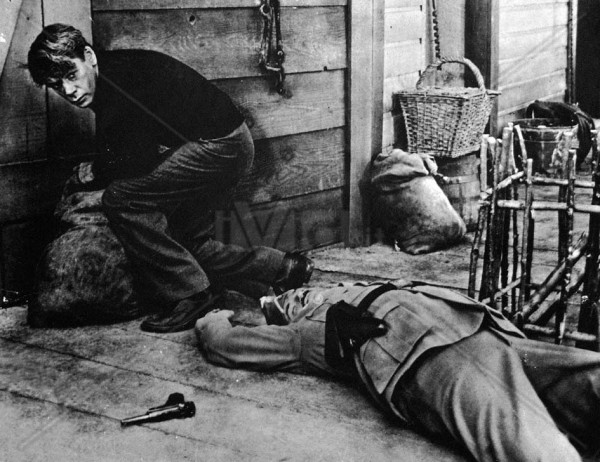
When Eric is rightly suspected of killing the German colonel, he flees to England and tells them that the Germans are building an aerodrome near the village.  He returns to guide British commandos to the spot.

commandos strike at dawn 2

This is so much more than a combat picture.  Most of it is scenes of life under the Nazis in Norway.  The fantastic cast brings the situation to life.  This well made in every respect and reminded me more of the British war pictures of this year than of the American ones I have seen up until now.

Commandos Strike at Dawn was nominated for Best Music, Original Scoring of a Dramatic or Comedy Picture.

Trailer

Rain Man (1988)

Rain Man
Directed by Barry Levinson
Ronald Bass and Barry Morrow
1988/USA
United Artists/The Guber-Peters Company/Star Partners II Ltd./Mirage Enterprises

Repeat viewing/Amazon Instant Video
#820 of 1001 Movies You Must See Before You Die

[box] Charlie: What you have to understand is, four days ago he was only my brother in name. And this morning we had pancakes.[/box]

This movie made me tear up.  I thoroughly enjoyed it.

Charlie Bennett (Tom Cruise) is a self-absorbed young wheeler-dealer.  As the story begins, his car dealership is in deep trouble with some clients and a lender.  The fast-talking Charlie is an expert at putting people off with lies.  He takes a break from his woes with a road trip with his Italian girlfriend Susanna (Valeria Golino).   He’s less good at having an actual conversation.  In the midst of the drive, Charlie learns that his father has died. Susanna accompanies him to the funeral in Cincinnati.

Charlie is a bundle of resentment.  His mother died when he was too young to remember her.  For years, he has held on to anger with his father for a) not letting him drive the father’s prized convertible, b) reporting the car as stolen when Charlie drove it any way, and c) letting the police hold him in jail.  The two had been estranged since Charlie left home at 16 because of that incident.  After the funeral, Charlie learns that all his father has left him is that car and his cherished rose bushes.  The house and dad’s three million dollar estate have been left in trust to an unnamed beneficiary.

Soon enough, Charlie traces the trustee to a home for mentally challenged adults.  By chance, he is brought into contact with his autistic savant brother Raymond (Dustin Hoffman).  He had never before known he had a brother.  He decides to basically kidnap Raymond to finagle half of the inheritance.

Charlie is totally unprepared for the demands of caring for an autistic person.  He has a hard time putting up with Raymond’s repetitive behavior, need for strict routines, and tantrums when confronted with change or overstimulated.  Nevertheless, Charlie is determined to milk the situation for what it is worth.  His behavior so disgusts Susanna that she leaves him to cope with Raymond  on his own.

The rest of the story follows the pair’s long car journey from Cincinnati to Los Angeles and the gradual blossoming of Charlie’s connection with his brother and with his own past and emotions.

Dustin Hoffman won the Oscar but I thought Tom Cruise was his equal.  Cruise is never better than when he plays this kind of hustler.  The script is intelligent and, while the whole project screams Movie of the Week, manages to avoid many of the more cringe-worthy cliches that plague this genre. There’s not enough uplifting movies out there.  This is an excellent one.

Rain Man won Academy Awards for Best Picture, Best Director, Best Actor (Hoffman), and Best Writing, Screenplay Written Directly for the Screen.  It was nominated in the categories of: Best Cinematography (John Seale); Best Art Direction-Set Decoration; Best Film Editing; and Best Music, Original Score (Hans Zimmer).

Trailer


Flying Tigers (1942)

Flying Tigers
Directed by David Miller
Written by Kenneth Garnet and Barry Trivers
1942/USA
Republic Pictures
First viewing/Amazon Instant Video


[box]”Since the Flying Tigers first spread their wings in the skies above China, the enemy learned to fear the intrepid spirit they have displayed in face of his superior numbers. They have become the symbol of the invincible strength of the forces now upholding the cause of justice and humanity. The Chinese people will preserve forever the memory of their glorious achievements.” ‘Generalissimo Chiang Kai-Shek’ – opening title card[/box]

This not a bad movie but come prepared for a representative collection of tropes from every other flight combat movie out there, with some from Only Angels Have Wings thrown in for good measure.

The movie is the story of the all-volunteer Flying Tigers squadron that fought missions against the Japanese in China in 1941-42.  It was thus made almost contemporaneously with these activities.

Capt. Jim Gordon (John Wayne) commands the squadron.  He is well respected by his men and loved by nurse Brooke Elliot.  As the movie begins, we see the carnage wreaked on little children in a refugee shelter by Japanese bombers.  The vastly outnumbered fighters of The Flying Tigers wipe out the bombers but not without the loss of a rookie pilot who, however, heroically lands his plane before dying.  Gordon has a whole collection of the personal effects of these heroes in his desk drawer.

He goes to Rangoon to pick up supplies and replacement pilots.  One he brings back is his old buddy ace pilot Woody Jason (John Carroll).  Woody is in it strictly for the money — the men are paid per mission and per “kill”.  His avarice causes him to take a bunch of unjustified risks that make him unpopular with the rest of the pilots.  The final straw comes when he arrives too late for a mission he was supposed to back Gordon on and all because he was out with Gordon’s girl.  Will the Japanese attack on Pearl Harbor show Woody the error of his ways?

The movie moves along at a good clip and there are lots of exciting flight sequences.  Evidently, pilots grounded because of their eyesight, disgraced pilots seeking redemption, and sacrificial lambs had become de rigeur for this kind of movie by this early date.  I especially enjoyed seeing Anna Lee and look forward to more of her.  Wayne is awfully good too.

Flying Tigers was one of the highest grossing movies of 1942 and broke all box office records for a film made by Republic Pictures.

The film was nominated for Academy Awards for Best Sound, Recording; Best Effects, Special Effects and Best Music, Scoring of a Dramatic or Comedy Picture (Victor Young).

Trailer