The Harvey Girls (1946)

The Harvey Girls
Directed by George Sidney
Written by Edmund Beloin, Nathaniel Curtis et al from a novel by Samuel Hopkins Adams
1946/USA
Metro-Goldwyn-Mayer
First viewing/Netflix rental


[box] H.H. Hartsey: Now wait a minute Ms. Bradley. I wanna marry ya, I wanna marry ya somethin’ like all get-out. I wanna marry ya somethin’ awful ma’amm. But please ma’am, please say no.[/box]

The best part is in all those clips. Who would not thrill to Judy Garland singing “On the Atchison, Topeka, and the Santa Fe” with a cast of thousands? Sadly, the rest of the movie, while pleasant enough, never reaches that height.

An opening title informs us that Fred Harvey and his train station restaurants, with their “Harvey Girl” waitresses, civilized the Wild West.  Our story begins as a bevy of these beauties heads to Sandrock by train to open Harvey’s latest.  Traveling with them is the feisty Susan Bradley (Garland) who is going to Sandrock to become a mail order bride. When she arrives, she discovers that her intended is a middle-aged rube (Chill Wills) whose letters were ghost written by saloon owner Ned Trent (John Hodiak).  Susan gives Ned a piece of her mind and then becomes a Harvey Girl herself.

The Sandrock powers that be have no interest in seeing the town civilized.  In addition, music hall headliner Em (Angela Lansbury) is mighty jealous over any rival for the attentions of her beloved Ned.  Efforts to frighten the girls away are followed by more serious threats. But the girls are up to the the challenge.  With Marjorie Main as a cook, Preston Foster as a baddie, Cyd Charisse as a Harvey Girl and Ray Bolger as the town’s new blacksmith.

This is an entertaining way to spend a couple of hours but the songs, other than the Oscar winner, and laughs are not such as to make it one of the top musicals.  The DVD I rented had a very interesting commentary by director George Sidney.  The story spent many years in pre-production as a straight Western intended for Clark Gable.

Harry Warren and John Mercer won the Academy Award for Best Original Song for “On the Atchison, Topeka, and the Santa Fe”.  The Harvey Girls was nominated for Best Music, Scoring of a Musical Picture.


Trailer


Anna and the King of Siam (1946)

Anna and the King of Siam
Directed by John Cromwell
Written by Talbot Jennings and Sally Benson from the biography by Margaret Landon
1946/USA
Twentieth Century Fox Film Corporation
First viewing/Netflix rental


[box] Kralahome: Mem, I cannot promise that it will ever be easy for you. We have proverb here: “Go up by land, and you meet tiger. Go down by water, and you meet crocodile.” But for you, it will be place to put your life.[/box]

I can’t imagine the filmmakers realized just what an effective critique of colonialism they were making. Nonetheless, this is a solid, entertaining telling of Anna Leonowen’s fictionalization of her own life.

The setting is 1862 Bangkok. Anna Owens (Irene Dunne) has been hired to teach English to the many children of King Mongut (Rex Harrison).  On arrival, she asks to be taken to the house the King promised her but  Prime Minister (Lee J. Cobb) informs her she is to live within the palace.  This turns out to be private quarters in the harem. Anna is unable to meet with the King or start teaching for several weeks.  The King continues to refuse her the house.

When Anna finally does begin teaching, she wages all out war via songs and sayings taught to her pupils (“There’s No Place Like Home”, etc.) until she gets her way.  This is not successful until she also begins assisting the King with his correspondence with Westerners.  Having proved her point, she prepares to leave but the Prime Minister persuades her that the King, who is struggling to preserve Siam’s independence, needs her counsel.

Anna becomes the beloved teacher of not only the King’s children but his wives.  She becomes friendly with first wife Lady Tiang (Gale Sondergaard), the mother of Crown Prince Chulalongkorn.  She spars with the feisty Tuptim (Linda Darnell), current favorite of the King’s many wives.  Anna is unaware that Tuptim was ripped from her beloved fiancee as a gift by her father to the King and is miserable.

The highlight of Anna’s career in Siam is her whirlwind success in Europeanizing the court in time for a visit by the British Counsel General from Singapore.  Siam recently lost Cambodia to the French and the King fears losing is whole kingdom to the British unless he can establish he is not a “barbarian”.  She dresses all the wives in the latest fashions, teaches the King to eat with a knife and fork, and convinces him to widen the gathering to include representatives of other European nations.   The event is a smashing success.

But, when Tuptim escapes the harem to join her lover in a monastery, the King meets out the traditional punishment and only a personal tragedy can prevent Anna from fleeing in horror.

In the wake of the devastation following WWII,  Americans were questioning the whole idea of Empire.  The film reflects this in Anna’s many speeches about individual freedom, rule of law, and national independence.  At the same time, however, the story contains all the worst aspects of colonialism.  Anna has picked up the White Man’s Burden of civilizing the ignorant and showing them the light.    She makes little to no effort to understand the Thais ancient culture or beliefs.

That said, I liked the film.  I was a bit worried about Rex Harrison but I needn’t have been.  In a part that so easily could have been a caricature, he never once steps over the line. He and Dunne have excellent chemistry and their scenes sparkle.  Lee J. Cobb is the least likely looking Asian since Walter Connelly in The Good Earth.  Poor Linda Darnell. She was Zanuck’s favorite beauty and kept being cast as ingenues or in sex pot roles that simply do not suit her, ignoring her true flair for comedy and cynical bad girls.

The DVD I rented contained an excellent biographical documentary on Anna Leonowens, a woman who continually reinvented herself to get her gig in Siam and later to sell books.  She was a young widow without family in a man’s world.  You can’t help admiring her pluck, really.

Anna and the King of Siam won Academy Awards for Best Cinematography, Black-and-White (Arthur C. Miller) and Best Art Direction-Interior Decoration, Black-and-White.  It was nominated for Best Actress in a Supporting Role (Sondergaard); Best Writing, Screenplay; and Best Music, Scoring of a Dramatic or Comedy Picture (Bernard Hermann – beautiful evocative score).

Clip

The Yearling (1946)

The Yearling
Directed by Clarence Brown
Written by Paul Osborn from the novel by Marjorie Kinnan Rawlings
1946/USA
Metro-Goldwyn-Mayer
First viewing/Amazon Instant

[box] Penny Baxter: [on the ocasion of the burial of Fodderwing] Oh Lord. Almighty God. It ain’t for us ignorant mortals to say what’s right and what’s wrong. Was any one of us to be doin’ of it, we’d not of bring this poor boy into the world a cripple, and his mind teched. We’d of bring him in straight and tall like his brothers, fitten to live and work and do. But in a way o’ speakin’, Lord, you done made it up to him. You give him a way with the wild creatures[/box]

I spent most of the movie thinking it was way too folksy for me. I ended up crying like a baby by the end anyway.

Eleven-year-old Jody Baxter (Claude Jarman, Jr.) lives with his kind but rugged father Penny (Gregory Peck) and no-nonsence mother Orry (Jane Wyman) in pioneer Florida. Father and son are close and enjoy working and hunting together.  Mom lost all her other children to diseases and, as a result, is distant and rather hard.  An only child, Jody longs to adopt a forest creature as a pet.  Mom is adamantly against this idea and Penny backs her up.

The day comes when Penny is bitten by a rattlesnake.  He shoots a doe in the belief that its organs will help draw the poison out.  Jody runs for help.  When Penny recovers from this close brush with death, Jody begs to adopt the doe’s baby fawn in gratitude for the sacrifice of its mother’s life.  Although Orry is concerned about the amount of milk the animal will take from the family, Penny agrees and tells Orry he doesn’t want to hear a word out of her about it.

Jody is inseparable from the fawn whom he names Flag.  The year cycles around again and it is time for planting.  Penny has decided to try a cash crop of tobacco to get the money to dig a well so Orry won’t have to walk a mile for water. The whole family pitches in with all the hard labor this involves.  Meanwhile, Flag has grown and developed an appetite for greens.  With Chill Wills, Margaret Wycherly, Henry Travers, and Forrest Tucker as friends and neighbors.

This is heavy on the paternal folk wisdom, all in dialect that sounds pretty funny coming out of the mouth of Gregory Peck.  But it contains so many lyrical moments that somehow I got caught up in it anyway.  Jane Wyman was the standout for me.  She is not afraid to make Orry generally unsympathetic with beautiful flashes of the woman within.  The ending might wring tears from a stone.  Its work was easy on a soft touch like me.

The Yearling won Academy Awards for Best Cinematography, Color and Best Art Direction-Interior Decoration, Color.  It was nominated in the categories of: Best Picture; Best Actor; Best Actress; Best Director and Best Film Editing.

Kiddie matinee trailer


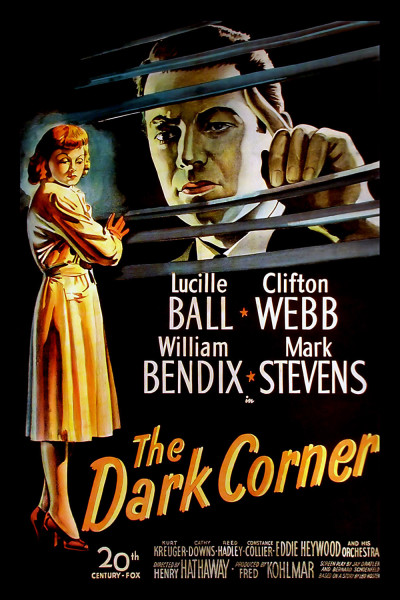
The Dark Corner (1946)

The Dark Corner the_dark_corner
Directed by Henry Hathaway
Written by Jay Dratler and Bernard C. Schoenfeld; story by Leo Rosten
1946/USA
Twentieth Century Fox Film Corporation
First viewing/Netflix rental

Hardy Cathcart: Lovers of beauty never haggle over price, Tony.

Pretty nifty film noir with a haunted private eye hero.  Lucille Ball fills the gap left by the missing femme fatal with her fine portrayal of his loyal secretary.

P.I. Brad Galt (Mark Stevens) is trying to start anew in New York City after mysterious circumstances caused him to leave San Francisco.  His secretary Kathleen (Ball) clearly has a big crush on him, motivated in part by the urge to mother his troubled soul.

But soon Mark is being followed by a man in a white suit (William Bendix).  When caught, the man tells him he was hired by Mark’s former associate Anthony Jardine (Kurt Krueger). Mark had to fire Jardine for his womanizing, blackmailing ways back in San Francisco.  Mark’s life is apparently in danger from this quarter.

dark corner 1

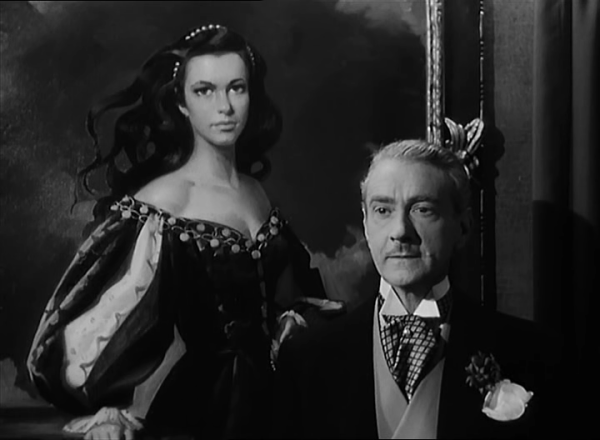
In the meantime, we follow the story of art collector Hardy Cathcart (Clifton Webb).  He dotes on his trophy wife, the much younger Mari (Cathy Downs), who reminded him of the woman in his most treasured portrait.  Mari is in love with the slimey Jardine.  Push comes to shove and Brad finds himself neatly framed for Jardine’s murder.  He knows far less than the audience at this point and must scramble to discover the murderer and the motive.

dark corner 3

This thing is supposed to be a Raphael!

Here we have another sterling performance by Clifton Webb in a part that is not so different from his role in Laura, perhaps a bit more restrained.  Though Lucille Ball reportedly hated everything about making this movie (MGM loaned her out as “punishment”) for trying to get out of her contract), none of that shows in her performance.  She is very appealing as the smart, practical secretary that bosses dream of.   The writers gave her and the other actors the snappy dialogue worthy of them and the story.   It’s a thoroughly enjoyable movie.

Trailer

The Jolson Story (1946)

The Jolson Story
Directed by Alfred E. Green
Written by Harry Chandlee, Stephen Longstreet, and Andrew Solt
1946/USA
Columbia Pictures Corporation
First viewing/Netflix rental


[box] I’ll tell you when I’m going to play the Palace. That’s when Eddie Cantor and George Burns and Groucho Marx and Jack Benny are on the bill. I’m going to buy out the whole house, and sit in the middle of the orchestra and say, ‘Slaves, entertain the king!’ — Al Jolson[/box]

I don’t much care for Al Jolson so it comes as no surprise that I was not crazy about this musical biopic.

Little Asa Yoelson gets his start singing in the choir led by his father, a cantor at the synagogue.  At a very young age, he is obsessed with show business and spends much of his time at burlesque houses.  He is discovered by burlesque comedian Steve Martin (William Demerest) when he is the only one to pipe up when Martin tries to get the audience to sing along.  Martin puts the spotlight on him and a star is born.  Asa’s parents realize it is futile to resist and allow their boy to go on tour.  His name is promptly changed to Al Jolson.

Right from the start, Jolson (Larry Parks) will do anything to get attention and particularly likes to sing with the house lights up so he can see the audience.  After an awkward period when his voice is changing, he goes on for a black-faced artist and is such a hit that he is hired to feature in a big-budget minstrel show.  Martin becomes his manager. But Jolson is not satisfied for long singing the old standards and yearns to sing in the new jazz style.  He eventually becomes a Broadway star doing so.

[box] [on why she was not portrayed in The Jolson Story] I don’t like him. I don’t want my children to grow up someday and maybe see the picture and know I was married to a man like that. — Ruby Keeler[/box]

He meets up-and-coming dancer Julie Benson (Evelyn Keyes) and proposes within a few hours.  She realizes resistance is futile soon enough and they marry.  Their lives are totally taken up with hard work in the theater.   With the development of sound technology, Hollywood beckons to Al.  He promises Julie he will be away only for long enough to make The Jazz Singer.  Weeks turn into months and he lures Julie out to join him promising her stardom as well.  But the limelight that is like a tonic to Al is draining to Julie.  She wants to call it quits but he agrees to retire to a house in the country.  Life goes on placidly enough until Al gets the singing bug again at his parents’ anniversary party.

I don’t “get” Al Jolson.  I don’t particularly like his singing style, the black face, or his personality.  Yet  he was the most popular performer in America for many years in the 20’s and 30’s.  His fans will probably love this movie.  Jolson himself dubbed all of Larry Parks’s singing, so this is the real deal.  Non-fans might enjoy seeing Demarest doing a burlesque comedy song-and-dance routine but that doesn’t last long.  For the rest of the film, he is his enjoyable standard self.

The Jolson Story won Oscars for Best Sound, Recording and Best Music, Scoring of a Musical Picture.  It was nominated in the categories of:  Best Actor; Best Supporting Actor (Demerest); Best Cinematography (Color) and Best Film Editing.

Clip – “The Anniversary Song” – dubbed by Al Johnson


Nobody Lives Forever (1946)

Nobody Lives Forever
Directed by Jean Negulesco
Written by W.R. Burnett
1946/USA
Warner Bros.
First viewing/Amazon Instant

[box] Nick Blake: I don’t wanna get rough with you unless I have to![/box]

Average noir with good performances by John Garfield, Geraldine Fitzgerald, Walter Brennan and George Coulouris.

Nick Blake (Garfield) is honorably discharged after a war wound and returns to New York. Al (George Tobias), his buddy from his days as a con artist, is raring to get back in business.  All Nick wants to do is take a long vacation at the beach in California.  Before he goes, he looks up his girlfriend Toni (Faye Emerson) with whom he left the $50,000 in proceeds from his last con.  Toni claims she lost the money in a failed nightclub but it looks like she invested it in a new beau’s club.  After strong-arming the money back from the boyfriend, Nick departs for his well-earned rest.

The first thing Nick does in California is look up a washed-up associate he calls Pop (Brennan).  The old man has been reduced to running a racket on the boardwalk in which he picks people’s pockets while they are looking through his telescope for one thin dime.

Nick is not to be allowed to sunbathe in piece.  Doc Ganson (Coulouris) approaches Pop about a sure-fire con he’d like Nick to help him with.  Doc has spotted a lonely heiress who should be good for $2 million.  Pop and Al are both eager, if not desperate, for a cut of the proceeds and Nick reluctantly agrees.  It turns out, however, that the widow, Gladys Halvorson (Geraldine Fitzgerald), is not only lonely but young and beautiful.  Nick has no problem worming his way into her affections.  But, when he falls in love with her in the process, he must protect both of them from the ruthless Doc.

This could have been better paced but it was basically quite enjoyable.  My favorite performance was by Coulouris.  He sounds pretty funny mouthing gangster slang with a British accent but is marvelous at portraying a weak, neurotic, self-agrandizing hoodlum.  Next came Brennan.  I seem to like more every time I see him.

Trailer

The Captive Heart (1946)

The Captive Heart
Directed by Basil Dearden
Written by Angus McPhail and Guy Morgan from an original story by Patrick Kirwan
1946/UK
Ealing Studios
First viewing/Netflix rental


[box] Pvt. Mathews: [discussing his escape plans with Horsfall and Evans] Why, all I have to do is stow away in one of those garbage bins or something. Why, it’s as easy as kiss your… [sees Mitchell approach][/box]

This enjoyable British POW story lost me in the last few minutes.  It is reportedly the first POW film to be made after the war.

The story begins in England as various soldiers prepare to say goodbye to their families.  A couple of these are leaving in the midst of complications.  One is in the midst of a love triangle he appears to be winning.  The family of another, Geoffrey Mitchell, is only too glad to be rid of its mostly absent head of household.

Karel Hasek (Michael Redgrave), a Czech, has escaped from Dachau and made his way to France.  He finds himself in a foxhole on a battlefield with a surrounded band of British soldiers. He grabs the identification papers and uniform of Geoffrey Mitchell who lies dead there.  Then he and the British are taken as POWs by the Germans.  Hasek was brought up in London and speaks fluent English and German. His German causes his comrades to be deeply suspicious.

Hasek comes clean in time and settles into the routine of prison life with the other men. Life in the prison camp seems more boring and lonely than acutely unpleasant.  After months of waiting, the prisoners receive letters and parcels via the Red Cross.  Life is going on at home even while the men are in limbo.  The soldier in the love triangle is informed his lover is now having an affair with a the other man and a private’s wife is pregnant at an advanced age.

Despite the fact that their marriage is essentially over, Geoffrey’s wife Celia (Rachel Kempson) has written to him out of pity.  Hasek, who is being eyed with considerable suspicion by a Gestapo officer, feels compelled to write back to preserve his cover.  As the months turn into years, the correspondents fall in love.   In an act of real bravery, the other men manage to have Hasek included in the repatriation of some of them in 1944.  The story then turns to melodrama as the soldiers reunite with their loved ones and Geoffrey must inform Celia that her husband is dead.  With Basil Radford and Gordon Jackson as prisoners.

I always love Michael Redgrave and this film was no exception.   This may have been the first time I had seen his wife Rachel Kempson.  She was OK and certainly beautiful.  The film does well as long as it stays in the camp.   It is one of those understated day-in-the-life British war stories that I enjoy so much, with many vignettes of grace under pressure.  I thought the whole thing fell apart after the release of the men.  The director, who had kept things real so well up to then, let the whole thing slide right over the top in the climactic scenes.  A shame really.

Clips

Utamaro and His Five Women (1946)

Kitagawa_Utamaro_-_Takashima_Ohisa_Using_Two_Mirrors_to_Observe_Her_Coiffure_Night_of_the_Asakusa_Marketing_Festival_-_MFA_Boston_21.6410

Print by Utamaro

Utamaro and His Five Women (“Utamaro o meguru gonin no onna”)
Directed by Kenji Mizoguchi
Written by Yoshikata Yoda from a novel by Kanji Kunieda
1946/Japan
Shôchiko Eiga
First viewing/Hulu Plus


[box] Every portrait that is painted with feeling is a portrait of the artist, not of the sitter. — Oscar Wilde [/box]

Interesting, if confusing, story by an artist about art.

Utamaro was an 18th Century Japanese wood-block artist famous especially for his lifelike portraits of beautiful women.  His work was later an influence on the Impressionists.

The film begins with a young art student, Seinosuke, shopping for a print as a present for his fiancee Yukie.  When he leafs through a few, he spots one by Utamaro.  It is beautiful but contains a remark disparaging the Chinese style as “unsightly”.  Seinosuke studies with Yukie’s father, a master of that style.  He is immediately out for revenge and challenges Utamaro to apologize or die.

Utamaro refuses to do either and says that an argument about art should properly be decided by art.  Seinosuke draws a portrait of the moon goddess.  Utamaro pronounces this beautiful but unsightly and “dead”.  In ten seconds he transforms the image into a living woman with a few strokes of the pen. Seinosuke becomes a convert and abandons his status, and Yukie, to become a disciple of Utamaro, who does his best work in brothels and other low dives.   Seinosuke catches up with him as he is drawing on the beautiful back of a courtesan.

utamaroandhisfivewomen5900x506The courtesan elopes with the lover of teashop owner Okita (the great Kinuyo Tanaka). Yukie appears to beg Seinosuke to come home.  He refuses and wants nothing more to do with her unless she is willing to become the wife of a common artist.  Then he just refuses, having been seduced by the vengeful Okita.

Utamaro suffers from “artist’s block”.  His manager decides what he needs is a view of the women the local shogun orders to disrobe and then go fishing in the sea.  Utamaro is indeed inspired and selects one as his model.  The shogun hauls Utamaro off to jail and Sinosuke takes off with the model. Utamaro is handcuffed for 50 days.  Yukie cries a lot throughout.  Okita trails the eloped couple relentlessly.

utamaro-o-meguru-gonin-no-onna-(1946)

I’m not so sure I have the plot right and I know I left out a lot.  I found this one fairly confusing with way too many subplots.  The ending in which Okita’s jealousy (that leads to unmitigated disaster) is found to be the epitome of true love was the most baffling of all.

Plot aside, I thought this was very interesting.  Utamaro’s passion for his work seems very modern. So is the artist’s attitude that women are human beings whose feelings matter.  The scene with the women in the surf is just masterful.   I found the film beautiful to look at throughout even though the print on Hulu Plus is no great shakes.

Clip – opening 10 minutes (subtitled)

The Razor’s Edge (1946)

The Razor’s Edge
Directed by Edmund Goulding
Written by Lamar Trotti from the novel by W. Somerset Maugham
USA/1946
Twentieth Century Fox Film Corporation
First Viewing/Netflix rental


[box] Elliott Templeton: The enjoyment of art is the only remaining ecstasy that’s neither immoral nor illegal.[/box]

This is a good movie but too earnest for my taste.

Larry Darrell (Tyrone Power) has returned from WWI with a burning desire to find himself following an incident in which a comrade died to save his life.  He has a modest trust fund to support him and a disinclination to live a conventional life as a bond salesman as envisioned by his fiancee Isabel Bradley (Gene Tierney).  She finally encourages him to take some time to think things over in Paris.

But in Paris Larry becomes more unconventional still.  Isabel cannot sway him from his course, thinks better of a plot to hook him through pregnancy, and breaks off the engagement.  Larry departs to study with a guru in India.  Isabel returns home and marries the extremely wealthy Gray Maturin (John Payne).

Fate has a funny way of settling scores and Gray loses all his money in the stock market crash of 1929.  Gray and Isabel and their two children are reduced to living on the same amount of money that Isabel initially spurned when she was engaged to Larry.  Larry, on the other hand, found inner peace in India.  He helps Gray recover from his nervous breakdown when the friends reunite Paris.

They all decide to go slumming in the seedier part of the city and encounter Sophie (Anne Baxter), an old friend, who has succumbed to alcoholism and possibly drug addiction after her husband and child were killed in an auto accident.  Larry remembers Sophie as a sensitive child and takes her under his wing.  He helps her stop drinking and they decide to marry.  But Isabel, who never stopped loving Larry, has other plans.  With Clifton Webb as Isabel’s effete uncle (and the best thing about this movie) and Herbert Marshall as Somerset Maugham in whom Isabel confides all her deepest secrets.

I can’t help it.  I just have a problem believing in Gene Tierney.  After her fantastic performance in Leave Her to Heaven, she is back to her old ways here.  Although the character is almost as evil as in the prior film, we have to believe that her love for Larry is genuine.  That’s where I have a problem.  Tyrone Power also seems to me miscast as a seeker of enlightenment.  Marshall is fine, if tired, Baxter is very good and Clifton Webb is at his catty best.  Webb’s dialogue is the highlight of the film.  If you like Tierney and this kind of melodrama with a message appeals to you, you will probably like this movie.  It’s almost 2 1/2 hours long and, even for me, the time flew by.

The DVD I rented had an excellent commentary by a couple of film scholars and a lot of juicy gossip about director Edmund Goulding.

Anne Baxter won the Academy Award for Best Supporting Actress for her performance in The Razor’s Edge.  The film was nominated in the following categories:  Best Picture; Best Supporting Actor (Webb); and Best Art Direction-Interior Decoration, Black-and-White.  If the category had existed, it probably would have received a nod for Best Costumes as well.  Tierney’s husband Oleg Cassini designed her gowns.

Original featurette, Movietone News, with snippets from the 1947 Oscar ceremony

Murderers Among Us (1946)

Murderers Among Us (“Die Mörder sind unter uns”
Directed by Wolfgang Staudte

Written by Wolfgang Staudte
1946/Germany
Deutsche Film
First viewing/Netflix rental

[box] It is a man’s own mind, not his enemy or foe, that lures him to evil ways. — Buddha [/box]

This is a good, but not great, exploration of how various Berliners cope with their wartime experiences in the rubble of their defeated city.

Suzanne (Hildegarde Neff) comes home looking great after a stint in a concentration camp. She finds Hans Mertens, a bitter alcoholic ex-serviceman, living in her bombed out apartment.  Instead of evicting him, she gives him a few days to find another place to live. Within a few days, he has become a permanent boarder and she is cooking and cleaning for him despite his continued drinking and abusive behavior.  While cleaning, Suzanne finds an  unopened letter that was to be opened on the death of the sender, a Ferdinand Brückner.

When Hans refuses to deliver the letter, Suzanne takes on the job herself.  She finds Herr Brückner still alive and happily reunited with his wife, to whom the letter was written, and children.  The affable Brükner is happy to hear that Hans lives as well.  To say the least, Hans is not so happy to learn Brükner is alive.  He packs a pistol when he goes calling on the man.  Through a series of flashbacks we learn why.

For me the highlights of this film were the authentic images of 1945 Berlin and evocative use of same by the director.  The story is basically the triumph of love and forgiveness over hate and revenge.  It was well done.  I liked the perfomance of the actor who played Herr Brükner best.  Interesting that a returned war criminal is portrayed as such a complacent, good-natured family man.

This was the first film made in Germany after the war.  It was made in the Soviet sector of Berlin and launched what was to become the East German film industry.

Clip