Little Fugitive (1953)

Little Fugitive
Directed by Ray Ashley, Morris Engel, and Ruth Orkin
Written by Ashley, Engel and Orkin
1953/USA
Little Fugitive Production Company
Repeat viewing/Netflix rental

This early no-budget indie film turned out remarkably well.

Mother, a widow, is raising her two boys alone.  They are Lennie, who is maybe twelve years old, and Joey, who is six.  Lennie is long accustomed to baby sitting duty and is as gracious about it as most pre-teens, which is to say not very.  He has been given some money for his birthday and the plan is to go to Coney Island with some buddies and have fun.  But Grandma gets sick and Mother must go away for the day so Lennie is stuck again caring for Joey.

One of Joey’s friends decides it would be hilarious to pull a  trick on Joey.  They tell the kid that they have a real gun and let him shoot it, telling him to be very careful.  He fires and Lennie falls down “dead” and smeared with ketchup.  The gullible Joey is convinced that he must flee from the cops.

Joey takes some money Mother left for Lennie and gets on the subway.  He ends up in Coney Island where he has a fine time.  We see him at batting practice, on the beach, and playing various games.  He is nuts about horses and soon figures out that he can get the money to take some pony rides by collecting bottles for the refund.  He remains unfazed until his anxious brother can retrieve him.

The filmmakers found a real talent in little Richie Andrusco and it is his utter naturalness that makes the film.  The other actors, presumably amateurs, are a bit more forced but not too bad.  This is more a cinema verite documentary of New York childhood than an actual story.  I like it a lot.  It is amazing to think of a time where a six-year-old child could feel perfectly safe wandering around through throngs of New Yorkers.

Trailer

It Came from Outer Space (1953)

It Came from Outer Space
Directed by Jack Arnold
Written by Harry Essex from a story by Ray Bradbury
1953/USA
Universal International Pictures
First viewing/Amazon Instant


[box] [first lines] John Putnam: [off-screen] This is Sand Rock, Arizona, of a late evening in early spring. It’s a nice town, knowing its past and sure of its future, as it makes ready for the night, and the predictable morning. The desert blankets the earth, cooling, resting for the fight with tomorrow’s sun. And in my house near the town, we’re also sure of the future. So very sure.[/box]

Fifties sci-fi seems to be preoccupied with the alien in human disguise.

Amateur astronomer John Putnam (Richard Carlson) is whispering sweet nothings to his sweetie Ellen Fields (Barbara Rush) when they see a large object fall from the sky with a tremendous crash.  They assume it is a meteor and go out to the site to investigate.  John goes down into the crater and sees what seems to be a vehicle and what he thinks may be life inside. Immediately there is a landslide which buries the evidence and from which John barely escapes with his life.  He alerts some telephone repairmen who scoff at his report.  He leaves to fetch help and when he returns the repairmen are acting mighty strange.

John spends the rest of the film at odds with the town’s sheriff whose primary concern is protecting Ellen from John’s weird ideas.  When the evidence becomes undeniable, the sheriff further complicates matters by rushing to the other extreme in cowboy mode.

This is quite an OK example of the early 50’s sci-fi genre.  I’m sorry they found it necessary to show the alien.  The previous reaction shots and glimpses were way creepier.  I’d love to see this in 3-D.  The 2-D trailer shows the possibilities.

Trailer

Pickup on South Street (1953)

Pickup on South StreetPickup-on-South-Street-Poster
Directed by Samuel Fuller
Screenplay by Samuel Fuller; story by Dwight Taylor
1953/USA
Twentieth Century Fox Film Corporation
Repeat viewing/Netflix rental
#265 of 1001 Movies You Must See Before You Die

[box] Skip McCoy: Are you waving the flag at *me*?[/box]

Sam Fuller really hits his stride in this major studio production.

Skip McCoy (Richard Widmark) is a recently released pickpocket and three-time loser.  One of his first jobs is to pinch a wallet from the purse of Candy (Jean Peters) who is riding the subway on the way to a rendevous.  Trouble is she is being watched and he has been spotted.  Skip gets away though and returns with his loot to the seaside shack where he lives.  There, he discovers that the wallet contains microfilm.  Soon we learn that the microfilm contains some sort of top secret plans that are being sold to the Reds.

pickup-on-south-street

The police soon locate Skip through Moe (Thelma Ritter) a professional snitch who is saving up for a fancy funeral, but Skip isn’t talking.  Then Candy’s boyfriend Joey (Richard Kiley) sends her to buy back the film.  Skip and Candy are immediately attracted but he is not about to give up the film for less than $25,000.

The rest of the story follows the increasingly brutal tactics of both the Commies and the police to get their hands on the film.  Skip finds out who his friends are in the process.

port-de-la-drogue-02-g

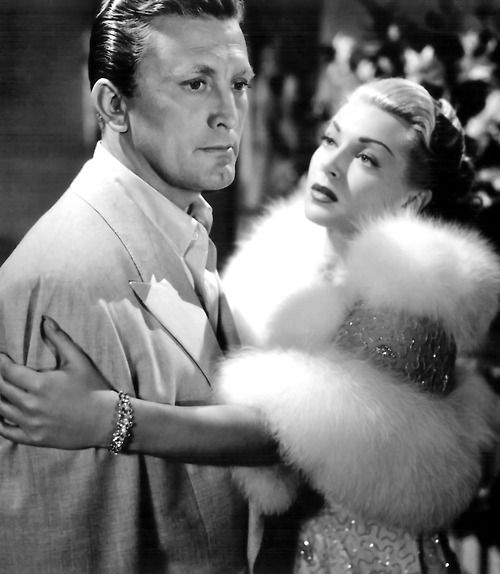
I really like this movie.  Superficially, it is about the Red menace but is really about honor among thieves and lowlifes.  The film is beautifully shot and tautly written.  The performances are outstanding too.  I especially like Ritter in perhaps her best performance as the tough yet fragile Moe.  I’ve not been especially impressed with Parker in other films but she is wonderful here.  She and Widmark just sizzle in their love scenes.  Recommended.

There is an interview with Fuller on the Criterion DVD.  He is exactly as I had expected, a true original.

Thelma Ritter was nominated for a Best Supporting Actress Oscar.

Trailer

Screenwriter on the film – Trailers from Hell


The Earrings of Madame de … (1953)

The Earrings of Madame de …
Directed by Max Ophüls
Written by Marcel Archard, Max Ophüls, and Annette Wademant from a novel by Louise de Vilmorin
1953/France/Italy
Franco London Films/Indus Films/Rizzoli Film
Repeat viewing/Netflix Rental
#268 of 1001 Movies You Must See Before You Die

[box] Monsieur Rémy: I thought I was doing both of you a favor.

Général André de…: I don’t follow, Monsieur Remy. I sometimes do favors for others but I avoid letting others do them for me.

Monsieur Rémy: A good policy.[/box]

The first time I saw this I was mesmerized by Ophul’s fabulous camera work.  This time I was moved by the story and the acting.  Either way, this film is a marvel.

General Andre de … (Charles Boyer) and his wife Louise (Danielle Darrieux) are sophisticates and members of the Paris elite.  As the story begins, Louise is trying to decide which of her jewels she should sell to pay off some debts she has kept a secret from her husband.  She decides her diamond earrings, a wedding present from André, are the easiest of her possessions to part with.  She covers her indiscretion by saying she can’t find the jewels, which are presumably lost or stolen.

Although she swore the jeweler to secrecy, he proceeds to inform André, a valued client. André buys them back, asks that the jeweler mention this to no one, and gives the earrings to his mistress who is departing for Constantinople at the conclusion of their affair. The mistress loses all her money at the casino and pawns the earrings.  Baron Fabrizio Donati (Vittorio de Sica), an Italian diplomat, sees the earrings in a jeweler’s window and buys them without a particular recipient in mind.

Donati is assigned to the Italian Embassy where he socializes with the General and his wife at many official functions.  While the General is away on maneuvers, Donati and Louise see more and more of each other.  Finally, he gives her the earrings.  The earrings start on another, more tragic, ownership cycle until they reach their destiny.

This film is beautiful in every way.  There is an amazing sequence that encapsulates the relationship between Louise and Donati through their dancing at various parties.  The camera dances right along with them.  I had not remembered how sad the story was.  By the end I felt so sorry for all the characters.  I don’t think Boyer was ever better.  He captures both the pride and the hurt of the General to perfection.  Highly recommended.

The Earrings of Madame de … was nominated for an Academy Award for Best Costume Design, Black-and-White.

Can’t find a good clip so here is this analysis of the opening tracking shots

Robot Monster (1953)

Robot Monsterrobot monster poster
Directed by Phil Tucker
Written by Wyott Ordung
1953/USA
Three Dimension Pictures
Repeat viewing/Amazon Prime

Great One: Earth Ro-Man, you violate the laws of plans. To think for yourself is to be like the hu-man.
Ro-Man: Yes! To be like the hu-man! To laugh! Feel! Want! Why are these things not in the plan?
Great One: You are an extension of the Ro-Man, and a Ro-Man you will remain. Now, I set you into motion. One: destroy the girl. Two: destroy the family. Fail, and I will destroy you!

This is my second viewing of this bad-movie classic after a gap of two years and seeing several more of its most notorious bretheren .  It stood up as still the most hilarious example of its genre I have ever seen.

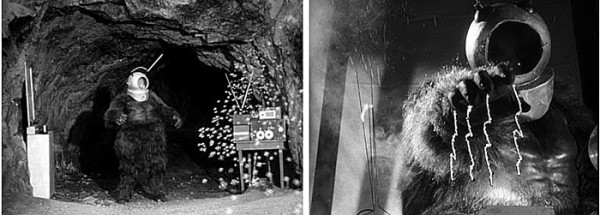
A family decides to picnic in what looks to be an abandoned rock quarry on the day Robot Monster, who refers to himself as Ro-Man, is sent to destroy all the Hu-mans (as he and the Great Guidance refer to our species) on earth. Ro-Man is played by a large man in a gorilla suit wearing a diving helmet and moves very, very slowly.

The survivors have all been innoculated with a serum which prevents every known disease and also happens to defeat Ro-Man’s death ray. There are thus 8 survivors left on earth, most of them conveniently located with yards of the Ro-Man’s cave headquarters.  Ro-Man offers them a painless death if they surrender but they decline preferring “peace with honor”.

robot_monster_03

Ro-Man: I cannot – yet I must. How do you calculate that? At what point on the graph do “must” and “cannot” meet? Yet I must – but I cannot!

The rest of the “plot” is perhaps unnecessary save to say that Ro-Man’s downfall is his unseemly feelings for the family’s hot eldest daughter. In between, we get random stock footage of dinosaurs fighting, a very bizaare wedding, and some of the most hilarious dialog ever captured on film. With the “automatic billion bubble machine”, which receives a special credit.

robot_monster_02

How I loved this movie! I had a silly grin on my face except during the many times I was laughing out loud.  Much of the fun comes from the many unexpected, because ludicrous, happenings so I will not spoil these for anyone brave enough to try this.  I suggest getting together with a like-minded friend and possibly a few drinks for maximum enjoyment.  It is only about an hour long.

Multiple complete versions of this gem are available on YouTube, including the Mystery Science Theater 3000 version, which I have never seen.  This is funny enough without an added riff track.

Trailer

Joe Dante on Robot Monster – Trailers from Hell

Stalag 17 (1953)

Stalag 17600full-stalag-17-poster
Directed by Billy Wilder
Written by Billy Wilder and Edwin Blum from a play by Donald Bevin and Edmund Trzcinski
1953/USA
Paramount Pictures
Repeat viewing/Netflix rental

Sgt. Schulz: How do you expect to win the war with an army of clowns?
Lt. James Skylar Dunbar: We sort of hope you’d laugh yourselves to death.

Billy Wilder wise-cracks his way through life in a POW camp.

The action takes place at about the time of the Battle of the Bulge in a camp housing US sergeants.  The men make their lives bearable through joking and various improvised games.  Sgt, J. J. Sefton (William Holden) is the organizer of many of these activities.  As the story begins, two of the men make an escape attempt.  Sefton takes bets from one and all that the men will not make it.  They are killed and Sefton wins his bet.  The men become convinced that one of their number is an informer.  Attention focuses on Sefton, who is thoroughly cynical and always seems to have the best of everything.

stalag17

One day, a couple of new POWs who are officers arrive.  One of them boasts that he blew up a train depot in Frankfurt even after he was captured.  Soon the officer is being questioned by camp commandant Col. Scherbach.  The men are more and more convinced that Sefton is the rat.  I think I will leave it at that.  With Sig Ruman as a prison guard and Robert Strauss, Harvey Lembeck, Don Taylor and Peter Graves as prisoners.

stalag-17-1953-02-g

The last time I watched this movie the Oscar-nominated performance of Robert Strauss as “Animal” irritated the hell out of me.  This time it didn’t bother me at all.  Holden is always Holden.  I find him appealing and enjoyed his performance.  It was fun to see Preminger as a Nazi.  Worth a watch.

William Holden won the Academy Award for Best Actor.  The film was also nominated for Best Supporting Actor (Strauss) and Best Director.

Re-release trailer

1952 Recap and Ten Favorites List

Singin-in-the-Rain-Poster

I’ve now watched 57 movies from 1952.  Finishing off almost all of the available movies rated by IMDb users at over 7/10 plus a few more was enough for me this time around.

1952 is not necessarily known as a great year overall for movies but film makers in Europe and Japan went from strength to strength and ended up dominating my favorites list.   Two of the films, both foreign, were new to me from this last round of viewing. You can find a complete list of the movies I watched here.

10.  The Bad and the Beautiful (directed by Vincente Minnelli)

bad beautiful

9.  Umberto D. (Directed by Vittorio de Sica)

umberto-d-1952-5

8.  The Life of Oharu (Directed by Kenji Mizoguchi)

oharu2big

7.  Le Plaisir (Directed by Max Ophüls)

le plaisir 5

6.  The Importance of Being Earnest (Directed by Anthony Asquith)

the_importance_of_being_earnest_asquith_1952_5

5.  Casque d’or (Directed by Jacques Becker)

Georges Manda (left, actor Serge Reggiani) and Marie (right, actress Simone Signoret) in the movie Casque D'or. Courtesy of The Criterion Collection.

4.  Forbidden Games (Directed by René Clement)

FosseyPoujuouly

3.  High Noon (Directed by Fred Zinnemann)

16723920_640

2.  Ikiru (Directed by Akira Kurosawa)

still-of-takashi-shimura-in-ikiru-(1952)

1.  Singin’ in the Rain (Directed by Stanley Donen and Gene Kelly)

Singin' In The Rain-08

1953

In 1953:

In further warfare against television and rival 3-D movies, Hollywood developed wide-screen processes such as 20th Century Fox’s anamorphic CinemaScope, first seen in Henry Koster’s Biblical sword-and-sandal epic The Robe.  Warner Bros’ first 3-D film, the horror classic House of Wax was the first full-length color 3-D film produced and released by a major US studio – it was also the first 3-D film with a stereo soundtrack.  The feature also launched the horror film career of Vincent Price with his first major starring horror role.

Otto Preminger’s The Moon Is Blue used the then-forbidden word “virgin” (and others such as “seduce” and “pregnant”).   This deliberately violated the Motion Picture Production Code and led to picket lines. It was the first studio-produced film from Hollywood that was released without an approved code seal from the Production Code Administration. It proved to be a major hit film despite its lack of a seal of approval.

The Academy Awards ceremony was televised for the first time.

First H-Bomb test

On January 7 President Harry S. Truman announced the United States had developed a hydrogen bomb.  The Soviet Union announced it had the H-bomb on August 8.

Francis Crick and James Watson published “Molecular Structure of Nucleic Acids: A Structure for Deoxyribose Nucleic Acid”, their description of the double helix structure of DNA. Jonas Salk announced his polio vaccine.

Hugh Hefner published the first issue of Playboy magazine, selling for 50 cents. It featured emerging starlet Marilyn Monroe on the cover and as the first centerfold model (although her picture had been taken specifically for a calendar in 1949 and not for the magazine).  Earl Warren was appointed Chief Justice of the United States by U.S. president Dwight D. Eisenhower.

The Pulitzer Prize for fiction went to The Old Man and the Sea by Ernest Hemingway and t
William Inge won the prize for Drama with his play Picnic.  Once again, the number one song was an instrumental, “Theme from Moulin Rouge” by Percy Faith, which spent ten weeks on top of the charts.

Hillary and Tenzing

On May 29,  Sir Edmund Hillary and Tenzing Norgay became the first men to reach the summit of Mount Everest just in time for the coronation of Queen Elizabeth II.  Later in the year, sugar rationing ended in the UK.

The North Sea flood killed 1,836 people in the southwestern Netherlands, 307 in the United Kingdom and several hundred at sea.  Joseph Stalin died on March 5.  Marshal Josip Broz Tito became president of Yugoslavia. Ian Fleming published his first James Bond novel, Casino Royale. 

The Korean War ended with the Korean Armistice Agreement: United Nations Command (Korea) (United States), People’s Republic of China, North Korea sign an armistice agreement at Panmunjom, establishing the uneasy border between the communist north and the democratic south.  The CIA helped to overthrow the government of Mohammad Mosaddegh in Iran, and retain Shah Mohammad Reza Pahlavi on the throne.

*****************************************

The 1953 movies I will select from are listed here.  I have previously reviewed the following 1953 films on this blog:  ; ; ; ; ; and .

Montage of stills set to “Secret Love”


Singin’ in the Rain (1952)

Singin’ in the Rain
Directed by Stanley Donen and Gene Kelly
Written by Adolph Green and Betty Comden
1952/USA
Metro-Goldwyn-Mayer
Repeat viewing/My DVD collection
#256 of 1001 Movies You Must See Before You Die

[box] Let the stormy clouds chase/
Everyone from the place/
Come on with the rain/
I’ve a smile on my face – Lyrics by Arthur Freed[/box]

By some miracle, a lot of very talented people reached their peak at the same time and created magic.

Don Lockwood (Gene Kelly) and Lina Lamont (Jean Hagen) are big silent movie stars, having cranked out one swashbuckler after another.  They are a hot romance according to the fan magazines.  Lina believes her own PR but Don can hardly tolerate her.  Don’s best friend and constant companion is pianist Cosmo Brown (Donald O’Connor), whom he grew up with.  One day, Don meets cute with young Kathy Selden (Debbie Reynolds).  It is love at fist sight.  Naturally, Lina gets her fired from her job as soon as possible.

But eventually Don and Kathy reunite and begin dating.  At about this time, The Jazz Singer comes out.  Monumental Productions decides it will rejigger the latest Lockwood and Lamont romance as its first talkie.  This is a disaster on many levels, mostly due to Lina’s horrible speaking voice and inability to take direction.  Don can see his career going through the tubes as well.  Then Cosmo gets the brilliant idea of making the picture over into a musical and getting Kathy to dub Lina’s voice.  With Millard Mitchell as probably the most sympathetic studio head ever put on film and Cyd Charisse as a vamp.

My plot synopsis does not begin to convey how funny this movie is.  Indeed, I believe that it is so popular among musical haters because it works so well as a comedy – perhaps one of the best ever.  Then there is all that glorious singing and dancing.  To me, Kelly’s “Singin’ in the Rain” number perfectly conveys the essence of giddy new love.  Even the concluding “ballet” works for me.

I have now finally decided that when anyone asks me what my all-time favorite movie is, it will be this one.  Whenever I am looking for a boost I know right where to turn.  It was one of the first movies I saw in a revival theater on the big screen and has not faded over years of repeated viewing.  I saw it on Blu-Ray this time and it looked just gorgeous.

Singin’ in the Rain was nominated for Academy Awards in the categories of Best Supporting Actress (Hagen) and Best Music, Scoring of a Musical Picture.  I think Hagen was robbed.

Trailer

Affair in Trinidad (1952)

Affair in Trinidadaffair poster
Directed by Vincent Sherman
Written by Oscar Saul and James Dunn; story by Virginia Van Upp and Berne Giler
1952/USA
Columbia Pictures Corporation/The Beckworth Corporation
First viewing/Netflix rental

[box] Dominique: It is the prerogative of a faithful and loyal servant to be impertinent.[/box]

The story, a mash-up of Gilda and Notorious, falls rather flat.  Not so Rita Hayworth’s dancing.

Neal Emory’s body is found in Port of Spain harbor with a bullet in the head.  At first, it is thought that the unsuccessful painter may have committed suicide.  The police and American consul call on Neal’s widow, Chris (Hayworth).  She has no idea why he might have committed suicide but reveals that the couple had been married in name only for about a year.  A witness and an autopsy reveal that the corpse was shot after Neal was strangled.

The police suspect the murder may have had something to do with the wealthy Max Fabian (Alexander Scourby), who is well-known to the police.  The police threaten that they will attribute Neal’s “suicide” to Fabian’s attraction to Chris if she does not cooperate by getting next to Fabian and reporting back.  She is not to reveal what she is doing to anyone.  For some reason, this intimidates Chris into cooperating.

Affair-In-Trinidad-1952-2

In the meantime, Neal had written to his brother Steve (Glenn Ford) telling him that he had a job for him in Trinidad.  Steve shows up and starts a parallel investigation of his brother’s death.  He also ends up staying in Chris’s house.  Naturally, they begin a stormy love affair. Chris must play up to Fabian, however, causing ever more violent storms.  With Juanita Moore, as Chris’s wise, mystical Trinidadian housekeeper.

Affair-in-Trinidad-1952

The plot is shot through with holes and its resolution is rushed and unsatisfactory.  I wasn’t expecting much from this movie and was pleasantly surprised that Ford and Hayworth retained their Gilda chemistry.

Clip – Rita Hayworth doing “Trinidad Lady”