Play It Again, Sam Directed by Herbert Ross Written by Woody Allen from his play 1972/USA IMDb page
Repeat viewing/Amazon Prime rental
Dick: [On the phone] Let me tell you where you can reach me, George. I’ll be at 362-9296 for a while; then I’ll be at 648-0024 for about fifteen minutes; then I’ll be at 752-0420; and then I’ll be home, at 621-4598. Yeah, right George, bye-bye. (Dick needed a cell phone)
He didn’t direct it but he did create it and this film would pave the way for Annie Hall and other romcoms in Woody Allen’s future.
Allen Felix (Allen) is a film critic. He is obsessed with Casablanca and Humphrey Bogart. His wife (Susan Anspach) is not feeling it and dumps him. Best friends Dick (Tony Roberts) and Linda (Diane Keaton) try to set him up with new ladies. But although in constant communication with Bogart (Jerry Lacey), Allen messes up every date and romantic advance.
What Allen doesn’t suspect for a while, is that Linda is feeling neglected by Dick and has a real soft spot for him. Will this be a romance for the ages?
Well, it was a real treat to watch this again. It’s plenty funny and sometimes farcical but also has a genuine heart to it. Keaton probably had something to do with that. The film stands up all these years later. Recommended.
Marjoe Directed by Howard Smith and Sarah Kernochan 1972/US IMDb link
Repeat viewing/Amazon Prime rental
Marjoe: Can God deliver a religion addict?
In the years before tele-evangelism, preachers like Marjoe Gortner raked in the cash doing revivals. This documentary exposes the hypocrisy of the business and illustrates its raw power over believers.
Marjoe Gortner was “called by the Lord” to his ministry at age 4 1/2. His father, also an evangelical preacher, may have assisted the Lord. At any rate, Marjoe was a gifted no-holds-barred charismatic preacher from a tiny child. He was performing marriages, to the consternation of orthodox religion, at the age of eight. He was adept at faith healing and speaking in tongues.
He apparently took a break at some point and came back to the circuit as a young man with rock-star-level gifts to make a crowd break out its change, bills, and check books. But Marjoe never, even as a child, had the slightest bit of religious faith. By making this movie Marjoe hoped to break with his old life and perhaps pave the way to a lucrative new one.
This documentary is a nice blend of a lot of things. We get soul-baring sessions between Marjoe and the crew that provide insights into his life and personality and into evangelist show business. But it is the actual footage of the revival shows that is really compelling. Gortner struts around with the posing and attitude of a Mick Jagger and can really work the crowd into a frenzy. Plus we’ve got a lot of riveting gospel singing to enjoy. If the subject matter is intriguing, I can recommend.
Marjoe won the Oscar for Best Documentary, Feature.
Sleuth Directed by Joseph L. Mankiewicz Written by Anthony Shaffer from his play 1972/UK IMDb page
Repeat viewing/My DVD collection
One of 1001 Movies You Must See Before You Die
Andrew Wyke: You said everything was in plain view! Milo Tindle: Well aren’t I the shifty old sly boots, then.
Imagine a movie where two very different but great actors try to upstage each other for the entire running time. Now imagine they are given a brilliantly literate screenplay and one of the best directors of Hollywood’s Golden Age. That is Sleuth.
It would be criminal to give away any of the plot so I will but set the stage. Andrew Wyke (Lawrence Olivier) writes old-fashioned crime fiction replete with a brilliant aristocratic private detective and dense police inspectors. He lives in a palatial estate in the English country side. Every inch of the house and grounds is stuffed with playthings. Anywhere you look there is a puzzle, or a mechanical toy, or other kind of oddity, Despite his proclivity for “fun”, Andrew is in all respects a very conservative, class-conscious lord of the manor. He has a sharp tongue and a keen wit.
Milo Tendle (Michael Caine) is a much-younger half-Italian hairdresser from Soho. He has been having an affair with Andrew’s wife and wants to marry her. Andrew has invited Milo to his place to discuss the matter. What Milo lacks in breeding he makes up for in street smarts and cunning. Let the games begin!
I saw this on stage and then this film on original release. Fortunately, I forgot some of the plot twists! At any rate, there is so much to look at and absorb that I can’t imagine this movie ever getting old. Such fun to watch Olivier and Caine do their thing! Highly recommended.
Both Caine and Olivier were nominated for the Best Actor Oscar rejected by Marlon Brando. Both of them were as good and had more screen time than Brando but, of course, The Godfather has “important” written all over it. Mankiewicz got a nod for Best Director and John Addison was nominated for his Originial Score
This was Mankiewicz’s last theatrical film. Nice to see him go out on a high.
Apache Indian Sacheen Littlefeather declined Marlon Brando’s Best Actor Oscar for The Godfather on his behalf as a protest against government Indian policies.
The X-rated Deep Throat was the second hard-core pornography feature film widely released in the US. It came after the feature length X-rated Behind the Green Door by the Mitchell Brothers. Both films contributed to the explosion of the porn industry and ‘porn chic’ by being exhibited in many mainstream film theatres. Deep Throat was one of the most financially successful films ever made (grossing over $1,000,000, but costing only $24,000 to make). However, it was ruled obscene by a New York court in 1973 and prints of the film were seized when it was subsequently banned in 23 states, and the film’s exhibitors (and actor Harry Reems) were found guilty of promoting obscenity and fined. The publicity only fueled the worldwide box-office gross of the film.  It seems like a lifetime ago when I actually saw Deep Throat in the theater on original release as some kind of dare with office colleagues!For the first time in 20 years, 82 year-old silent comedian/director/producer Charlie Chaplin returned from exile and set foot on US soil. Two decades earlier, he was denied a re-entry visa amid questions about his leftist politics and moral character.  Chaplin accepted an honorary Academy Award “For the incalculable effect he has had in making motion The pictures the art form of this century”. His standing ovation lasted a record 12 minutes.
The world lost Maurice Chevalier, Brian Donleavy, George Sanders, Bruce Cabot, Margaret Rutherford, Brandon DeWilde, Oscar Levant, Akim Tamaroff, Miriam Hopkins, Edgar G. Ulmer, Leo G. Caroll, and William Dieterle. Â Ned Beatty, Jody Foster, Bob Hoskins, Isabelle Huppert, Samuel L. Jackson, Ben Kingsley, Steve Martin, and Nick Nolte made their film debuts.
Richard M. Nixon won re-election by a landslide. Â The Watergate Scandal broke. Â Terrorists attacked the Munich Olympics killing eleven Israeli athletes. Â Roberta Flack’s “The First Time Ever I Saw Your Face” spent six weeks atop the Billboard Charts and was the number one single of the year. Â The Pulitzer Prize for Literature was awarded to Wallace Stegner for Angle of Repose. Â No prize was awarded for Drama. Â Richard M. Nixon and Henry Kissinger were named Time Magazine’s Men of the Year.
*******************************
I’m enjoying cherry-picking these later years. Â Here is the list I will pick from.
I have now watched 38 films from 1971. Some of those I did not rewatch for this exercise. I ended at six weeks on October 21 and feel perfectly satisfied with the streamlined schedule. A list can be found here. Here’s the list of my 10 favorites in no particular order:
Clint Eastwood’s directorial debut is a solid thriller with a few real scares.
Dave (Eastwood) is a DJ at a radio station in Carmel-by-the-Sea, a picture-postcard tourist village on the California Coast. He hosts the late night show, playing mellow jazz and taking requests. Dave has a wandering eye. His biggest fan is Evelyn (Jessica Walter). She calls most nights to request that Dave play Errol Garner’s “Misty” for her and he obliges Finally she tracks him down to a bar and makes advances leading to a one-night-stand. After this Evelyn is crazy in love (she was already crazy) and she begins to act like the female half of the most passionate affair of the century. Dave tries to let her down gently but Evelyn doesn’t have a subtle bone in her psyche.
The situation gets even more complicated when Dave’s sometime-girl friend and true love decides to give him another chance. This Evelyn is one seriously messed up chick.
For my final film of 1971 I had to chose between The Hired Hand one and this one which I saw before years ago. I’m glad I picked this one though I will remain curious about the other. Clint started out as he meant to continue – making workmanlike entertainment as concisely as possible. This first one has some pretty darn scary jump shots and a dynamite performance by Jessica Walter. There’s also an awesome jazz score which includes Roberta Flack’s “The First Time Ever I Saw Your Face.” Clint just acted like Clint. There’s some of those flowery slo-mo romance shots that seem to plague movies of this era but not too many of them.
The Go-Between Directed by Joseph Losey Written by Harold Pinter from a novel by L.P. Hartley 1971/UK
First viewing/YouTube rental
“The past is a foreign country; they do things differently there.” ― L.P. Hartley, The Go-Between
Pinter meets period piece meets illicit passion in the English countyside. And it all comes together beautifully.
The plot is told as a long flashback during a meeting between 50-somethings Leo Colston (Michael Redgrave) and Marian (Julie Christie in age make-up). They discuss the summer of 1900, the eventful season when Leo (Dominic Guard) turned 13.
Leo spent the summer at the grand estate of Mr. (Michael Gough) and Mrs. (Margaret Leighton) Maudsley as a guest of their son Marcus. But Marcus gets ill and Leo finds himself with time on his hands. Leo is just starting puberty and develops a massive crush on Marian. This makes it easy for her to inveigle him into becoming a sort of top-secret messenger between her an hunky tenant farmer Ted Burgess (Alan Bates).
Then Leo finds out Marian’s parents are about to announce her marriage to aristocrat Hugh Trimmington (Edward Fox). Marian has no intention of abandoning her double life until her wedding day. Marcus recovers and Leo begins to feel it wrong to aid and abet the lovers. Ted bribes him with a promise to explain to him the mechanics of sex. And here I will end my summary.
This is actually as much a coming of age story as it is a romance. I iked it a lot. The production and cast are both great and a beautiful score by Michel LeGrande adds to the atmosphere.
Margaret Leighton was nominated for the Best Supporting Actress Oscar for her performance as a gracious matriarch with a heart of stone.
Sweet Sweetback’s Baadassss Song Directed by Melvin Van Peebles Written by Melvin Van Peebles 1971/US IMDb page
First viewing/Amazon Prime rental
One of 1001 Movies You Must See Before You Die
Tagline: You bled my Momma–You bled my Poppa–But you won’t bleed me.
This may be historic, revolutionary and all that but I hated almost everything about it.
A boy (Mario Van Peebles) is raised in a brothel. When he is about 13, he is initiated into sex by one of the prostitutes. We watch at length as the little boy mounts a woman twice his size and gets to work. His prodigious endowments earn him the nickname “Sweetback”. Sweetback grows up to be Melvin Van Peebles and he is now the main attraction of a live sex show. We get to watch some of the “acts”.
Eventually white LAPD officers raid the club and coerce its owner into supplying a man who can be temporarily used as a suspect in a case the police are getting nowhere with. He is assured the man will not even be handcuffed and will be returned in a couple of days. Sweetback is the patsy. He escapes later after killing a couple of cops. Now he is the subject of a major manhunt and will make his way to Mexico for the rest of the film. If you think the graphic sex stops during this part you would be wrong.
From the unsimulated sex, to the amateur acting, to the murky photography, to the graphic violence, this movie had nothing to offer me. The score is by Van Peebles and the band Earth, Wind, and Fire. They sound nothing like they did when they began to sell records.
Fun Facts: Bill Cosby lent Van Peebles $50,000 to make this thing. The director also reportedly collected worker’s compensation from the Director’s Guild for contracting gonorrhea during one of the sex scenes.
Shaft Directed by Gordon Parks Written by Ernest Tidyman and John D.F. Black from Tidyman’s novel 1971/US IMDb page
First viewing/Amazon Prime rental
One of 1001 Movies You Must See Before You Die
Who’s the black private dick / That’s a sex machine to all the chicks? / SHAFT! / Ya damn right! Who is the man that would risk his neck / For his brother man? / SHAFT! / Can you dig it? Who’s the cat that won’t cop out / When there’s danger all about? / SHAFT! / Right On! They say this cat Shaft is a bad mother… / SHUT YOUR MOUTH! / I’m talkin’ ’bout Shaft. / THEN WE CAN DIG IT! – Theme from Shaft, Lyrics by Isaac Hayes
Solid but routine crime/thriller is lifted by its attitude, its photography, and its iconic score.
John Shaft (Richard Roundtree) is a private detective working the streets of Harlem. He has a quick wit and attitude to spare. He’s not good at tolerating BS or following orders. Some of his clientele need to stay as far away from cops as possible. So a gang lord in Harlem hires Shaft to rescue his teenage daughter, who has been kidnapped by people who did not leave a ransom note. Shaft’s first lead is to members of a black radical organization. This does not pan out but the group is in need of money and agrees to help Shaft locate and rescue the girl.
Then NYPD Lieutenant Androzzi, with whom Shaft frequently wrangles, wants info on Shaft’s case. Androzzi finally reveals that the Mafia is trying to take over territory run by black organized crime in Harlem. Androzzi fears that a mob war will be perceived by the public as a race war. There is plenty of bloodshed on the way to the crime’s solution.
We’ve seen this story hundreds of times but not with this film’s cool. The parts I liked best were gazing at Roundtree, the streets of New York from around the time I first saw the city, and that wonderful score.
Isaac Hayes won the Oscar for Best Music, Original Song. He was nominated for Best Music, Original Dramatic Score.
Two-Lane Blacktop Directed by Monte Hellman Written by Rudy Wurlitzer and Will Corry 1971/USA IMDb page
First viewing/Netflix rental
One of 1001 Movies You Must See Before You Die
G.T.O.: If I’m not grounded pretty soon, I’m gonna go into orbit.
I came in expecting one thing. I got something different, and better.
None of the characters in this movie has a name so I’ll be referring to them by the actors’ names. James Taylor and Dennis Wilson own a souped-up 1955 Chevy hot rod. Taylor is the driver and Dennis is the mechanic. They are the kind of guys who don’t speak unless strictly necessary and when they do it’s usually to reveal the solution to some mechanical puzzle they’ve been working out in their heads. They survive by challenging other hot-rodders to drag races for money. They pick up bedraggled but pretty hitchhiker Laurie Bird but pay her far less attention than she would like.
As the story goes on, our heroes meet up with Warren Oates who is the proud owner of a new orange GTO. After much banter, the three agree to race cross-country to Washington DC. The stakes will be the pink slips to their vehicles. We spend the rest of the film watching the unorthodox proceedings. Oates constantly picks up hitchhikers so he can regale them with tall tales and lies about his very colorful fantasy life.
Well, I thought this was going to be a movie about drag racing. In fact, there is hardly any racing in it. And after the “race” with Oates begins, the other car frequently lets him catch up. It’s the journey that is the point. The story has much to say about alienation, obsession, aimlessness, and looking for America. It’s 1971, man. I liked this a lot. Oates is utterly fantastic.
I’ve been a classic movie fan for many years. My original mission was to see as many movies as I could get my hands on for every year from 1929 to 1970. I have completed that mission.
I then carried on with my chronological journey and and stopped midway through 1978. You can find my reviews of 1934-1978 films and “Top 10” lists for the 1929-1936 and 1944-77 films I saw here. For the past several months I have circled back to view the pre-Code films that were never reviewed here.
I’m a retired Foreign Service Officer living in Indio, California. When I’m not watching movies, I’m probably traveling, watching birds, knitting, or reading.
Photographs and videos found in this blog, unless indicated, are not owned by me and are here only for the purpose of education and discussion. Media found here are not intended for any commercial purpose. Copyright infringement is not intended.
Written material belongs to me and is copyrighted by flickersintime.com
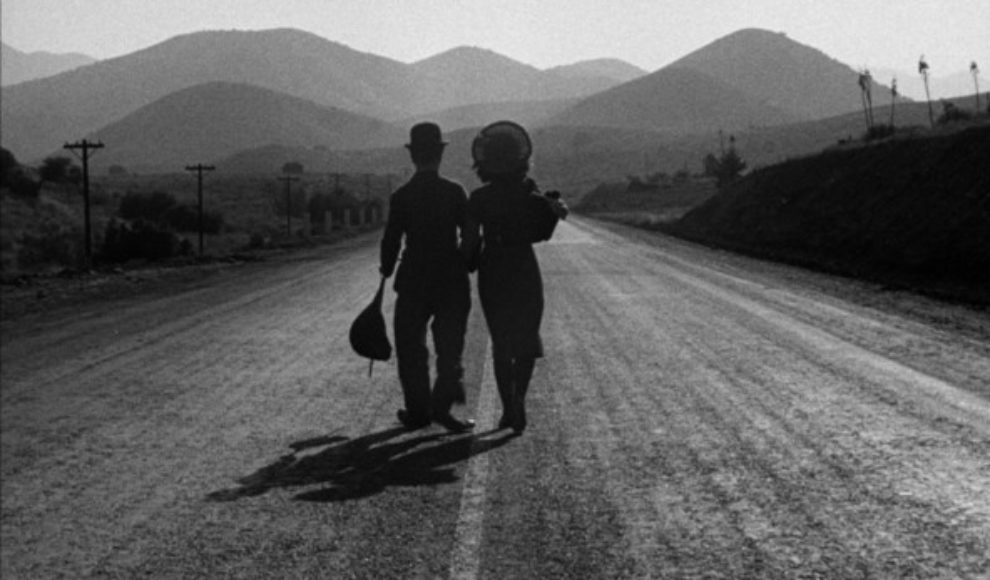


 For the first time in 20 years, 82 year-old silent comedian/director/producer Charlie Chaplin returned from exile and set foot on US soil. Two decades earlier, he was denied a re-entry visa amid questions about his leftist politics and moral character. Â Chaplin accepted an honorary Academy Award “For the incalculable effect he has had in making motion The pictures the art form of this century”. His standing ovation lasted a record 12 minutes.


