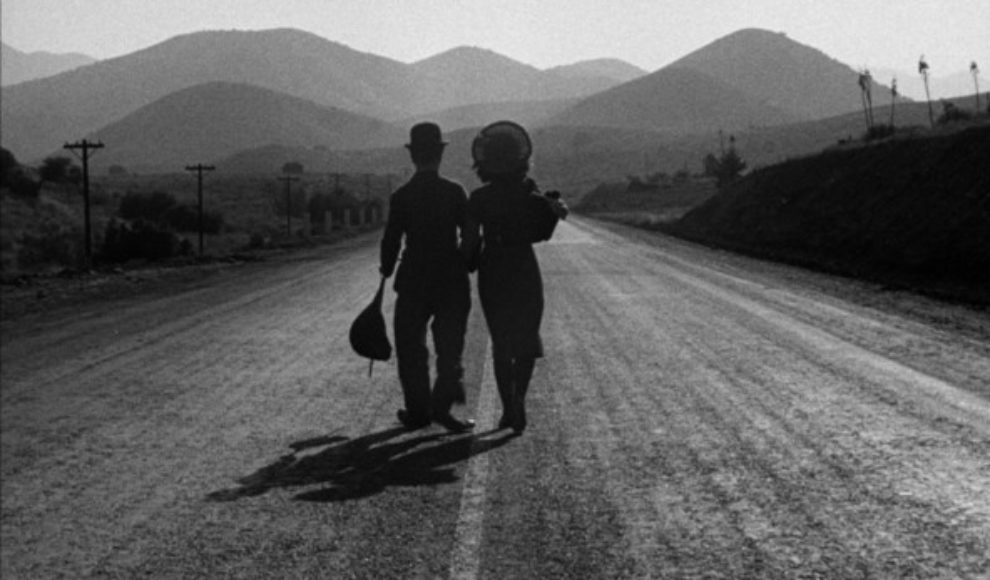
La Mujer del Puerto (1934)

La Mujer del Puerto (“The Woman of the Port”) (1934)la-mujer-del-puerto DVD
Directed by Arcady Boytler and Raphael J. Sevilla
1934/Mexico
Eurindia Films

First viewing


You just never know when you are going to find that special film!  I had never heard of this one until I was gathering films for this exercise.  Rosario (Andrea Palma) lives in poverty with her aging father and is in love with a neighbor who says he will marry her when he has more money.  Her father dies and her lover proves unfaithful so Rosario becomes a prostitute on the docks in another town.  One night she meets a client who defends her from a drunk and her fate takes an even more tragic turn.  (I will not spoil the ending but I was shocked.)

La Mujer del Puerto 1

The plot and acting in this are secondary to some exceptionally beautiful images.  In terms of the story, the film is uneven with certain parts moving at a very leisurely pace and the final fifteen minutes unnaturally rushed.  Some of the acting is a bit overdone.  However, the composition of the shots and some of the editing are just masterful.  There is a scene where Rosario is escorting her father’s coffin through a group of carnival revelers that is breathtaking.  The whole movie is bathed in gorgeous expressionist lighting.  Well, well worth seeing.

Director Arcady Boytler was born in Moscow and directed silent films in the USSR and Europe before arriving in Mexico and meeting Sergei Eisenstein at the time of the filming of Qué viva Mexico! (1932).  He made several other films during Mexico’s Golden Age of cinema but it looks like this is the one that is most readily available on DVD.

Excerpts with song “Vendo Placer” (Pleasure I Sell) as background

Judge Priest (1934)

Judge Priest Judge Priest Poster
Directed by John Ford
1934/USA
Fox Film Corporation

First viewing
#85 of 1001 Movies You Must See Before You Die


Opening crawl: The figures in this story are familiar ghosts of my own boyhood. The War between the States was over, but its tragedies and comedies haunted every grown man’s mind, and the stories that were swapped took deep root in my memory.

This is essentially a love letter to a simpler time – in this case 1890’s Kentucky, where folks still remember the glories of the antebellum South vividly.  Judge Priest (Will Rogers) presides over the court in his small town dispensing justice and folksy wisdom.  His nephew returns to town, having just graduated from law school, and is courting a local belle.  His mother objects due to the girl’s lack of breeding; her father’s identity is unknown.  The nephew’s first client is a mysterious loner who is charged with assault for defending the girl’s honor.  Judge Priest is forced to recuse himself from the case, which enables him to assist his nephew at the trial.  With Hattie McDaniel as Judge Priest’s cook/maid and Stepin Fetchit as his errand boy.

Judge Priest 2

Well, I have to admit that this was much better than Doctor Bull, the 1933 Will Rogers/John Ford movie I saw.  There is a sort of small town charm to the storytelling.  On the other hand, there is also much too much of Lincoln Theodore Monroe Andrew Perry, better known in his Stepin Fetchit persona.  His shtick just makes my skin crawl.  I can’t help it. Many people would also be offended by Hattie McDaniel’s character but that does not rub me so much the wrong way.

Setting the racial stereotyping questions aside, I do not understand why this pleasant but unremarkable film should be rated a “must see.” It is an introduction to Will Rogers, who I suppose is a major personality of early 20th Century American pop culture but not more than some others we don’t meet in our journey through The List.  Will Rogers worked with Stepin Fetchit many times so it may be hard to pick a decent Rogers film that doesn’t include that character.

Clip – Stepin Fetchit and Hattie McDaniel

Baby Take a Bow (1934)

Baby Take a Bowbaby-take-a-bow poster
Directed by Harry Lachman
1934/USA
Fox Film Corporation

Second viewing?


Trigger Stone: So you’re Eddie Ellison’s kid.
Shirley Ellison: I’m not a kid, I’m a girl, and today is my birthday.

Kay (Claire Trevor) is waiting for her sweetheart Eddie Ellison (James Dunn) to be released from Sing Sing.  Eddie goes straight and they marry and have an adorable little girl, Shirley (Shirley Temple), who they love dearly.  Fast forward to six years later and Eddie is working as a chauffeur for a wealthy family.  Fellow ex-con Trigger Stone shows up and wants Eddie to fence some stolen property.  Eddie refuses.  A valuable pearl necklace is stolen from Eddie’s employer and insurance inspector Welch, who has long had it in for Eddie, tries to pin the blame on him.  Shirley helps clear her father’s name.

Baby Take a Bow 2

Shirley is irresistible, to those of us who love her, in this film, released when she had just turned six years old.  James Dunn is her ideal Daddy and Claire Trevor turns in a good performance as her mother.  This is part prison film, part gangster film, and part musical.  It all works in that 1930’s studio alternative reality.  No masterpiece but I enjoyed it.

Clip “On a Account-a I Love You” starts at 3:14 – sorry about the colorization

Jane Eyre (1934)

Jane EyreJane Eyre Poster
Directed by Christy Cabanne
1934/USA
Monogram Pictures

First viewing


“I am not an angel,’ I asserted; ‘and I will not be one till I die: I will be myself. Mr. Rochester, you must neither expect nor exact anything celestial of me – for you will not get it, any more than I shall get it of you: which I do not at all anticipate.” ― Charlotte Brontë, Jane Eyre

The first sound adaptation of the Charlotte Brontë novel.  After a lonely and difficult childhood, the independent-minded Jane Eyre (Virginia Bruce) becomes a governess at Thornfield Hall.  There she falls in love with the master of the house Mr. Rochester (Colin Clive)  but he has a shocking secret that stands in the way of their happiness.

Jane Eyre 1

I have a few more films to watch but I do believe I may have hit the bottom of the barrel for 1934.  This film might not be worse than Maniac but it is certainly less fun.  Where to start?  With the sets that quiver when brushed?  No, I think the worst part is the amateurish brutalization of the novel.  Here we have a glamorous Jane Eyre with golden ringlets who sings to Rochester at their first meeting for what seems like five minutes of this 62-minute movie.  The Adele character is changed to being Rochester’s niece and has quite a prominent part in the story so that she can do hilarious stunts like falling head first into an urn.  Crazy wife Bertha shows up at the wedding looking quite OK and asking to see her husband.  There are many times when it seems like the actors have been asked to improvise their lines.  Since it is evident that no one, including the director, has read the novel, this was a bad idea.

I may be revising how I go forward with my year-by-year project.  Seeing so many mediocre movies in a row is making me jaded and cranky.  I think I may forego seeing anything with a user rating less than 6.0/10 on IMDb.  This one was rated 4.7/10.

Clip – Wedding scene (appearance of Bertha Mason)


We Live Again (1934)

We Live Again (AKA “Resurrection”)We Live Again Poster
Directed by Rouben Mamoulian
1934/USA
The Samuel Goldwyn Company

First viewing

Every man and every living creature has a sacred right to the gladness of springtime.” ― Leo Tolstoy, Resurrection

 The story is based on the novel Resurrection by Leo Tolstoy.  A noble household is quite attached to its servant girl Katusha (Anna Sten); the son, Prince Dmitri (Fredric March), and the girl grew up together.  One summer, the callow, idealistic Dmitri comes home from military training full of ideas about equality of the classes and falls chastely in love with Katusha.  But when he returns to the army Dmitri is quickly swept up in its decadent lifestyle and forgets about his ideals.  When he comes home again, he seduces and abandons Katusha who ends up pregnant, disgraced, and discharged from her position.  Years later, Dmitri sees Katusha again when she is on trial for murder, having previously descended into a life of prostitution.  He realizes the great wrong he has done and attempts to make amends.  With Joan Baxter as Dmitri’s fiance; C. Aubrey Smith as her father (did the man have time to sleep in 1934??), and Sam Jaffe as a revolutionary.

We Live Again 1

First, let me say that this is a really gorgeous film lensed by Gregg Toland and with wonderful authentic 19th Century Russian sets.  There is a glorious scene of Russian Orthodox Easter in a church.  I have never seen Anna Sten before and she is very beautiful and appealing in the love scenes.  She overdoes it a bit after her fall but not too badly.    Frederic March is good as always.

Something happened to this film between the first act and the second act.  The early love scenes took their time and were a pleasure to watch.  The later scenes were good too but seemed rushed or something – like this was clumsily edited for time.


The Scarlet Letter (1934)

The Scarlet LetterScarlet Letter Poster
Directed by Robert G. Vignola
1934/USA
Larry Darmour Productions

First Viewing


“It [the scarlet letter] had the effect of a spell, taking her out of the ordinary relations with humanity, and enclosing her in a sphere by herself.” ― Nathaniel Hawthorne, The Scarlet Letter

This poverty-row adaptation of the Nathaniel Hawthorne novel stars Colleen Moore as Hester Prynne, Hardie Albright as Rev. Arthur Dimmesdale, Henry B. Walthall as Roger Chillingworth, and Alan Hale as comic relief.  In 17th century Massachusetts, a woman whose husband was thought to be lost at sea is forced to wear a scarlet “A” on her breast as punishment for adultery that resulted in the birth of a child.  She refuses to reveal the father of the girl but her husband returns incognito, determined to hound both parties to the affair for the rest of his days.

Scarlet Letter 1

It is hard to find anything good to say about this movie.  The first strike against it is that the makers felt compelled to lighten the dark story of the novel with copious amounts of comic relief, mostly supplied by Alan Hale and William Kent as sort of a Mutt and Jeff team.  Their bits are really jarring and not all that funny.  All the beards look obviously fake.  Then you get the principals posturing as if they were making a silent movie.  Colleen Moore is the worst and also seems years too old for her part, though she would have only been 35 in 1934.  This was the last film Moore ever made.

Colleen_bobbed


Colleen Moore was a silent film star.  She is most famous for “flapper” roles such as in  classic Flaming Youth (1923), in which she played Patricia Fentriss. By 1927 she was the top box-office draw in the US.  She invested her motion picture earnings wisely and remained wealthy until her death in 1988 at age 88.

Excerpt – oh, those wacky Puritans!

Zouzou (1934)

ZouzouZouzou Poster
Directed by Marc Allégret
1934/France
Les Films H. Roussillon/Productions Arys

First viewing


Beautiful? It’s all a question of luck. I was born with good legs. As for the rest… beautiful, no. Amusing, yes. — Josephine Baker

Zouzou (Josephine Baker) and Jean (Jean Gabin) performed in the circus as “twins” as children and grew up as brother and sister.  Zouzou is in love with Jean.  When he is falsely arrested, she enters show business to get the money to defend him.  Will Jean see the light?

Zouzou 2

This is the French equivalent of a backstage musical and very charming, if not as polished as a Hollywood production.  I have read about Josephine Baker for years and was excited to be able to see her in something.  Jean Gabin is a major heart throb of mine and it was nice to see him in a different kind of role and singing a bit no less!

Jean Gabin sings “Viens Fifine”

Josephine Baker sings “Haiti”

Transatlantic Tunnel (1935)

Transatlantic Tunnel (AKA “The Tunnel”)Transatlantic Tunnel Poster 1
Directed by Maurice Elvey
1935/UK
Gaumont British Picture Corporation

First viewin


Richard ‘Mack’ McAllan: There are bigger things than money.
Airways Magnate: We don’t deal in ’em.

It is the near future (as of 1935).  The Channel Tunnel was completed in 1940 and a Bahamas-Miami Tunnel is profitable.  Television is everywhere and people talk by “Televisor” even from their seats in airplanes.  Intrepid American engineer Richard “Mack”  McAllan (Richard Dix)  proposes a tunnel to link England with America an accomplishment that would “unite the English-speaking peoples” and “bring World Peace”, made possible by a new giant radium drill  He convinces a group of greedy industrialists to back his plan and sets to work on the multi-year project.  His obsession with the project leads him to neglect his wife (Madge Evans) and son and leave them in charge of his best friend and fellow engineer (Leslie Banks).  Mack’s publicity duties have him frequently on the arm of a key investor’s lovely daughter (Helen Vinson).  No spoilers here but illnesses, mass deaths, and a volcano cannot deter Mack’s determination to complete his task.  World Peace is more important than the problems of a few little people!  With C. Aubrey Smith as a magnate, George Arliss as the British Prime Minister, and Walter Huston as the U.S. President.

Transatlantic Tunnel 4

I think its a lot of fun to look at the future from the perspective of the past and I came into this movie with high hopes. I have to admit that it delivered in terms of the special effects and art decoration.  The problem is that the story gets bogged down in the same old plot points that are in every second non-science fiction film of this era.  Far too much time is spent on the love rectangle between the engineer, his wife, his best friend and the magnate’s beautiful daughter.  Not only that but this sub-plot is milked for every bit of melodrama that can be wrung out of it.  We also meet a second problem which is that Richard Dix apparently figured he didn’t need to work on his acting any more after he won the Best Actor Oscar for Cimmaron.  He is pretty awful.

Also, I never did figure out how exactly the tunnel was going to lead to World Peace or how the engineers got around their volcano problem.  I could have overlooked my questions, though, if we had more tunnel and less tears.

Clip – opening

The Band Concert (1935)

The Band ConcertThe Band Concert Poster
Directed by Wilfred Jackson
1935/USA
Walt Disney Productions

Repeat viewing


Mickey Mouse conducts an old-fashioned band composed of his animal buddies in a rendition of “The William Tell Overture” but Donald Duck keeps distracting the musicians by playing “Turkey in the Straw” on his fife.  The cartoon concludes with the band being sucked up by a tornado and playing valiantly through it all.

The Band Concert 1This is one of the funniest Mickey Mouse cartoons of all time.  I laughed out loud several times. Some full-length comedies don’t get that out of me.  I love Donald Duck! This was the first Mickey Mouse cartoon in Technicolor.

Complete cartoon (10 minutes)

Turn of the Tide (1935)

Turn of the Tide Turn of the Tide VHS
Directed by Norman Walker
1935/UK
British National Films

First viewing


Turn of the Tide is a sort of a Romeo and Juliet story told in a fishing village on the coast of Yorkshire.  It was based on a real feud.  The Fosdycks have fished the area for 400 years when the Lunns arrive.  The Lunns have modern ideas (like buying an engine for their boat) and the Fosdycks, particularly the patriarch of the clan, mightily resent their presence.  John Lunn (Niall MacGinness in his film debut) and Ruth Fosdyck (Geraldine Fitzgerald) are in love and both families object.

Turn of the Tide Poster

This film has a semi-documentary feel and is enjoyable for the good acting and glimpse at a vanished way of life.  It took brave men to go out in those rough seas in small boats!  This was the first feature film produced and distributed by J. Arthur Rank.

For your listening pleasure