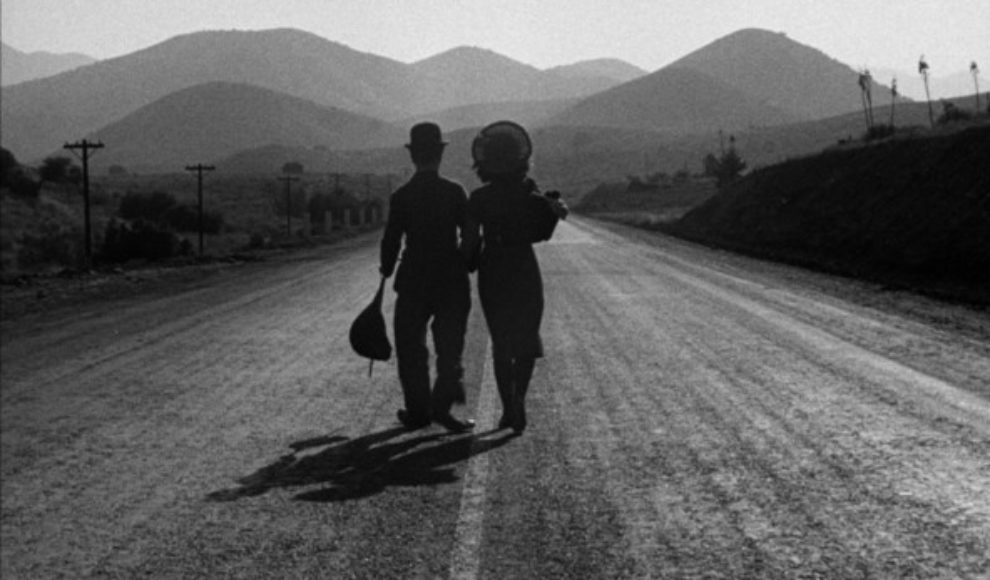
You Only Live Once (1937)

You Only Live Once
Directed by Fritz Lang
Written by Gene Towne and C. Graham Baker
1937/USA
Walter Wanger Productions
Repeat viewing


[box] Joan Graham: Anywhere’s our home. On the road. Out there on a cold star. Anywhere’s our home.[/box]

Fritz Lang continues with the man pursued by an uncaring society theme explored in M and Fury.  While this does not hit the heights achieved by those films, it is very good and Fonda turns in an outstanding early performance.

Joan Graham (Sylvia Sidney) has waited three years for Eddie Taylor (Henry Fonda) to be released from prison.  Eddie is a three-time loser and everyone warns Joan away from him but to no avail.  Eddie emerges with a huge chip on his shoulder, convinced that the world has it in for him.  This is despite the fact that Joan’s boss the Public Defender (Barton MacLaine) got him a job as a truck driver.

Joan’s love is the one good thing Eddie sees in his life and they marry immediately.  But they are thrown out of their honeymoon hotel and Eddie loses his job when he fails to return to his dispatcher on time after a run.  No one has sympathy for an ex-con.  While Eddie is out looking for work, six people are killed in a violent bank holdup and Eddie’s hat is found at the scene.  The rest of the film follows Eddie and Joan’s sad story as he is re-imprisoned and they go on the lam.


I have a couple of nits to pick but basically this is a powerful film.  Fonda is just superb as a hardened criminal with a soft spot for his girl.  He is so excellent as a tough guy that it is hard to understand where his noble persona came from.  The escape through the fog and some of the other shots reflect Lang’s mastery of the expressionist style.  Some have referred to this as an early film noir and it definitely has that flavor.

I think this film suffered particularly from the Production Code.  I read that Lang was forced to tone down the violence and the ending comes out of left field.  It also features a rather ludicrous birth without pregnancy.  This stuff is minor, though.  Recommended.

You Only Live Once is currently available to watch streaming on Netflix Instant and Amazon Prime Instant in the U.S.

Clip – prison escape – SPOILERS


The Edge of the World (1937)

The Edge of the World
Directed by Michael Powell
Written by Michael Powell
1937/UK
Joe Rock Productions
Repeat viewing


[box] “Art is merciless observation, sympathy, imagination, and a sense of detachment that is almost cruelty.” — Michael Powell[/box]

This was Michael Powell’s first major creative project after several years of directing “quota quickies”.  It is an exquisite film.

The island of Hirta in the Outer Hebrides of Scotland is cut off from the rest of the world during much of the year and accessible only by sea during the rest.  The people live a simple life herding sheep and fishing as they have for hundreds of years.  Now young people are moving away and the peat the people cut for fuel is giving out.  Most people know their days on the island are numbered but community leader Peter Manson (John Laurie) refuses to budge.  James Gray (Finlay Currie), another leader, suspects evacuation is inevitable.

Gray’s son Andrew (Niall McGinnis) is in love with Manson’s daughter Ruth.  The couple is intent on marrying and raising a family on the island.  Manson’s son Robbie has returned for a final visit.  He has fallen in love with a girl on the mainland and has no intention of bringing her back to the island.  The conflict inherent in the threads of the plot comes to a head when Robbie and Andrew engage in a contest of nerve and physical prowess.

What an eye Powell had!  This film contains some of the most stunning shots to be seen anywhere.  If people could eat scenery, Hirta would have been overpopulated.  Powell also captures the sadness and poetry of a dying way of life.  The choral music and orchestral score is beautiful.  The story is secondary I feel. Highly recommended for lovers of the visual aspects of film.

Clip – Introduction

Young and Innocent (1937)

Young and Innocent (AKA “The Girl Was Young”)
Directed by Alfred Hitchcock
Written by Charles Bennett et al based on a novel by Josephine Tey (“A Shilling for Candles”)
1937/UK
Gaumont British Picture Corporation

Repeat viewing


[box] [last lines] Erica Burgoyne: Father, don’t you think we ought to ask Mr. Tisdall to dinner?[/box]

Except for the iconic restaurant shot, this is unexceptional fare from Hitchcock, who is always entertaining.

Robert Tisdall (Derrick De Marney) is a young writer who is friendly with an older actress.  Her ex-husband is insanely jealous. Tisdall finds her strangled on a beach with the belt from his own raincoat, which was earlier stolen.  He is apprehended and taken to the local police station where things look bleak for him but he seizes an opportunity to escape.

He winds up hitching a ride in the car of the Chief Constable’s even younger daughter, Erica (Nova Philbeam).  Gradually, he earns her trust.  They spend the rest of the film trying to find the evidence to clear him amidst other adventures. With Basil Radford, later of Charters and Caldicott fame in The Lady Vanishes, as Erica’s uncle.

Young and Innocent was billed as “the successor to The 39 Steps“.  It shares a wrong-man theme and some of the cheeky flavor of that film.  It is missing the conflict between the leads that was half of the fun and the caliber of acting necessary to pull this kind of thing off.  It comes off as rather predictable, but enjoyable.  There are a couple of very good Hitchcock set pieces – a cliffhanger in a mine and the aforementioned restaurant shot.

Clip – restaurant shot

Dead End (1937)

Dead End
Directed by William Wyler
Written by Lillian Hellman based on the play by Sidney Kingsley
1937/USA
The Samuel Goldwyn Company

First viewing


[box] Hugh ‘Baby Face’: [Hugh doesn’t give a street kid money when the kid doesn’t deliver] Nothing for nothing, kid.[/box]

This gritty story of the mean streets of New York has a lot going for it, including some outstanding performances and a carefully rendered setting.

The story takes place near the Hudson River where highrise apartment buildings have sprung up that overlook a squalid tenement. A gang of unruly boys camps out on the back stoop of one of these posh buildings rough housing and annoying all the passers-by. Dave (Joel McCrea) grew up here.  He has been educated as an architect but can only get odd jobs.  He is infatuated with the beautiful Kay (Wendy Barrie) who lives in the apartment building.  Drina (Silvia Sidney) is a striking factory worker who is bringing up her younger brother Tommy in the tenements on her own.  Drina loves Dave.

Into this environment comes fugitive murderer Baby Face Martin (Humphrey Bogart).  Martin has changed his appearance with plastic surgery and has come back to his old stomping grounds after a long absence to see his mother (Marjorie Main) and girl (Claire Trevor).

Tommy joins the gang of kids.  They engage in all kinds of petty mischief but things get serious when they beat and rob a rich kid from the building.  In the meantime, Martin’s reunion with his mother and girl do not go as expected.  Martin’s anger leads him to attempt a desperate crime.

I thought this was really good in all aspects.  While Bogart is still playing a thug, he does so very sensitively.  We can see the pain in his eyes as his mother and girlfriend do not live up to his dream.  The other actors are all fine.  The collective “lead” is really Leo Gorsey, Huntz Hall and the rest of the Dead End Kids.  They give the film much of its life and have the timing down perfectly.  While the plot contains few surprises, this genre has seldom been done better.  Recommended.

Dead End was nominated for four Academy Awards:  Best Picture, Best Supporting Actress (Claire Trevor), Best Cinematography (Gregg Toland) and Best Art Direction; (Richard Day).  This was the first of seven movies featuring the Dead End Kids.  The group subsequently evolved into the East End Kids and Bowery Boys and made many B comedies.

Trailer


Adaptation. (2002)

Adaptation.
Directed by Spike Jonze
Written by Charlie Kaufman and Donald Kaufman
2002/USA
Beverly Detroit/Clinica Estetico/Good Machine/Intermedia/Magnet Productions/Propaganda Films
First viewing
#1044 of 1001 Movies You Must See Before You Die (Combined List – 2013 ver.)
IMDb users say 7.7/10; I say 8.0/10

[box] Donald Kaufman: I loved Sarah, Charles. It was mine, that love. I owned it. Even Sarah didn’t have the right to take it away. I can love whoever I want.

Charlie Kaufman: But she thought you were pathetic

Donald Kaufman: That was her business, not mine. You are what you love, not what loves you. That’s what I decided a long time ago.[/box]

Spike Jones and Charlie Kaufman have created a weird and wacky portal into the writer’s mind.  Unfortunately, this was not a place I wanted to go particularly.

Charlie Kaufman (Nicholas Cage) has an assignment to adapt Susan Orleans’s (Meryl Streep) sprawling novel  The Orchid Thief for the screen.  He has severe writer’s block compounded with depression and obsesses endlessly on his baldness, fatness, and lack of luck with the ladies.  Charlie’s twin brother Donald (also Cage) lives with him and is writing a screenplay about a serial killer with multiple personalities.  Donald is everything Charlie is not – cheerful, confident, and a  lady killer.

Much of the movie is made up of Charlie’s fantasies about the relationship of Susan Orleans with the book’s protagonist orchid hunter John LaRoche (Chris Cooper). Eventually, he puts himself into their story.

I must start by noting that I have not read The Orchid Thief and don’t really know where elements of that book and the script intersect.  I assume the film can be enjoyed without that information.  I also need to say that I could find no fault with the production itself.  The acting, in particular, is quite impressive.  I expect good things out of Meryl Streep and Chris Cooper but Nicholas Cage was a revelation here.  He nailed those twins.  Spike Jones directing style fits Kaufman’s vision perfectly.

This is a unique and wildly creative film but also a self-indulgent one with a kind of winking hipster sensibility.  It failed to engage me on an emotional or aesthetic level.  I can see how  folks that are interested in seeing the lengths to which a writer’s imagination can take him would love it.

Chris Cooper won the Academy Award for Best Supporting Actor.  The film also received nominations in the categories of Best Actor (Cage) and Best Supporting Actress (Streep) The nomination of Charlie and Donald Kaufman for Best Adapted Screenplay made Donald the first truly fictitious person nominated for an Oscar.

Trailer


Heidi (1937)

Heidi
Directed by Allan Dwan
Written by Walter Ferris and Julien Josephson based on the book by Johanna Spyri
1937/USA
Twentieth Century Fox Film Corporation

Repeat viewing


[box] Heidi: I am not her child! She’s a bad lady! She tried to sell me to gypsies! Please. Please, let the Grandfather take me home. He didn’t mean to do anything bad. I’ll work hard and pay back for everything he broke. So will Swanli and Bearli.[/box]

I loved the book as a girl and was pleased to find it when I cleaned out my parents’ house. Although Shirley Temple didn’t fit the image I had of Heidi in my head, I have a soft spot for this movie.  The story of an orphan who warms the heart of her hermit grandfather was made for little Shirley but she plays it blessedly straight in this one.

The orphan Heidi (Temple) is literally dumped at the mountain cabin of her grandfather when her aunt tires of caring for her.  The Grandfather (Jean Herscholt) is none too pleased to see her as he disowned her father for marrying her mother and has not spoken to anyone since.  But Heidi’s sweet nature gets through to the old man and he eventually warms up to the local villagers as well.

Then Heidi’s aunt shows up and steals Heidi away to serve as the companion of the crippled rich girl Klara in the big city.  Klara’s nanny Frau Rottenmeier hates Heidi on sight and treats her badly.  But Klara loves the girl and Frau Rottenmeier can’t get rid of Heidi. When Klara’s father returns from his travels, he falls in love with Heidi as well.  Heidi’s only wish is to go home to the Grandfather.  But events cause Frau Rottenmeier’s jealousy to get the better of her, threatening to separate Heidi from her home forever.

It had been years and years since I had seen this film.  I had forgotten how superb Jean Herscholt was in his role.  Shirley has a regrettable, but clearly mandatory, song and dance routine at the beginning but after that the film is a straight drama.  I thought she acquitted herself rather well in the acting department.

Trailer


The Prisoner of Zenda (1937)

The Prisoner of Zenda
Directed by John Cromwell
Written by John Balderston, Edward E. Rose et al based on the novel by Anthony Hope
1937/USA
Selznick International Pictures

First viewing

[box] Rudolph Rassendyll: But I’ve reformed.

Princess Flavia: Almost beyond recognition. You seem to be an entirely different person.[/box]

Before I get started, I have to confess that my viewing conditions for this film were far from ideal.  My rental DVD became unplayable about three-quarters of the way in.  I then resorted to watching the remainder of the film on YouTube in parts.  After I was about 10 minutes from the end I discovered that one or more scenes were missing from the YouTube footage, including the climactic sword fight!  Since I am not going to watch this again for purposes of this exercise, I will go ahead and review it.  What I saw was an entertaining adventure with an accomplished cast, though it does break down into soppy romantic melodrama at the very end.

Major Rudolf Rassendyll (Ronald Colman) is an Englishman taking a fishing holiday in a Ruritanian Eastern European country.  There he meets up with his distant relation and double Prince Rudolf (also Colman) on the eve of the latter’s coronation.  The Prince is accompanied by his stalwarts Colonel Zapt (C. Aubrey Smith) and Fritz von Tarlenheim (David Niven).  Prince Rudolf is drugged by his evil illegitimate brother Michael (Raymond Massey) who wants to seize the throne.  His friends convince Rassendyll to be crowned in the Prince’s place.

In the meantime, Michael has been plotting with his cohort in crime Rupert of Hentzau (Douglas Fairbanks, Jr.)  Michael plans to rule as Regent and then marry the Prince’s fiancée Princess Flavia (Madeleine Carroll), who is next in line for the throne.  This makes Michael’s girlfriend (Mary Astor) extremely jealous.  Rassendyll is crowned.  He and Flavia fall madly in love at the coronation.

The rest of the story traces the twists and turns of the intrigue as Michael continues to pursue the throne after the coronation.

With a cast like this, the movie has to be fun, right?  I thoroughly enjoyed it despite my many trials.  Madeleine Carroll plays a very different sort of character than her usual and has never been more meltingly lovely.  The men, despite looking very similar with their dark mustaches, are all at the top of their game.  I could have lived without so many love scenes.  Recommended.

The Prisoner of Zenda was nominated for Academy Awards for Best Art Direction (Lyle R. Newman) and Best Score (Alfred Newman – the first of his 44 nominations).  It was listed in the National Film Registry in 1991.    This was the fourth adaptation of the novel and the first sound version. The story was remade in 1952 with Stewart Granger and Deborah Kerr and as a spoof in 1979 starring Peter Sellers.

Re-release trailer

Bulldog Drummond Comes Back (1937)

Bulldog Drummond Comes Back
Directed by Louis King
Written by Edmund T. Lowe, Jr.
1937/USA
Paramount Pictures

First viewing


[box] Bulldog Drummond: Tenny, what rhymes with married?

Tenny: Married, married? Harried, Sir!

Bulldog Drummond: No, no, no Tenny, harried doesn’t go with married.

Tenny: You speak with the voice of inexperience sir![/box]

Another in the series of Bulldog Drummond programmers starring John Barrymore, John Howard, Reginald Denny and E.E. Clive.  Drummond’s plans to marry Phyllis are again foiled when she is kidnapped by a pair of foreigners seeking revenge. The kidnappers put Drummond and his pals through a series of riddles intended to culminate in their deaths. They warn that Phyllis will be immediately killed if Colonel Nielson (Barrymore) is brought in on the case.  Nielson then relies on a couple of elaborate disguises to follow the action. Barrymore had more to do here than in Bulldog Drummond’s Revenge and he was entertaining. A fun way to kill an hour, if nothing much more than that.


Kid Galahad (1937)

Kid GalahadKid Galahad poster
Directed by Michael Curtiz
Written by Seton I. Miller from a story by Francis Wallace
1937/USA
Warner Bros.

First viewing


Nick ‘Nicky’ Donati: Say, did you ever see a bellhop didn’t want to be a fighter?

I thought this was a pretty good boxing movie with strong performances by Edward G. Robertson and Humphrey Bogart.

Nick Donati (Robinson) is a rough-edged fighting promoter who expects 100% obedience from his fighters.  “Fluff” (Bette Davis) is his assistant.  There are hints that Fluff might want something else from the relationship but Nick is oblivious.  Nick’s fighter throws a fight to the thuggish Turkey Morgan’s (Bogart) fighter, Chuck McGraw.  At an after-fight party, bell boy Ward Guisenberry (Wayne Morris) knocks out Chuck defending Flips honor. Nick decides Ward has potential.  After Ward knocks out Turkey, Fluff decides to hide him at the farm of Nick’s mother.  There Ward meets and falls in love with Nick’s convent-educated sister.  This does not set well with Nick, to say the least.

Kid Galahad 1

This is fairly routine stuff but Robinson takes it to another level when he is on.  Bogart is also dynamic in a one-note tough guy role.  Bette Davis is still playing the ingenue and it doesn’t suit her well.  Possibly my favorite moment of the film came when Robinson spoke Italian with great fluency and at some length in a scene with his screen mother.

Bette Davis was nominated for Best Actress for this film and Marked Woman at the Venice Film Festival and Michael Curtiz was nominated for the Mussolini Cup for Best Director.

Clip – Bette Davis, night club singer (!)

A Star Is Born (1937)

A Star Is Bornstar is born poster
Directed by William A. Wellman
Written by Dorothy Parker, Alan Campbell, and Robert Carson from a story by William A. Wellman and Robert Carson
1937/USA
Selznick International Pictures

Repeat viewing

Matt Libby: That’s a charming match. A nice girl like Vicki and Public Nuisance Number One.

I enjoyed this more than my memory of it lead me to expect.

Esther Blodgett (Janet Gaynor) dreams of stardom on her South Dakota farm.  Her folks are opposed but her grandmother (May Robson) sympathizes and finances her trip to Hollywood.  Esther can’t get a break, though.  Then she chances to meet alcoholic movie star Norman Maine (Fredric March) and he helps her get a screen test.  They fall in love and, when Norman promises to reform, marry.  Everything starts coming up roses for Esther, who is rechristened Vicky Lester, but Norman begins a long slow slide.  With Adolphe Menjou as a producer, Lionel Stander as a caustic press agent, and Andy Devine as Esther/Vicky’s friend.

Star-Is-Born 1

I had forgotten many things about this melodrama, notably what a cynical indictment of Hollywood is concealed behind the tears.  You can really sense Dorothy Parker’s hand in this.  Also, this has got to be one of Fredric March’s very best performances.  He is a wonderful drunk, not comic or exaggerated.  At times, you can kind of see Mr. Hyde peeking through.  Janet Gaynor is also still lovely and vulnerable at this late date in her career.

This was the first all-color film to be nominated for a Best Picture Academy Award.  The film won an Oscar for Best Writing (Original Story) and was nominated for awards for Best Actor (March), Best Actress (Gaynor), Best Director, Best Writing (Screenplay), and Best Assistant Director.  W. Howard Green won an Honorary Award for his color cinematography.

Trailer