Son of Fury: The Story of Benjamin Blake (1942)

Son of Fury: The Story of Benjamin Blake
Directed by John Cromwell
Written by Philip Dunne from a novel by Edison Marshall
1942/USA
Twentieth Century Fox
First viewing/Netflix rental


[box] Eve: You will go! If you stay out of pity, I will throw myself in sea.[/box]

This is an OK costume drama notable for a unique chance to see George Sanders boxing bare-chested.

It is sometime in the 18th Century.  Young Ben (Roddy MacDowall)  is being raised by his humble grandfather to become a blacksmith.  The other children tease him because he has no name.  One day, Sir Arthur Blake (Sanders) comes into the shop, announces that Ben is the illegitimate son of his deceased older brother and the gunsmith’s daughter, and takes Ben away to live with him ostensibly to be educated.  Instead, Ben is made an indentured servant and treated even more cruelly than the rest of the heartless Sir Arthur’s minions.  He grows up to be Tyrone Power.

Sir Arthur’s daughter Isabel (Frances Farmer) lusts after the handsome Benjamin and eventually falls in love with him.  Finally, he can bear his mistreatment no more and attacks Sir Arthur.  Now he is a fugitive.  He escapes as a seaman on a vessel headed on an around the world voyage.  He meets fellow seaman Caleb Green who tells him of a fortune in pearls to be found off the coast of a South Sea Island,  They detour the ship and go AWOL on the island.

 The islanders had previously been visited by Spaniards who abused them and are hostile to the two adventurers.  But when Benjamin shows them the scars on his own back the locals accept them with open arms.  Benjamin is promptly enchanted by the beautiful islander he calls “Eve” (Gene Tierney).  He declares her his bride since no one knows when another ship will arrive to take the pearl hunters back to England.

Their ship does come in and the rest of the story is devoted to Benjamin’s adventures as he seeks to redeem his rightful inheritance courtesy of the treasure trove of pearls he brings with him.  With Elsa Lanchester as a prostitute who helps Benjamin escape.

This is alright but I didn’t find it gripping.  This kind of thing isn’t usually for me though and those who like costume dramas will find this a very polished one.

This was the last film Frances Farmer made before alcoholism and erratic behavior caused her parents to commit her to a series of insane asylums.

Trailer


Bambi (1942)

Bambi
Directed by David Hand et al
Written by Perce Pearce, Larry Morey et al from the story by Felix Salter
1942/USA
Walt Disney Studios
Repeat viewing/Netflix Rental


[box] Young Bambi: What happened, Mother? Why did we all run?

Bambi’s Mother: Man was in the forest.[/box]

What is it about the folks at Disney and separation anxiety?  This beautifully drawn animated feature takes it to a whole new level.

The fawn Bambi’s father is the Prince of the Forest and Bambi will inherit that title when he grows up.  We see him getting to know new friends in the forest, including the rabbit Thumper, the skunk Flower, and Friend Owl.  The woods are populated with a host of birds and small mammals.  The deer enjoy a life without animal predators.  Everybody sings and plays.

Spoiler alert.  Then one day, Bambi’s mother takes him to the beautiful meadow.  She warns him that it is very dangerous because there is no way to hide from Man.  Bambi gets to know the female fawn, Faline.  Soon enough, poor Bambi’s mother is shot and killed by hunters.  Bambi goes off with his father, who really hasn’t been in the picture up to now.  Bambi grows up to be a fine young buck.  He pairs off with Faline.  Then come more hunters.  They almost get Bambi.  He survives to confront a massive, very scary forest fire,  Faline is attacked by savage dogs.  Then all of a sudden the circle of life is complete and Bambi is presiding over the birth of twin fawns.

I haven’t seen this movie since I was a child myself and I didn’t have any desire to see it again until now.  It may have permanently scarred me.  How could Disney do this to us?

The first part of this movie is animated to appeal to very small children.  It has the kind of gentle sweetness that pre-schoolers would like.  All the children go merrily along identifying with Bambi and then they lose their mother?  I’m sure all the events after that are meant to provide drama and excitement but I thought they would be pretty horrifying for someone small.  The animation can’t be faulted though and there is a kind of realism behind the anthropomorphized creatures that is very nice.  The music is pleasant too.

Bambi was nominated for Academy Awards for Best Sound, Recording; Best Music Original Song (“Love Is a Song”); and Best Music, Scoring of a Dramatic or Comedy Picture.

Clip – Spring is in the air


Woman of the Year (1942)

Woman of the Year
Directed by George Stevens
Written by Ring Lardner Jr. and Michael Kanin
1942/USA
Metro-Goldwyn-Mayer
First viewing/Netflix rental

[box] Sam Craig: I don’t want to be married to Tess Harding any more than I want you to be just Mrs Sam Craig. Why can’t you be Tess Harding Craig?

Tess Harding: I think it’s a wonderful name.[/box]

This was the first of the nine pictures in which Katharine Hepburn and Spencer Tracy were paired and the beginning of one of Hollywood’s most iconic love affairs.  Their chemistry fairly explodes from the screen.

Tess Harding (Hepburn) is multi-talented, multi-lingual and knows everybody who is anybody.  She is a political columnist on a New York paper.  During a radio interview she is asked who will win the World Series and replies that people should put such frivolous things as sports aside for the duration.  Sam Craig (Tracy), the sports columnist on the same paper, is mightily offended by this and the two start sparing in their columns.  But when Sam actually meets Tess the attraction is instantaneous.  He asks her out to a baseball game and she falls for him too.  After some very romantic scenes they marry.

Married life is nothing like what Sam expected or wanted.  Tess is in such demand that they can hardly get a moment alone together, even on their wedding night.  And Tess, despite her true love for Sam, doesn’t seem to understand that there are two people to take into account now.  The final straw comes when she adopts a little Greek refugee without asking Sam about it.  Can such a marriage ever work out?  With Fay Bainter as Tracy’s aunt.

I had seen so many clips from this film in documentaries that I was sure I had seen it before.  Not so and it has become a new favorite.  I hope Tracy’s wife didn’t see it since it is very clear that the two are madly in love.  This is one of those rare romantic comedies that is also mature and intelligent at the same time.  I absolutely loved it.  Highly recommended.

Woman of the Year won the Academy Award for Best Writing, Original Screenplay. Katharine Hepburn was nominated as Best Actress.

Tracy and Hepburn meet for the first time in a movie

You Were Never Lovelier (1942)

You Were Never Lovelier
Directed by William Seiter
Written by Michael Fessier, Ernest Pagano, and Delmer Davies from a story by Carlos Olivari and Sixto Pondal Rios
1942/USA
Columbia Pictures Corporation
First viewing/Netflix rental

[box] Lita Acuña: Just think papa, you’ve been married longer than we’ve lived!

Eduardo Acuña: I consider that a very fortunate coincidence, my dear.[/box]

The plot could not be more inane but the songs and dances are very nice.

The irascible nightclub owner Eduardo Acuña (Adolphe Menjou) has four daughters.  He intends to strictly inforce the family tradition that the girls will marry in order by age. Unfortunately for the two youngest girls, who both have longtime fiances, their older sister Maria (Rita Hayworth) has never met a man who captured her imagination.  Acuña himself starts to send Maria anonymous love letters and boxes of orchids every day to get her in the proper mood.

In the meantime, dancer Robert Davis (Fred Astaire) has gone broke playing the ponies and tries desperately to get an audition with Acuña who takes an instant dislike to him. Robert grabs the orchids one day and delivers them to the house.  When Maria spots him it is love at first sight.  Glad that Maria is in love but disgusted by her choice, Acuña bribes Robert with a job at his club to disillusion the girl.  Needless to say, Acuña is stuck with a son-in-law not of his choosing instead.  With Xavier Cougat and his orchestra.

The film is blessed with a couple of great standards (“I’m Old-Fashioned” and “Dearly Beloved”) and other good songs, fantastic dancing, and beautiful sets and costumes. Musical lovers need no more for an entertaining romp.  Unfortunately, the movie has one of those “idiot” plots that would fall apart like a house of cards if even one of the protagonists acted like a normal human being for five minutes straight.  It’s also the kind of story where love turns on and off on a dime that I find particularly irritating.  I enjoyed the film any way.

You Were Never Lovelier was Oscar-nominated for Best Sound, Recording; Best Music, Original Song (“Dearly Beloved” by Jerome Kern and Johnny Mercer); and Best Music, Scoring of a Musical Picture (Leigh Harline).

Fred Astaire sings “Dearly Beloved”


Saboteur (1942)

Saboteursaboteur-movie-poster-1942-1020220992
Directed by Alfred Hitchcock
Written by Peter Vertiel, Joan Harrison and Dorothy Parker
1942/USA
Frank Lloyd Productions
Repeat viewing/Netflix rental


Charles Tobin: Very pretty speech – youthful, passionate, idealistic. Need I remind you that you are the fugitive from justice, not I. I’m a promient citizen, widely respected. You are an obscure workman wanted for committing an extremely unpopular crime. Now which of us do you think the police will believe?

This is easily Hitchcock’s most political and patriotic movie.  It doesn’t particularly help the suspense.

Barry (Robert Cummings) works at a defense plant.  One day his friend bumps into the unfriendly Fry who drops a lot of letters and a hundred dollar bill.  Barry notes the man’s name so he can return the money.  Soon afterward the three men are together again watching a fire that has broken out.  Barry and his friend decide to try to fight the fire.  Fry hands the friend a fire extinguisher that causes the flames to explode into a huge fire ball, killing the friend.  The extinguisher was filled with gasoline.  Barry becomes the prime suspect in the sabotage.  His case isn’t helped when no employee by the name of Fry is on the payroll of the plant.

saboteur 1

Barry flees the police.  He heads for the address on the envelopes he saw drop from Fry’s pocket.  There he meets affable wealthy rancher Charles Tobin (Otto Kruger).  Tobin’s little granddaughter unwittingly reveals another stack of letters that proves Tobin to be a Fifth Columnist.  Tobin turns Barry over to the police but he miraculously escapes.  Now he is on the run from both Tobin’s gang and the police,

Barry is caught in a downpour and takes shelter in the cabin of a sympathetic blind man.  The man’s niece Pat (Priscilla Lane) arrives and spots Barry’s handcuffs.  She is a patriot who wants to turn him over to the police.   But Barry takes her as a kind of hostage and the rest of the film plays out remarkably like the story of The 39 Steps.

saboteur 2

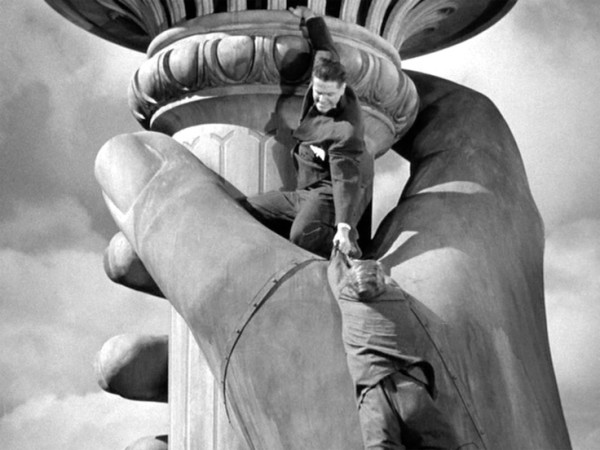
My favorite part of this film is Otto Kruger’s perfomance.  He is so deliciously evil!  The final set piece on the Statue of Liberty is memorable.  Aside from being a highly patriotic affair with much speechmaking, it is also interesting that wealth is clearly associated with Nazism by the writers.  Bigger stars or better actors in the leads might have helped this film but the speechifying probably would have dragged it down any way.  Not bad but not a standout in Hitchcock’s cannon.

Trailer

In This Our Life (1942)

in-this-our-life-movie-poster-1942-1020457948In This Our Life
Directed by John Huston
Written by Howard Koch from a novel by Ellen Glasgow
1942/USA
Warner Bros.
First viewing/Netflix rental


Stanley Timberlake: You’re afraid aren’t you? Afraid of yourself. Afraid of what you might feel if you let yourself go. Why don’t you admit the truth Craig? You’ve never gotten over me and you never will. You’d like to put your arms around me right now, wouldn’t you? You’d like to kiss me, wouldn’t you?

John Huston directs a “woman’s picture?”?  Yes, and it’s not bad.

Stanley (Bette Davis) and Roy (Olivia de Havilland) Timberlake are sisters.  (The origin of their masculine names is never explained).  Stanley is a wild thing famous for careening around in the car her uncle gave her.  Uncle William (Charles Coburn) is a kindred spirit, an amoral rapscallion who robbed the family business from the girls’ father.  As the story begins, Stanley’s latest impulsive move is to run away with her sister’s husband Peter (Dennis Morgan) the night before her planned wedding to fiance Craig (George Brent).

in this our life 1

The runaways cause enormous pain of course but Roy is determined to be strong and live her liife and gives Craig the courage to carry on as well.  Roy and Craig, a liberal lawyer, naturally fall in love.  Peter is punished for his sins by marrying Stanley who leads him a miserable existence.  I will not spoil the rest of the story except to say that Stanley gets herself deeper and deeper into hot water.  With Frank Craven as the sisters’ father and Billie Burke cast against type as their invalid, hysterical mother.

in this our life 2

I never like Bette Davis better than when she is bad and she is really rotten here.  Olivia De Havilland’s calm lady-like but strong performance is a perfect foil to Davis’s histrionics.  Bette Davis called this the worst movie in the history of the world and both Jack Warner and Hal Wallis begged Huston to tone down her performance but I think it is pretty delicious.  Davis’s make-up gave her a new look that was not a hit with audiences but I thought it made her more attractive than usual.  The story is pretty silly of course but it does present a young black man with aspirations to a career, something unusual at the time.

The Warner Home Video DVD I rented has an excellent commentary.

Trailer

Wake Island (1942)

Wake Islandwake island poster
Directed by John Farrow
Written by W. R. Burnett and Frank Butler
1942/USA
Paramount Pictures
First viewing/Universal Studios DVD


Maj. Geoffrey Caton: Boys, the honeymoon’s over. From now on you’re marines.

Why, if  Wake Island is the first “action” WWII movie, does it feel like such a cliche?  Maybe this is where these cliches started?

The film began production before the December 1941 battle for Wake Island was over and is a highly dramatized account of the Marines defense of the U.S. garrison on the island beginning on the day Pearl Harbor was attacked.

The story begins as Major Geoffrey Caton (Brian Donlevy) is arriving to take command of the sleepy outpost.  From the beginning, he clashes with crusty Shad McClosky (Albert Dekker) who is arriving to supervise the civilian construction crew on the island.  At the same time we get the back stories of several of the Marines including cutup “Smacksie” Randall (William Bendix) who is being discharged and shipping home to marry his sweetheart and pilot Lt. Bruce Cameron (Macdonald Carey) whose wife is working at Pearl Harbor.

Wake-Island 2

All the kidding around and squabbling stops when the Japanese attack the island. Although they are vastly outnumbered, the Marines fight on to the last man, inflicting serious damage on the enemy.  With Robert Preston as a Marine private.

Wake Island 1

Although the film implies that there were no survivors, the garrison surrendered after the first wave of attacks.  The Marines were sent to POW camps in Japan but the construction crew remained on the island as forced labor to build up defenses for the Japanese.  Ninety-nine of these civilians were massacred when the Japanese expected an Allied attack to retake the atoll.  The commander that ordered the murders was later executed as a war criminal.

This was my first viewing but I certainly felt like I had seen this before.  It has all the usual Hollywood combat picture tropes excepting a multi-ethnic platoon which I imagine emerges soon enough.  The combat scenes are good, though

Wake Island was nominated for four Academy Awards:  Best Picture; Best Director; Best Supporting Actor (William Bendix); and Best Writing, Original Screenplay.

In Which We Serve (1942)

In Which We Serve
Directed by Noel Coward and David Lean
Written by Noel Coward
1942/UK
Two Cities Films
First viewing/Netflix rental


[box] (last line) Voiceover: God bless our ships… and all who sail in them.[/box]

This has been the best yet in my mini-festival of 1942 British films made to prepare the populace for hard times to come.

In Which We Serve is a tribute to a ship, the HMS Torrin, the men who love her, and the women who love them.  Noel Coward plays the captain of the ship E.V. Kinross, a character closely modeled on his friend Lord Mountbatten.  Cecilia Johnson, in her film debut, plays his wife.

The story begins with the dive bombing of the ship and is told in flashback as some of the survivors cling to a life raft and ponder the past.

We follow the fate of the ship from its construction in the run-up to Britain’s entry into the war through various engagements, its evacuation of soldiers from Dunkirk, and its eventual sinking.  We witness the wives and sweethearts of the sailors saying goodbye repeatedly to their men and displaying their own heroism during the Battle of Britain.

Noel Coward brought in seasoned editor David Lean to direct the action sequences. as his directorial debut.  Coward soon tired of his directing duties leaving Lean at the helm for most of the shooting.  He did a really superb job on a very complicated project.  The acting is uniformly top-notch.

As I mentioned before many of the films of this period seem designed to teach the British how they were expected to deal with adversity – i.e. with a stiff upper lip, good humor, and courage.  There are many touching moments in the story whose pathos was only heightened with the bravery with which the men and women carried on in spite of everything.  Warmly recommended.

The film is apparently in the public domain and is widely available online.

Noel Coward won an honorary award at the 1943 Academy Awards ceremony for “his outstanding production achievement in In Which We Serve“.  The film was nominated for Best Picture and Best Writing, Original Screenplay the following year.

In Which We Serve marked the screen debut of Richard Attenborough who died on August 24, 2014.  May he rest in peace.

Trailer

The Major and the Minor (1942)

The Major and the Minor 
Directed by Billy Wilder
Written by Charles Brackett and Billy Wilder; suggested by a play by Edward Childs Carpenter; from a story by Fanny Kilbourne
1942/USA
Paramount Pictures
First viewing/Netflix rental

[box] First Conductor: If you’re Swedish, suppose you say something in Swedish.

Susan Applegate: I vant to be alone.[/box]

Billy Wilder’s directorial debut is made with his characteristic panache but I found the premise vaguely icky.

Susan Applegate (Ginger Rogers) finally gets a job in New York City. On her first night as an in-home scalp masseuse, she is repeatedly propositioned by her randy middle-aged client (Robert Benchley).  This is the final straw and Susan decides to return home to small town Iowa.  She has saved the return fare in a sealed envelope but when she tries to buy a train ticket she discovers that the price has increased.  Broke, she disguises herself as a twelve year old to ride on the half-price children’s fare.

Conductors on the train find the disguise none too convincing and Susan slips into a sleeping compartment for shelter.  Surprisingly, the occupant Major Kirby buys Susan’s age hook, line and sinker leading to a number of risqué situations in which he tries to put Susan into bed with him to calm her fears of thunder, etc.

Kirby takes Susan to the military academy where he works as an instructor and is engaged to the very single-minded daughter of its commandant, Pamela.  He refuses to let Susan ride home alone, so she is subjected to the unwanted attentions of the teenage cadets.  Susan is put up in the room of Pamela’s kid sister Lucy (Diana Lynn) who is immediately wise to the ruse.  Lucy is willing to keep the secret, though, since she has little use for her sister and is trying to fight Pamela’s efforts to keep Kirby at the academy despite his desire to go on active duty in the army.  Lucy and Susan, who is falling for Kirby, team up to try to get him his wish.

There is nothing per se wrong with this highly rated film.  Rogers, in particular, is excellent. She might even pass for a precocious twelve-year-old.  The trouble is that she often acts more like a six-year-old.  The other problem is that there is something that just seems wrong with using a twelve-year-old’s age to get away with a bunch of double entendres, however witty.  Otherwise, I would say go for it.

Trailer

Went the Day Well? (1942)

Went the Day Well?
Directed by Alberto Cavalcanti
Written by John Dighton, Diana Morgan, and Angus MacFail from a story by Graham Greene
1942/UK
Ealing Studios
First viewing/Lionsgate DVD

[box] Went the day well?/We died and never knew/But well or ill/Freedom, we died for you. — Title card[/box]

Ealing Studios is generally associated with comedies.  This fine early effort is anything but.

Although the film was made while the outcome was far from clear, the story is told in flashback from a time after the Allies have won WWII.  A group of German parachutists disguised as “Royal Engineers” takes over a small English town as an advance team for the upcoming invasion of Britain.  They are assisted in their nefarious scheme by local Fifth-Columnist Oliver Wilsford (Leslie Banks).

After initially cooperating, the villagers discover the identity of the soldiers fairly early on. The Nazis react by herding everyone into a church and terrorizing them.  Unfortunately, the villagers nominate Wilsford as their spokesman.  The rest of the story follows their heroic efforts to make their plight known to the authorities.

I was surprised at how graphic and hard-hitting this movie was.  The Nazis are, of course, beasts but the villagers are driven to equal brutality by the end of the piece.  The most loathsome of the characters, however, is the oily Wilsford.  The film must have been a powerful means of rousing the people during the darker days of the war when fears of invasion were running high.  Very interesting and recommended.

Trailer for the BFI restored release