House of Frankenstein (1944)

House of Frankenstein
Directed by Erle C. Kenton
Written by Edward T. Lowe Jr. from a story by Curt Siodmak
1944/USA
Universal Pictures
First viewing/Netflix rental


[box] [last lines] Dr. Gustav Niemann: Quicksand![/box]

This all-Monster sequel to The Wolf Man Meets Frankenstein was only further proof that Universal had jumped the shark in its horror franchise.

The film more or less takes up with the situation at the Frankenstein castle as at the end of its predecessor.  Criminially insane Dr. Gustav Niemann (Boris Karloff) escapes with his assistant the hunchback Daniel (J. Carroll Naish) following a prison fire.  The doctor, who had been jailed for attempting to put a dog’s brain in the body of a man, is bent on revenge on the village authorities who locked him up.  On the road, the two run into a carny who is exhibiting the skeleton of Dracula.  Knowing that he need only remove the stake to revive the vampire, Niemann has Daniel murder the carny, revives the Count (John Carradine), and takes the show into town.

Niemann is determined to continue his experiments, this time with the brains of the village leaders.  He thinks he will receive instruction from Dr. Frankenstein’s records and goes to the castle to search for them.  There he finds Larry Talbot (Lon Chaney Jr.) and Frankenstein’s Monster (Glenn Strange) encased in ice.  He revives Talbot, who shows him to the documents in exchange for his promise to free him of the Wolf Man curse.  In the meantime, we get a love triangle between the hunchback, Talbot, and a gypsy girl (shades of The Hunchback of Notre Dame).  Mayhem ensues.  With Lionel Atwill and Sig Rumann in their old roles as village fathers.

I can just imagine the story conference at Universal.  Somebody said “why not throw in all our monsters?” We can promise the public five times the thrills!  But it just doesn’t work that way.  Instead we get a incoherent, confusing story with snippets of horror action.  Karloff is always effective but it was a mistake to put the Frankenstein monster in the same movie with his originator.  This just highlights the pathetic lameness of Glenn Strange’s creature.  Fortunately, he is only in the film for a very few minutes at the end.  Still an improvement over Lugosi in the same role in The Wolfman meets Frankenstein.

Trailer

Passage to Marseille (1944)

Passage to Marseille
Directed by Michael Curtiz
Written by Casey Robinson and Jack Moffitt from a novel by Charles Nordhoff and James Norman Hall
1944/USA
Warner Bros
First viewing/iTunes rental

[box] Maj. Duval: Haven’t you been taught to stand in the presence of officials?

Jean Matrac: [Flatly] No.[/box]

Warner Brothers attempts to recapture the success of Casablanca with this story of Devil’s Islands escapees turned French freedom fighters. It can be forgiven for not reaching the heights of the former film.

Crusading journalist Jean Matrac (Humphrey Bogart) is accused of inciting a riot and sent off to Devil’s Island leaving his new wife (Michéle Morgan) behind.  Devil’s Island strips him of his ideals quickly.  Then a group of men who speak patriotically of France are approached by freed convict “Grandpere” (Vladimir Sokoloff) who has gathered a sum of money together and would like to take a group of men willing to fight for the Free French along with him on his escape.  The men point to Matrac as the natural leader of such an endeavor.  Matrac, however, is silent as the old man makes the escapees swear an oath to fight for France.

The band manages to leave the island and a passing French freighter rescues the nearly starving men after many days.  They concoct a story about having been miners in Venezuela but fellow passenger Major Duval (Sidney Greenstreet) sees right through them. They finally confide the truth to the other officer on board Captain Freycinet (Claude Rains).

During the journey, everyone learns of the armistice between Marshall Petáin and the Nazis.  The ship’s captain and Freycinet decide to divert the ship from its course toward Marseille and take its cargo of vital nickel ore to England.  Duval insists that the freighter go on to France and persuades part of the crew to side with him.  A fight between the factions ensues, putting Matrac’s patriotism to the test.  With Peter Lorre, John Loder, and George Tobias as convicts.

It was a treat to see Bogart, Greenstreet, Lorre and Rains together again.  This is a pretty entertaining picture.  Why do they always have to kill off the youngest member of any company right after he makes a patriotic speech, though?

The Keys of the Kingdom (1944)

The Keys of the Kingdomkeys-of-the-kingdom-movie-poster-1944-1020746572
Directed by John M. Stahl
Written by Joseph L. Mankiewicz and Nunnally Johnson from the novel by A.J. Cronin
1944/USA
Twentieth Century Fox Films Corporation

First viewing/Netflix Instant

Father Francis Chisholm: Dear Lord, let me have patience and forbearance where now I have anger. Give me humility, Lord; after all, it was only thy merciful goodness and thy divine providence that saved the boy… but they *are* ungrateful and You know it!

I’ve been putting this off for awhile. It wasn’t my cup of tea exactly but I needn’t have worried.

Father Francis Chisholm (Gregory Peck) is now an old man trying to enjoy some last peaceful years at the parish of his childhood home in Scotland.  The Bishop, an old childhood friend named Angus Mealey (Vincent Price), has had complaints about the priest due to his unorthodox views and wants him to retire.  He sends an emissary (Sir Cedrick Hardwicke) to assess the situation.  While staying the night, the monsignor chances on Father Chisholm’s diary.  We segue into flashback.

We follow Francis from his youth in a household of a Catholic father and Protestant mother.  The prejudiced townsfolk beat the father mercilessly and both father and mother drown in an accident as she is trying to get him home.  Francis is raised by a Catholic friend of the family.  His adoptive mother’s dearest wish is that Francis become a priest but he is more interested in marrying Nora.  But Nora, despairing that he will really come home to her from university, “goes bad”, becomes an unwed mother and dies before he can return to her.  Francis, who had lately been leaning toward the priesthood any way, is now easily convinced to enter the seminary by his mentor at school Father Hamish MacNabb (Edmund Gwynne).

keys2

After his ordination, Father Francis tries his hand as a parish priest but is a “failure”.  His doctrine of universal brotherhood and love is something too unorthodox for local Catholics.  McNabb tells him to never change and sends him to do missionary work in China.

After his arrival at a rural village, Father Francis begins to despair of ever winning converts.  He refuses to supply people with rice in exchange for their conversion. Finally, a Christian Chinese named Joseph (Benson Fong) comes along to help.  The priest’s big break comes when he gets a shipment of medical supplies from his atheist friend Willie Tulloch (Thomas Mitchell) at home.  He cures a local mandarin’s son and, while he refuses to allow the man to convert as a form of thanks, he does accept land and a church building from him.

We follow Father Chisholm’s 40 year stay in China as he builds a congregation and tries to defend it during the Civil War.  A subplot involves the aristocratic and dismissive Mother Superior who heads a group of nuns sent to help in the work.  With James Gleason and Anne Revere as Protestant missionaries.

keys of kingdom 1

I have to admit that I am not a big fan of Gregory Peck, unfortunately.  He is less pedantic sounding than usual at this stage of his career, however.  The movie is long but fairly solid. I think viewers will react based on their feelings about the subject matter.  All the Chinese are played by Chinese-American actors instead of in yellow face, thank goodness.

Gregory Peck was nominated for a Best Actor Oscar for this, only his second screen appearance.  The Keys of the Kingdom was also nominated for Best Cinematography, Black-and-White; Best Art Direction-Interior Decoration, Black-and-White; and Best Music, Scoring of a Dramatic or Comedy Picture (Alfred Newman).

Trailer


Wilson (1944)

Wilson
Directed by Henry King
Written by Lamar Trotti
1944/USA
Twentieth Century Fox Film Company
First viewing/Amazon Instant Video


Tagline: DRAMA AND SPECTACLE UNPARALLELED! ENTERTAINMENT UNDREAMED OF! 12,000 PLAYERS! 200 MIGHTY SCENES! TOLD TO THE TUNE OF 87 BELOVED SONGS!

Every time I looked at the clock, there were at least eleven more hours left of this very dull biopic.

The story follows the life of Woodrow Wilson (Alexander Knox) in a linear fashion for 154 minutes. While he is President of Princeton University, one of the New Jersey bosses prevails on him to run for Governor of New Jersey.  His lack of political experience is seen as an asset.  The idea appeals to Wilson, a scholar of political science, as an opportunity to put his ideas of social equality into practice.  After consulting his adoring wife Ellen and three daughters, he agrees to run on a reform platform.  Wilson surprises his mentor by haranguing against the political machine.

After a successful stint as Governor, he is urged to run for the Democratic Presidential nomination.  A split in votes between the two front runners, Jim Clark and William Jennings Bryan, leave Wilson as the nominee.  The split in votes between the incumbent President William Howard Taft running on the Republican ticket and former President Theodore Roosevelt running as an Independent put Wilson in the White House.  In spring of 1914, Wilson’s wife Ellen dies suddenly throwing him into a depression.  Within months he is restored to his former vigor when he falls in love with and begins to court socialite Edith Gault (Geraldine Fitzgerald).  Overcoming her initial reluctance, they marry in December 1915.

Despite urging by many prominent people, Wilson uses every effort to keep the U.S. out of World War I.  He runs for re-election on a “he kept us out of war” platform and wins in a close race against Charles Evans Hughes.  But German perfidy changes his mind in 1917.  Still deeply committed to internationalism, Wilson labors at the Paris Peace Conference to put together a lasting peace guaranteed by a League of Nations that would mediate future disputes.  But Wilson runs into serious opposition at home, and must engage in a grueling national tour to whip up public support for his idea.  The strain of the trip leads to his collapse of a stroke which paralyzes his left side.  Edith insulates him from the rigors of office and acts as a go-between during the remainder of his term.  With a host of great character actors including Thomas Mitchell, Sir Cedric Hardwicke, Charles Coburn and Sidney Blackmer and with Marcel Dalio as Premier Georges Clemenceau.

Something must have happened to Darryl F. Zanuck’s instincts during his stint in the Army.  When he returned to the studio, he became consumed with making this movie, which cost more than Gone with the Wind.  His enthusiasm for the subject seems to have blinded the normally savvy producer to the probable reaction of the public.  Although the movie received good critical reviews, it was a colossal failure at the box office.

It is easy to see why.  The Academy Award-winning screenplay is the heart of the problem.  The characters do not converse.  They either orate patriotically or convey expository information.  And nothing really happens as we plod along the course of a life that should have been familiar to most Americans either from experience or history books.  I found it absolutely deadly, though you certainly cannot really fault the actors or the production values.

Wilson won Academy Awards in the categories of: Best Writing, Original Screenplay; Best Cinematography, Color (Leon Shamroy); Best Art Direction-Interior Decoration, Color; Best Sound, Recording, and Best Film Editing.  It was nominated in the categories of: Best Picture; Best Actor; Best Director; Best Effects, Special Effects (????); and Best Music, Scoring of a Dramatic or Comedy Picture (Alfred Newman).

To see clips on TCM’s website go here


The Way Ahead (1944)

The Way Ahead (AKA The Immortal Battallon)
Directed by Carol Reed
Written by Peter Ustinov and Eric Ambler based on an original story by Ambler
1944/UK
Two Cities Films
First viewing/YouTube

Pvt. Ted Brewer: Only one good man ever got into Parliament.
Pvt. Herbert Davenport: Oh really? Who?
Pvt. Ted Brewer: Bleedin’ Guy Fawkes.

Sometimes as I work my way down the list of films to see for a given year, I am tempted to succumb to a bit of boredom and cut things short.  Then an obscure little gem like this shows up and my enthusiasm is restored.

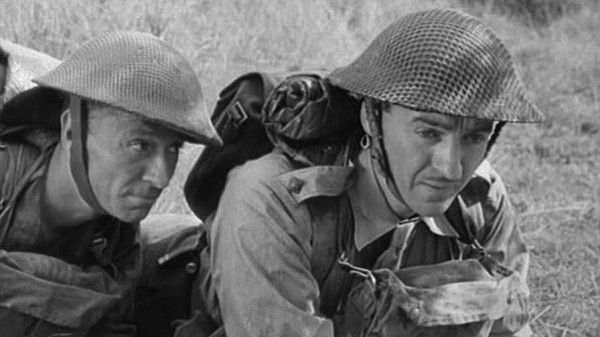
As the film begins, we see Lieutenant Jim Perry (David Niven), a recent returnee from Dunkirk and a career officer, training for combat duties.  We then move on to see the reactions of different men to the receipt of their draft notices. They range in occupation from a farmer and boiler mechanic to salesmen in a high-tone department store to a travel agent.  None is enthusiastic about joining the Army.  The stories of all intersect when their trains converge at the station from where all the men will travel to boot camp.  Unfortunately for the men, they have a confrontation with a uniformed soldier, who has heard all their defiance for authority and turns out to be their drill sergeant.

WayAhead01

The complaints continue once the men don their uniforms.  They believe their sergeant is working them extra hard because of the encounter at the train station.  One soldier goes so far as to complain to the lieutenant.  Then they get out of a war game by letting the enemy “kill” them.  The lieutenant skillfully shames them and eventually the men become a proud team of infantrymen ready and able to take on combat duty in North Africa.  With Stanley Holloway,John Laurie, and James Donald among the recruits and the twenty-one-year-old Peter Ustinov as a cafe keeper in North Africa (he speaks only French in the film). Trevor Howard made his screen debut in a small part as an officer on a transport vessel.

way ahead 2

I can’t understand why this film is not better known given the director and writers attached to it.  Most of the picture takes place in boot camp but there are some impressive action scenes both on a ship and defending a village toward the end.  The characters are all so human and we get to know them very well.  Although it had its origins as an army training film, it is remarkably free of sentimentality or jingoism.  It held my interest all the way through.  I can warmly recommend it.

Clips – one from the beginning and one from the very end

Samurai (1945)

Samurai (AKA “Orders from Tokyo”)
Directed by Raymond Cannon
Written by Raymond Cannon
1945/USA
Cavalcade Pictures
First viewing/Amazon Instant Video

Tagline: THE VILE JAP CODE THAT HORRIFIED THE CIVILIZED WORLD!

I’ve stopped reviewing most of the B pictures I watch on the blog but I found one so wrong-headed and laughably awful that I just had to share.

America in its great humanitarianism reached out to the people of Tokyo with massive aid during the 1923 earthquake.  Saintly medical missionaries Mr. and Mrs. Morley find little orphaned Ken lying amid the rubble, adopt him and take him home to America.  They lavish affection upon the boy and when he grows send him to medical school in Germany (or was that England?) followed by a stint at art school in Paris.

8C8796227-130830-samurai-warriors-vmed-12p

some real samurai

Unfortunately for the welfare of humanity, little Ken had already been spotted by an evil priest of the religion of Bushido while sketching near the sea.  The priest indoctrinates the boys in the mysteries of the cult of the war god Samurai and teaches him to be a good (i.e. treacherous) Japanese.  He is assigned to learn the ways of foreign secret service agents while he is in Europe.  Ken returns an licensed doctor and acclaimed modern artist.

He reports that Germany and Japan are now poised to rule the world and that he has worked out a method for hiding  highly detailed technical specifications for military installations in his paintings.  The priest sends him to Tokyo for further instruction.  The Japanese are highly suspicious of his intentions so he heads off to Shanghai.  There he impresses his handler by photoshopping rising sun logos onto pictures of Chinese relief workers to counter the bad press the Japanese are getting in China.  He is sent onto Peking.  After Ken passes a loyalty test consisting of watching a Japanese mistreating American female prisoners, the leadership is convinced.  Based on his Photo Shop and artistic skills, Ken receives a commission to be Governor of California after the coming invasion of the U.S. West Coast.

I will leave the denoument to your imaginations.

the-last-samurai-movie-picture-31

some movie Samurai – from The Last Samurai (2003)

Of course, this film is absolutely appalling in its total misrepresentation of Japanese culture and its propagation of prejudices that landed thousands of loyal Japanese-Americans in internment camps.  But it is also just so astoundingly bad as to be both hilarious and mesmerizing.  No chance of turning it off before the end because one just has to see what ludicrous incident will happen next.

Some examples of its delights.  All the Japanese are played by Chinese.  The man who plays the grown Ken is at least as old as his adoptive parents.  The acting is uniformly atrocious but it a totally overblown way.  All the exteriors seem to have been shot using rear-screen projection of the most fake kind.  Little Ken is discovered lying on what appears to be a photo of rubble in Tokyo.  The scene with the captive white women could have come from a Duain Esper exploitation flick.  The paintings are unbelievably childish in concept.

In short, this film was made for connoisseurs of bad movies.  You know who you are.

What Goes On In Vegas …

… stays in Vegas.  But my life is an open book.  The family is gathering for a combination Thanksgiving/Christmas celebration.  I will be back on December 8 to continue plugging my way through 1944.


Tall in the Saddle (1944)

Tall in the Saddle
Directed by Edwin L. Marin
Written by Michael Hogan and Paul Fix; original story by Gordon Ray Young
1944/USA
RKO Radio Pictures
First viewing/Netflix rental


[box] Rocklin: I never feel sorry for anything that happens to a woman.[/box]

This is quite OK as Westerns go, though somebody should have modulated Ella Raines just a tad. Her shrillness did not convince as toughness.

Woman hater and confirmed bachelor Rocklin (John Wayne) finds a soul mate in rapscallion stage coach driver Dave (Gabby Hayes) and ends up riding shot gun with him to take up a ranch hand’s job in another location.  The other passengers, a harridanish old lady and her sweet charge, are the prospective new owners of the property.  Former owner Red Cordell and his former foreman were killed, allegedly by cattle rustlers.  The sweet young thing is immediately taken with Rocklin.  But no way is the old bat going to hire Rocklin.  Meanwhile, mysterious forces are out to get him.

On arrival, Rocklin gets cheated in a poker game and has to take his rightful winnings at gunpoint.  Rough and tumble Arly Harraday (Raines), stepdaughter of the cheater’s father, not knowing the whole story, takes umbrage at Rocklin and starts taking pot shots at him. Rocklin further enrages her by easily wresting her gun away.  In the way of these things, Arly decides to hire him on at her ranch in order to have the pleasure of firing him later.  Before too long, she is sweet on him herself.  We get a classic love triangle with a little twist and some good Western action.  With Ward Bond as a duplicitous judge.

I thought this was much more solid than your average B Western.  Raines is hard to take during the first part of the picture but she mellows out nicely by the end.  There seemed to be a school of thought that tough women went around in a sort of hysterical rage.  Claire Trevor can be guilty of this too.

Clip

Together Again (1944)

Together AgainTogether Again poster
Directed by Charles Vidor
Written by Virginia Van Upp and F. Hugh Herman; story by Stanley Russell and Herbert Biberman
1944/USA
Columbia Pictures Corporation
First viewing/Netflix Rental

Maid: There’s only three things can start a woman talkin’ to herself: her bank account, her man, and her reputation, and they all three the same things, ain’t they?

This mostly preposterous romantic comedy is held together by the charm of the performances.

Anne Crandall (Irene Dunne) lives with her father (Charles Coburn) and wildly dramatic teenage step-daughter Diana (Mona Freeman).  Diana has a boyfriend whom she keeps dismissing called Gilbert.

Anne is now mayor of her small town following the death of her husband.  The husband was so popular that the town erected a statue in his honor and celebrates each anniversary of its installation with a ceremony.  The no-nonsense Anne has decided not to remarry but her father keeps egging her on.  One day, lighting strikes the statue and its head falls off.  The father sees it as a message from the husband that it is time for Anne to move on.  Anne insists there must be a new statue.

Together-Again03

Anne goes to the city to hire French sculptor George Corday.  He is immediately attracted to her bone structure.  Their date for dinner that night turns into an embarrassment for Anne and she decides to get another sculptor.  But George will not give up that easily. Then the movie descends into a ridiculous comedy of errors in which both the teenagers end up falling for the opposite sex adults.  Then there is the standard spat before the happy ending.

Together-Again04

One thing Dunne and Boyer had was oodles of chemistry.  You just believe their love.  I am really very fond of Dunne in everything.  The woman never seemed to age and there  is such a warmth and sense of fun about her.  We get another couple of very good performances out of Charles Coburn and Mona Freeman.  Pity about the plot.

Clip

Summer Storm (1944)

Summer Storm
Directed by Douglas Sirk
Written by Rowland Leigh, Douglas Sirk, and Robert Thoeren from the novel “The Shooting Party” by Anton Chekhov
1944/USA
Angelus Productions/Nero Films
First viewing/Netflix rental

[box] Fedor Mikhailovich Petroff: You’re so beautiful; why is it that you degrade everything you touch?[/box]

Amazingly, the filmmakers decided to promote Linda Darnell as the next Jane Russell via this adaptation of a Chekhov story.  Fortunately, it is a much, much better film than The Outlaw.

The story begins at a publishing house after the Russian Revolution.  Impoverished Count “Piggy” Volsky has brought a manuscript written by his friend Fedor Petroff for sale to Nadena Kalenin, who has inherited her father’s publishing house.  The Count has not even bothered to read the manuscript.   Moved by her former association with its author, Nadena begins to read it and the film segues into flashback.

Beautiful peasant girl Olga (Darnell) dreams of the finer things.  She has the looks and drive to get them too.  Decadent district judge Fedor Petroff (George Saunders) has been redeemed by the love of sweet “intellectual” Nadena Kalenin (Anna Lee).  Count Volsky (Edward Everett Horton) is a lusty twit.

Anna is determined to get ahead by hook or by crook and agrees to a marriage arranged by her drunkard father with the Count’s overseer.  Before he knows of the engagement, Fedor stops to give Olga a lift in his carriage.  Despite his love for Nadena, he is overwhelmed by Olga’s beauty and soon has her in his arms.  It is with this encounter that all his troubles begin.

Fedor slyly convinces the Count to throw a wedding and reception for Olga and her groom and to invite all the elite.  Fedor even volunteers to be the best man at the wedding. During the party afterwards, Olga arranges things so that Nadena will see him kissing her and Nadena breaks off their engagement.  After she has Fedor thoroughly in her grip, however, Olga sets her sights on bigger things.  Tragedy is bound to follow.  With Hugo Haas as Olga’s husband and Sig Ruman as her father.

This film has many highlights.  This may be the biggest part Horton ever had and he is quite funny in it.  Saunders shows he can play a tortured Russian romantic lead almost as well as he does a cad.  Darnell, despite all those poster shots, is fine and more calculating than sex-kittenish.  It’s certainly more of a period melodrama than it is a film noir as billed in my film noir guide.  If the story appeals, I’d recommend it.

This was only the second American film made by director Sirk who had been quite active in his native Germany and would go on to make such classic Technicolor melodramas as All That Heaven Allows and Written on the Wind.

Karl Hajos, borrowing liberally from Tchaikovsky,  was nominated for an Academy Award for Best Music, Scoring of a Dramatic or Comedy Picture.

Trailer