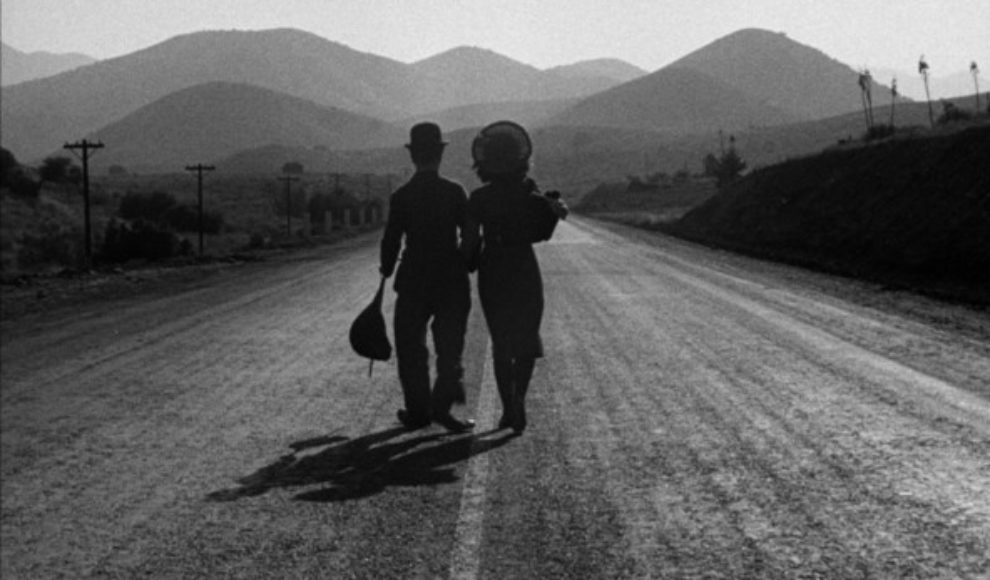
Early Summer (1951)

Early Summer (Bakkushû)
Directed by Yasujirô Ozu
Written by Kôgo Noda and Yasujirô Ozu
1951/Japan
Shôchiku Eiga
Repeat viewing/Netflix rental


[box] Mr. Ozu looked happiest when he was engaged in writing a scenario with Mr. Kogo Noda, at the latter’s cottage on the tableland of Nagano Prefecture. By the time he finished writing a script, after about four months’ effort, he had already made up every image in every shot, so that he never changed the scenario after we went on the set. The words were so polished up that he would not allow us even a single mistake. — Chisû Ryû[/box]

Yasujirô Ozu was at the height of his powers when he made the three films in which Setsuko Hara starred as a young woman named Noriko.  This is perhaps lesser known than the other two – Late Spring and Tokyo Story – but is just as good.

Three generations of the Mamiya family live in the same household.  They are grandmother and grandfather, their son Koichi (Chisu Ryô), daughter-in-law and two grandsons, and unmarried daughter Noriko (Hara).  Noriko is a modern sort of 28-year-old and helps with the expenses by working in the city as a secretary.  Koichi is a physician.

Noriko’s boss and everyone else who knows her think it is high time for her to get married. The boss has what seems to be the ideal candidate in mind.  Noriko’s parents and brother are enthusiastic about the match but Noriko is skillful at dodging any discussion about the matter.

Then Noriko accepts a marriage offer from an unexpected quarter and the household is thrown into a mild uproar until everybody gets used to the idea.

I love this film.  It all seems just like real life to me despite the exquisitely contrived compositions.  It takes about an hour for the marriage drama to arise.  Before that the story is more or less just a snapshot of daily life.

This is another film on Ozu’s favorite topic, which is not in fact marriage, but the dissolution of the Japanese family.  We are treated to an especially moving denouement in this one as the hoped-for marriage will mean that all the people in the household must go their separate ways.  The Criterion DVD has an excellent commentary by Ozu scholar Donald Richie.

Clip

1951

In 1951:

Legendary film critic and theorist Andre Bazin established the French film journal “Cahiers du Cinéma”. Its ideas and writing gave rise to the French New Wave (Nouvelle Vague) and brought respectability to the idea of film as a legitimate field of study.

The Motion Pictures Production Code specifically prohibited films dealing with abortion or narcotics.  Marking the decline of the old Hollywood studio system, this was the first year in which the Best Picture Oscar was given to the film’s producers rather than to the studio that released the film.  Motion picture mogul-executive Louis B. Mayer was forced to resign in 1951 after 27 years as the head of MGM Studios that he had founded. Mayer’s resignation followed continued disagreements with his eventual successor Dore Schary over cost-cutting and the issue of creating socially-relevant pictures.

Ethel and Julius Rosenberg

In U.S. news, the Twenty-second Amendment Constitution was ratified, limiting Presidents to two terms.

Ethel and Julius Rosenberg were convicted of conspiracy to commit espionage for passing atom bomb secrets to the Soviet Union. On April 5 they are sentenced to receive the death penalty.  The couple was executed in 1953.

U.S. President Harry S. Truman relieved General Douglas MacArthur of his Far Eastern commands for insubordination.   MacArthur made his last official appearance in a farewell address to the U.S. Congress. During his speech, he famously said: “I now close my military career and just fade away, an old soldier who tried to do his duty as God gave him the light to see that duty.”

Remington Rand delivered the first UNIVAC I computer to the United States Census Bureau. The first thermonuclear weapon was tested on Enewetok Atoll in the Marshall Islands. Direct dial coast-to-coast telephone service began. The world’s first (experimental) nuclear power plant opened. The United States became malaria-free,

The Catcher in the Rye by J.D. Salinger was published.   Jackie Brenston and His Delta Cats recorded “Rocket 88”, currently observed by most as the first rock and roll song ever made.  The Town by Conrad Richter won the Pulitzer Prize for Literature.  No drama prize was awarded.  “Too Young” by Nat King Cole was number 1 on the Billboard Charts.

Korean War Veterans Memorial, Washington DC

The Treaty of Paris (1951) was adopted, establishing the European Coal and Steel Community.  This was the first step toward the establishment of the European Union.

In early 1951, the territory around Seoul and central Korea changed hands several times as the UN and Communist forces advanced and retreated.  By July 1951, the conflict had reached a stalemate, with the two sides fighting limited engagements, but with neither side in a position to force the other’s surrender. Both the United States and China had, at this point, achieved the short-term goal of maintaining the demarcation line at the 38th parallel, while the North and South Koreans had failed in the larger goal of uniting the country under their preferred political systems. Representatives of all the parties began to discuss peace.  For the next two years, small-scale skirmishes continued to break out, while the various representatives argued over the peace terms.

************************

The list of films I will select from is here.  I have already reviewed the following 1951 films on this site.  ; ; ; ; ; and .


Montage of stills from the Academy Award winners

Bonus – “Rocket 88” – that’s Ike Turner’s backup band.


1950 Recap and 10 Favorite Films

Sunset Boulevard (1950)

I have now seen 64 films that were released in 1950. The complete list is here.  I decided to cut things a bit short and get on to the riches of 1951 since I don’t have long before I hit the road again.

This was a fantastic year for film on the high end.  The rankings of the first five films on my favorites list could be sorted in any number of ways on any given day.  There was only one new-to-me film on the list this time.  Several  of the films were reviewed here earlier as part of either Noir Month or the 1001 Movies You Must See Before You Die blog club.

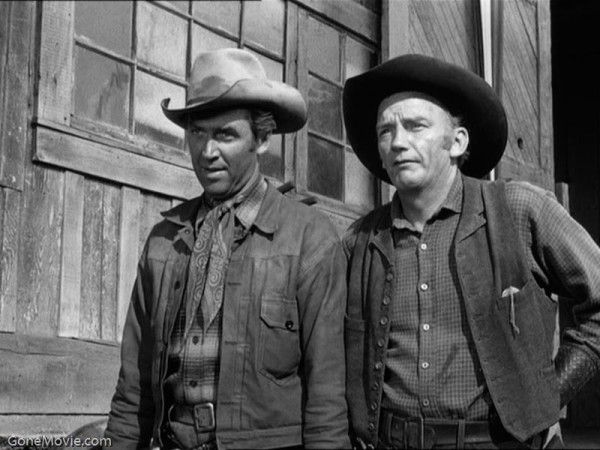
10.  Winchester ’73 (Directed by Anthony Mann)

James Stewart (Lin McAdam) rides into Dodge City with his friend Millard Mitchell (High Spade Frankie Wilson)

9.  Young Man with a Horn (Directed by Michael Curtiz)

horn2

8.  Panic in the Streets (Directed by Elia Kazan)

panic in the streets

7.  Harvey (Directed by Henry Koster)

james_stewart_harvey

6.  Gun Crazy (Directed by Joseph H. Lewis)

gun-crazy-1950-still-2

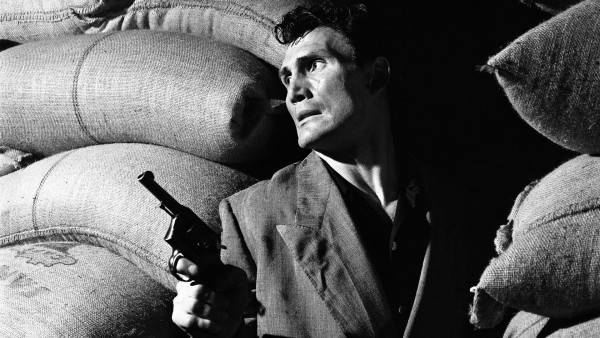
5.  The Asphalt Jungle (Directed by John Huston)

quand-la-ville-dort-1950-05-g

4.  All About Eve (Directed by Joseph L. Mankowicz)

all-about-eve-1950-001-00m-o9u-addison-eve

3.  In a Lonely Place (Directed by Nicholas Ray)

in-a-lonely-place-006-1000018401

2.  Rashomon (Directed by Akira Kurosawa)

roshomon 2

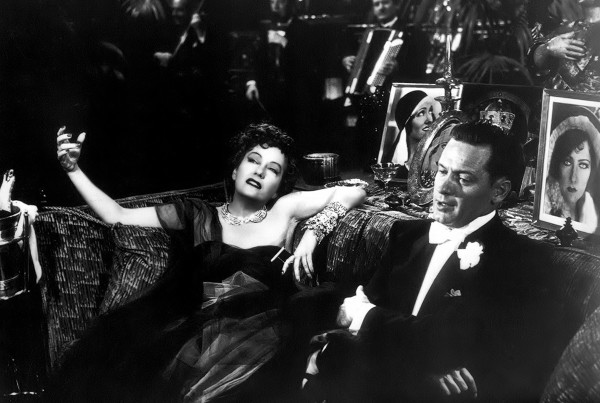
1.  Sunset Blvd.  (Directed by Billy Wilder)

gloria swanson & william holden 1950 - sunset boulevard. from jane's film noir series.

The Woman in Question

The Woman in Question (AKA “Five Angles on Murder”)
Directed by Anthony Asquith
Written by John Cresswell
1950/UK
J. Arthur Rank Organization/Javelin Films/Vic Film Productions
First viewing/Hulu


[box] In England when you make a movie, even the weather is against you. In Hollywood the weatherman gets a shooting schedule from all the major studios and then figures out where he can fit in a little rain without upsetting Metro-Goldwyn-Mayer too much. — Anthony Asquith[/box]

Here is another take on the Rashomon theme for 1950 with five versions of the character of a murder victim.  Not an entirely successful treatment, but interesting.

A small boy discovers the strangled body of his mother’s lodger Agnes AKA “Madame Astra” (Jean Kent) in her London flat.  Scotland Yard has very little to go on and begins by inquiring into the life and associates of the victim.  They begin with landlady Mrs. Finch (Hermoine Baddely) who tells the story of a “real lady” who, like her, is worrying about a chronically ill husband and is beset her horrible sister and an awful American caller.

We then get the story as told by the sister and the American (Dirk Bogarde)d, both of which portray a malicious harridan.  Then we hear from a couple of very different admirers, middle-aged pet shop owner Mr. Pollard who did odd-jobs for her and Irish seaman Michael Murray who hoped to marry her.  Just about all of these people had reason to hate the woman and the different interviews also reveal clues to the murder mystery.

This is actually more of a gimmick for telling a murder mystery story rather than anything more profound.  That being the case, one would hope that the mystery itself would be more intriguing.  I guessed the identity of the culprit fairly early on and didn’t care much who did it actually. Your mileage may vary.  Dirk Bogarde certainly could do a convincing American accent.

The Baron of Arizona (1950)

The Baron of Arizona
Directed by Samuel Fuller
Written by Samuel Fuller
1950/USA
Deputy Corporation
First viewing/Hulu

[box] [repeated line] James Addison ‘The Baron’ Reavis, aka Brother Anthony: I’ve known many women, but with you, I’m afraid.[/box]

Early in his career director Samuel Fuller was making nice low-budget Westerns like this one and was developing some of the style that would characterize him later.  As a bonus, we get Vincent Price as a scoundrel.

The film was based on the true story of James Addison Reavis, here played by Price, who attempted to gain title to most of the then-Territory of Arizona by forging Spanish land grant documents.  Reavis started his career as a humble government clerk who was appalled to see that the federal government recognized the validity of Spanish land grants. He made up his mind to profit from this.

Reavis’s elaborate plan spanned decades.  First, he befriends Pepito (Vladimir Sokoloff) and his little adopted daughter Sofia.  He tells them that Sofia’s parents were the descendents of the Peralta famiily who had been granted most of the current territory of Arizona by King Ferdinand of Spain back in the 18th Century.  This makes Sofia the Baroness of Arizona.  Reavis promises to make her claim a reality and sets to work.  Sofia falls in love with her benefactor when he gives her her first piece of candy.

First, Reavis goes to Mexico and creates a grave and monument for the Peraltas.  Then he sets off for Spain where he gets himself accepted as a monk in the monastery at which land grants of the period were enscribed and preserved.  Through years of patient effort he finally becomes one of the scribes himself, enabling him to use the monastery’s ancient supplies of ink and paper to forge his document.  He then tells the monks he is not cut out for the life and flees.  It turns out another copy of the records was preserved at the home of an aristocrat, so he must enlist the help of some gypsies and seduce the aristocrat’s wife in order to steal these.

His documents secured, Reavis returns to Arizona and marries the patiently waiting Sofia (Ellen Drew).  He presents his proof that she is the Baroness of Arizona and proceeds to extort money from railroads and other entities wishing to do business on “his” land.  This goes pretty well for awhile.  What Reavis had not counted on was the violent reaction of the common settlers to anyone, legitimate or not, taking their farms away from them.  And then there’s that pesky forgery expert who works for the Department of Interior …

I thought this was an interesting story and would like to learn more about the real Reavis.  You have to admire someone who would go to such lengths for long-term gain!  Some of Fuller’s flamboyance in staging is coming through here, as is shown by the huge Arizona map dominating Reavis’s office.  Price is deliciously hammy as always, though he doesn’t go too overboard here.  Worth seeing.

Clip

Madeleine (1950)

Madeleine
Directed by David Lean
Written by Nicholas Phipps and Stanley Haynes
1950/UK
Cineguild
First viewing/Amazon Instant

[box] I find dialogue a bore, for the most part. I think that if you look back on any film you’ve seen, you don’t remember lines of dialogue, you remember pictures. — David Lean[/box]

Another David Lean movie chock full of beautiful pictures and combining mystery and romance in a moderately intriguing way.

Madeleine (Ann Todd) is the daughter of a proper Victorian household headed by an iron-willed father, James Smith (Leslie Banks).  Madeleine has been resisting her family’s desire for her to marry nice, steady gentleman William Minoch in favor of carrying on a secret affair with penniless Frenchman Emile L’Angier.  She is reckless in her abandon, bringing Emile into her home after hours, having assignations with him in the maid’s room, and writing him letter after letter promising to marry him and declaring herself already his wife.

Madeleine just cannot bring herself to introduce Emile to her father.  Finally, he gives her an ultimatum.  Instead, she appears in his room and begs him to elope.  Marrying Madeleine without her money or social standing does not fit in with the Frenchman’s plans and he makes this clear.  Madeleine, alerted to his fortune-hunting, tells him the affair is over.

Madeleine then softens toward Minoch and agrees to marry him.  The couple seem genuinely happy and her family is over the moon with excitement.  Now Emile reappears and tells Madeleine she is still his fiancée and he will reveal her letters if he does not introduce her to the family as such.  Madeleine agrees but asks for more time.  Emile gets very ill after this meeting.

Then Emile goes away for a short holiday.  Somehow he does not receive Madeleine’s letters inviting him to meet her family and does not show up at the specified times.  He finally returns.  He gets extremely ill and dies, of what is found to be arsenic poisoning.  Madeleine’s letters are found in his lodgings after his death.

The rest of the movie consists of Madeleine’s trial for Emile’s murder.  I will not reveal the many wrinkles of the murder case.

According to the IMDb trivia, this was Lean’s least favorite film.  While I might agree, that does not mean that the film is without merit.  It’s worth seeing just for the below seduction scene and has many other pleasures.  I find Ann Todd to be slightly off in a lot of ways but the story is fairly interesting, if a bit confusing.

Clip

Where Danger Lives (1950)

Where Danger Lives
Directed by John Farrow
Written by Charles Bennett; story by Leo Rosten
1950/USA
RKO Radio Pictures
First Viewing/Film Noir Classic Collection, Vol. 4

[box] Frederick Lannington: ‘Now’ can be a long time, Dr. Cameron, but time passes, and then there’s the end of the line![/box]

This noir might have been better without Howard Hughes “protogee” Faith Domergue.

Jeff Cameron (Robert Mitchum) is the kind of doctor who tells his small patients bedtime stories about Elmer the Elephant.  He is having a romance with nurse Julie (Maureen O’Sullivan) and buys her a single white rose every day.  One night Margo Lannington (Domergue) is brought in, the victim of an attempted suicide.  The good doctor decides to help his patient get over her loneliness and before we know it Julie is completely out the window and the couple are talking wedding bells.  Margo is immensely wealthy and entertains Jeff at home while her “father” is out of town.

Margo begs off one of their dates to tell pops about Jeff.  He decides to show up unexpectedly.  When he announces his good intentions to Frederick Lannington, the older man Margo lives with (Claude Rains), he learns he is her husband and not her father.  Jeff wants nothing more to do with this situation and starts to leave.  He is drawn back by Margo’s screams.  He goes to her rescue and decks Frederick.  Jeff receives a blow to the head in the process.  He goes to get something for his pain and when he returns Frederick is dead.

Jeff wants to call the police but Margo manages to scare him into taking it on the lam.  Jeff diagnoses his own concussion and predicts he will become blind and paralyzed within hours.  In the meantime, Margo is suspiciously eager to avoid listening to any news about the murder.

This is OK if farfetched  but I didn’t care for Faith Domergue’s acting at all.  She is very shrill and poor at screaming, which the script requires her to do at regular intervals.  Mitchum can’t help being the perfect noir hero, though, so there’s that.

Howard Hughes became infatuated with Domergue when she was 17, even buying her adoptive parents off with a house, and immediately signed her to RKO, the studio he owned.  The romance was off by 1944 but Hughes promoted her career until 1950 when Vendetta, a vehicle created for her, and this film both bombed at the box office.

Trailer


To Joy (1950)

To Joy (Till glädje)
Directed by Ingmar Bergman
Written by Ingmar Bergman
1950/Sweden
Svensk Filmindustri
First viewing/Hulu


[box] No form of art goes beyond ordinary consciousness as film does, straight to our emotions, deep into the twilight room of the soul. — Ingmar Bergman[/box]

Ingmar Bergman allows a little bittersweet joy to seep into yet another of his early films about a failing  marriage.

The opening of the film has violinist Stig Eriksson called to answer a phone call in the midst of rehearsal.  We see him running frantically home.  There he learns that his wife Marta was killed when a kerosene stove exploded and that his daughter is recovering from her injuries in the hospital.  The story then segues into flashback.

Violinists Marta Olsson IMai-Britt Nilsson) and Stig Eriksson (Stig Olen) join the symphony orchestra of their provincial city on the same day.  Its crusty old conductor (Victor Sjöström) is all business.  Stig is a gloomy sort of Bergman hero who obsesses about his art and the meaninglessness of life. To make things worse, he is terribly insecure about his violin playing.  Nevertheless, he manages to fall in love with and marry the more stable Marta.  She soon reveals her pregnancy, which he does not welcome.  But eventually he gets used to the idea and they end up having two children, a boy and a girl.

The marriage starts out very tenderly.  Eventually, Stig is asked to replace a soloist for a concert at the last minute.  His performance is a disaster.  This setback causes him to wallow in self-pity and bitterness and he begins an affair with a much-older musician’s young wife.  Marta patiently bears this initially but finally they separate.  After some time, Stig comes to his senses and the couple reconciles.  I’ve already told the way the marriage finally ends.

As I have come to expect from Bergman, this is beautiful, psychologically insightful, and well acted.  Despite much vicious fighting and the downer ending, this is actually more optimistic and life affirming than some of his other early films.  The ending is a really beautiful sequence of the orchestra rehearsing Beethoven’s Ode to Joy while Stig’s little son looks on.

Clip — love blooms

Wedding Ring (1950)

Wedding Ring (Konyaku yubiwa)
Directed by Keisuke Kinoshita
Written by Keisuke Kinoshita
1950/Japan
Kinuyo Tanaka Productions/Shôchiku Eiga
First viewing/Hulu

[box] “Oh! how many torments lie in the small circle of a wedding ring.” — Colley Cibber[/box]

There’s some good acting here but the story sort of overstayed its welcome.

Michio Kuki has been very ill with TB for some time.  He is cared for in his wealthy father’s home near the sea.    His wife Noriko (Kinuyo Tanaka) runs the family’s dress shop business in Tokyo and visits only on weekends.  One day, Michio’s doctor is replaced by the handsome young Dr.  Ema (Toshiro Mifune).  The doctor must make regular house calls to drain his patient’s lungs.

Michio and his wife have not been intimate since he fell ill.  Noriko begins to have an overpowering physical attraction to Dr Ema and her passion is reciprocated.  The two spend the rest of the film trying to do the right thing despite themselves.

With two great actors in the lead, this can’t help being interesting.  However, this kind of unconsummated love affair isn’t really enough to sustain a feature length film .  The couple face the same dilemma over and over again as they can’t seem to keep apart.  Tanaka spends most of the film crying and Mifune even succumbs at one point.  Brief Encounter this isn’t.

Destination Moon (1950)

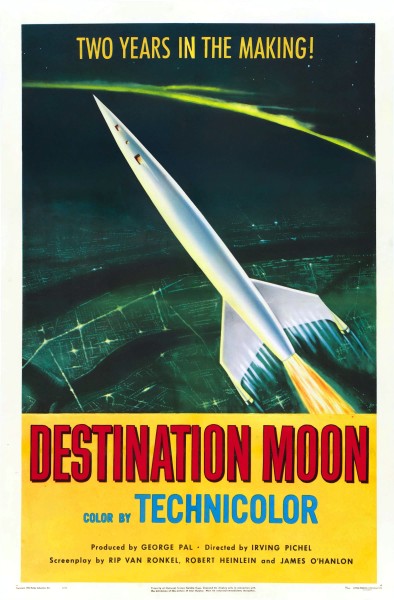
Destination MoonDestination-Moon-Poster
Directed by Irving Pichel
Written by Alford Van Ronkel, Robert A. Heinlein and James O’Hanlon from a novel by Heinlein
1950/USA
George Pal Productions
First viewing/Amazon Instant


General Thayer: The reason is quite simple. We are not the only ones who know that the Moon can be reached. We’re not the only ones who are planning to go there. The race is on – and we’d better win it, because there is absolutely no way to stop an attack from outer space. The first country that can use the Moon for the launching of missiles… will control the Earth. That, gentlemen, is the most important military fact of this century.

Turgid story but still an interesting insight on how space travel was envisioned about 20 years ahead of time.

General Thayer and Dr. Charles Cargraves set out to convince the titans of industry to invest in the space program since government will not do so in peace time.  The feasibility of a mission to the moon is illustrated by a Woody Woodpecker cartoon.  The audience is sold and work begins on an atomic-energy-powered  rocket to the moon.

destination moon 1950

Sinister forces sabotage plans to test the rocket by spreading rumors of possible radiation leaks in the area.  So it is decided just to go directly to launch without any testing.  In addition, the radio man has to have an appendectomy at the last minute so the ship takes off with an untrained man aboard.

Our astronauts survive a couple of possible disasters, one by making an early space walk to fix a part, to land on the moon and arrive safely home.

Destination Moon

For sheer entertainment value, I would go with Rocketship X-M, which was actually a low-budget rip-off of this film.  The effects are much better here, though.  I actually learned something from the Woody Woodpecker cartoon!

Destination Moon won the Academy Award for Best Effects, Special Effects.  It was nominated for Best Art Direction-Set Decoration, Color.

Trailer