Nine Lives (Ni liv) Directed by Arne Skouen Written by Arne Skouen from a book by David Howarth 1957/Norway Nordsjofilm
First viewing/YouTube
[box] Skiing combines outdoor fun with knocking down trees with your face. Dave Barry [/box]
This is a suspenseful true story about a resistance fighter’s escape from occupied Norway and the people who helped him.
Jan Baalsrud arrives in Norway by boat with a number of comrades to deliver supplies to resistance fighters in the north of the country. The Nazis are waiting for them and Jan becomes the only survivor. He flees with nothing save the clothes on his back and his gun.
Jan cannot survive without help but must make difficult decisions about who to trust. He survives brutal winter storms, gangrene and snow blindness, earning him the reputation of a man with nine lives.
This is quite a solid example of its genre. There are awesome shots of Saami (Lapps) herding reindeer through a blizzard!
Nine Lives was nominated for an Academy Award for Best Foreign Language Film.
Moby Dick Directed by John Huston Written by Ray Bradbury and John Huston from the novel by Herman Melville 1956/USA Moulin Productions
First viewing/Netflix rental
Captain Ahab: From hell’s heart I stab at thee; for hate’s sake I spit my last breath at thee. Ye damned whale.
In a time before the Save the Whale movement, John Huston captured the grandeur and deeper meaning of the Herman Melville classic novel. Better yet, in the end it is the Whale, or make that Nature or an Omnipotent God, that triumphs.
The film is remarkably faithful to the novel in plot, setting and dialogue. In 1841 a man (Richard Basehart) who asks us to call him Ishmael arrives in New Bedford, Massachusetts. He is tired of life on shore and wants to find out what whaling is like. At the inn, he is told he will have to share a bed. Thus he meets Queequeg, a cannibal harpooner, and the two become fast friends. They vow to ship out together and are hired for a three-year voyage on the Pequod. Before the ship sails, a stranger called Elijah predicts disaster for the ship and its Captain.
Pip: That ain’t no whale; that a great white god.
Early in the voyage, we see the camaraderie among the sailors and watch them work. Eventually, Captain Ahab (Gregory Peck) emerges from his cabin and announces a reward for the first man that spots the white whale named Moby Dick that cost him his leg. Moby Dick is a renowned behemoth that has maimed more than one man and sank more than one ship. The men are game but Starbuck (Leo Gann), the Chief Mate, is troubled.
He becomes more troubled when Ahab insists going after Moby Dick before concentrating on filling the ship’s hold and returning home. But Starbucks idea of mutiny is not shared by the other men and Ahab carries on until Elijah’s prophecy is fulfilled. With Orson Welles as a preacher who delivers a sermon on the story of Jonah.
I didn’t have high hopes for this film as I love the novel but thought it would be impossible for any film to convey what makes it great. Huston managed admirably however. This is largely accomplished by skillful lifting of the actual language of the text and a production design that looks to be taken from 19th Century illustrations. I’m not a huge Gregory Peck fan but he is ferocious and a perfect Ahab here.
Like the novel, this film is more about the Ahab’s blasphemy in trying to get vengeance on Fate, Nature, or God than it is a simple whaling adventure. Huston captures the biblical underpinnings of the novel brilliantly while keeping the action engaging as well. The whale hunts were not too graphic for me. Recommended.
This post is part of The Animals in Film Blogathon being hosted by In the Good Old Days of Classic Hollywood. Other excellent posts on this theme can be found here.
Fear Strikes Out Directed by Robert Mulligan Written by Ted Berkman and Raphael Blau from a story by Jimmy Piersall and Al Hirschberg 1957/USA Paramount Pictures
First viewing/Amazon Instant
[box] “Never allow the fear of striking out keep you from playing the game!” ― Babe Ruth[/box]
Nobody does troubled like Anthony Perkins. His performance makes this biopic about a baseball player battling mental illness.
This based on the story of Jimmy Piersall who came back from a very public nervous breakdown to stardom in Major League Baseball. Jimmy (Perkins) shows athletic talent from an early age. From that same age, his father (Karl Malden) has dreams that Jimmy will play for the Boston Red Sox and pushes him relentlessly to achieve that dream. Spending more than one year in the Minor Leagues is abject failure. So is achieving only third place in hitting. But Jimmy and dad are very close and the ballplayer can’t seem to make a move without him.
Jimmy gets some solace from his marriage. When he is finally selected to play for the Sox, he falls apart. It starts out by angrily driving his teammates to do better. Then he completely snaps, goes nuts after hitting a home run, and must be hospitalized.
I thought the theme was handled well. The treatment was not too heavy handed or Freudian. Perkins is outstanding and Malden makes the father very human. Piersall, however, disowned the movie because he thought it was too hard on his dad. I enjoyed this.
Trailer – this makes it look like Rebel Without a Cause and misses the mark
The Flying Carpet (Starik Khottabych) Directed by Gannadiy Kazanskiy Writtten by Lazar Lagin from his novel 1957/USSR Lenfilm Studio
First viewing/YouTube
[box] “Fairy tales do not tell children the dragons exist. Children already know that dragons exist. Fairy tales tell children the dragons can be killed.” ― G.K. Chesterton[/box]
Young Pioneer Volka opens an ancient bottle with a 3,000+ year old genie in it. The genie, Old Man Khottabych, is so grateful he essentially becomes the boy’s slave. It is not necessary for him to wish for anything. This creates problems as the genie is completely out of touch with modern times and messes up a lot. Volka and his friends also do some traveling courtesy of the flying carpet.
This is a moderately amusing children’s film. For me the most interesting parts were bits of relatively unobtrusive Soviet propaganda as with the boy’s distaste for owning anything. Everything is bright, shiny, and new in the USSR in this fairy tale.
The Monster That Challenged the World Directed by Arnold Laven Written by Pat Fielder; Story by David Duncan 1957/USA Gramercy Pictures
First viewing/Amazon Instant
[box] Dr. Jess Rogers: From the instant they’re born, they’re hungry.[/box]
Perhaps the greatest giant mollusk movie ever made.
Lt. Comdr. John Twiliger (Tim Holt) is the new guy at the U.S. Navy base on the Salton Sea. He is a by-the-book type who does not seem to be making a big hit with his men. A couple of Navy divers are mysteriously killed and Twiliger and some divers go out to recover one of the bodies. While doing so, the men encounter a gigantic object which later proves to be an egg. The boat is then attacked by mother.
Twiliger takes the egg back to the base’s research center. Dr. Jess Rogers (Hans Conreid) informs him that they are dealing with an ancestor of the modern sea mollusk. He foolishly keeps the egg alive. At the research center, Twiliger’s crusty exterior is pierced by Rogers’ comely secretary (Audrey Dalton) and her little girl. Most of the movie is spent battling the mollusk and its progeny.
For these things to work the monster must be either scary or absolutely ludicrous. In this case, we have a creepy monster and its disgusting slime. The movie was not going to win any awards but is a better than average example of its genre.
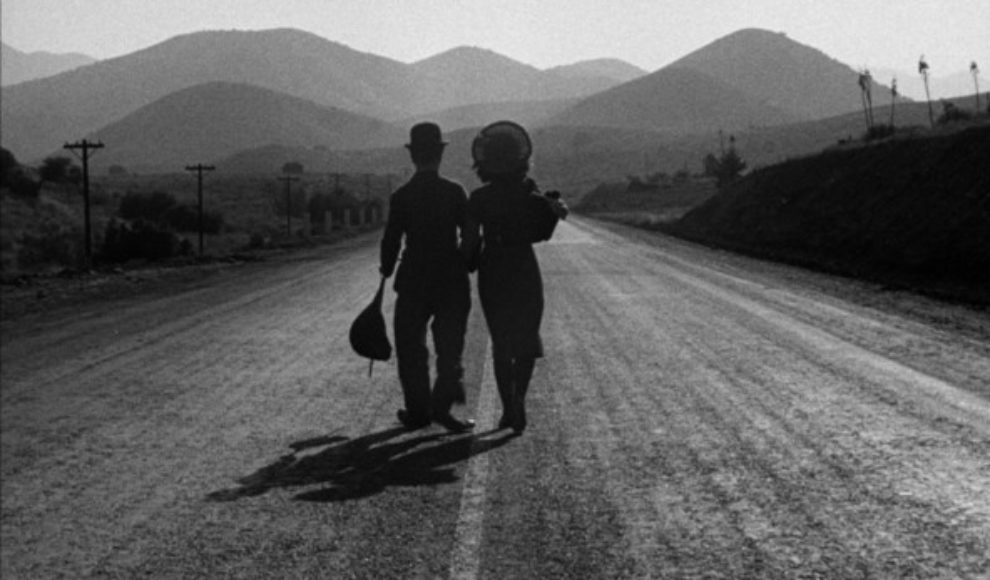
A King in New York Directed by Charles Chaplin Written by Charles Chaplin 1957/UK Attica Film Company
Repeat viewing/Netflix rental
[box] Rupert Macabee: I’m so sick and tired of people asking me if I’m this, if I’m that![/box]
The country that made Charlie Chaplin a mega-star treated him pretty despicably in the end. He got his revenge with this film. In more ways than one.
King Shahdov (Chaplin) has fallen victim to a revolution due to his opposition to nuclear weapons. He takes refuge in New York where he finds his Prime Minister has embezzled his large personal fortune. He is tricked into appearing in a candid camera type TV show in the guise of a dinner party. Soon he is the media darling and is getting large offers for commercial endorsements. He resists at first but poverty later changes his mind.
As one of his official duties he visits a progressive school. There he meets Rupert (Chaplin’s son Michael) who is a philosophy protege. Rupert’s parents were Communists and are being hauled before HUAC. Shahdov gives Rupert shelter after he runs away from school. Shadhov is then called before the committee where he gives an impassioned speech.
Just the plot summary should give perceptive readers an idea of why I hate this movie. It tries too hard, and fails, to be funny and contains many dreary rants, most of which Charlie shamelessly put into the mouth of his untalented son. Chaplin never should have started talking.
Time Limit Directed by Karl Malden Written by Henry Denker from a play by Denker and Ralph Berkey 1957/USA Heath Productions
First viewing/Netflix rental
[box] Maj. Harry Cargill: You can’t ask a man to be a hero forever. There ought to be a time limit. [/box]
This solid legal drama raises some interesting moral issues.
A JAG lawyer, Col. William Edwards (Richard Widmark), is trying to decide whether Maj. Harry Cargill (Richard Basehart) should be court-martialed for treason for collaborating with the enemy in a North Korean POW camp. On the surface it seems obvious. Cargill made a broadcast and signed a statement falsely accusing the US of using germ warfare and became the indoctrination officer for the men at the camp. He also admits everything and refuses to defend himself. But Edwards will not rest or make a decision until he finds out why Cargill turned. Cargill isn’t talking and the other soldiers in the camp have no explanation. Something about the consistency of their stories makes Edwards even more suspicious.
Complicating Edwards’ job is the fact that his supervising General’s son died in the same camp. Neither the general nor Edwards’ staff sergeant (Martin Balsam) can understand why the case can’t go to trial immediately. The rest of the movie follows Edwards’ continuing search for the truth. With June Lockhart as Cargill’s wife. The commie foreign baddies are the same as the ones in The Manchurian Candidate!
This film is basically a filmed stage play with forays into the camp in flashback. The drama is compelling enough to carry it. The movie asks the question “Can there be an excuse for treason?” In the end, it doesn’t really answer it, which only makes the story more interesting. These actors are always good and Karl Malden did a workmanlike job.
Pal Joey Directed by George Sidney Written by Dorothy Kingsley from the musical play book by John O’Hara 1957/USA Essex Productions/George Sidney Productions
Repeat viewing/Netflix rental
[box] Couldn’t sleep/ And wouldn’t sleep/ Until I could sleep where I shouldn’t sleep/ Bewitched, bothered and bewildered am I – “Bewitched, Bothered and Bewildered”, lyrics by Lorenz Hart[/box]
We get Rita Hayworth’s last film appearance, some great standards from
Sinatra, and Kim Novak at her most luscious all in one movie. What’s not to like?
Joey Evans (Sinatra) is a total louse and great womanizer. He is run out of one town for romancing the mayor’s daughter. The train lets him off in San Francisco, a town that looks great in this movie. He cons his way into a job as MC and singer in a mostly burlesque club in the Barbary Coast. There he gets into the pants of most of the girls on the line, save Linda English (Novak), a good girl who wants to be a singer. Joey ends up living next door to her and they become friends.
Joey is distracted from Linda’s charms when he sings at a gig in the home of the fabulously wealthy widow Vera Prentice-Simpson (Hayworth), who was a stripper before her marriage to the late Mr. Simpson. Joey sets out to seduce Vera with his philosophy of women – treat a lady like a tramp and a tramp like a lady. He misjudges Vera as the tramp type. When he figures out she is a lady, he is much more successful. Classic love triangle developments ensue.
Sinatra sings “There’s a Small Hotel”, “The Lady Is a Tramp” and “I Didn’t Know What Time It Was”, among other tunes, as only Sinatra can. Plus we get “Bewitched, Bothered and Bewildered” and “My Funny Valentine” from the singers dubbing Hayworth and Novak, respectively. This alone would have ensured I enjoyed the movie. I also enjoyed the acting and the story. This isn’t as highly rated by some but I am sticking to my guns.
Pal Joey was nominated for Academy Awards in the categories of Best Art Direction-Set Decoration; Best Costume Design; Best Sound, Recording; and Best Film Editing.
The Curse of Frankenstein Directed by Terence Fisher Written by Jimmy Stangster based on the classic story by Mary Shelley 1957/UK Warner Bros./Hammer Films
First viewing/Netflix rental
[box] Baron Frankenstein: Let’s let our friend here rest in peace… while he can.[/box]
The first color Frankenstein movie delivers an evil doctor and a different kind of monster.
As the movie begins, Victor Frankenstein is a spoiled and imperious young kid who has already inherited the title of Baron from his deceased father. We see him help out his destitute cousin Elizabeth and her mother. He then hires tutor Paul Kempe.
Years pass and Paul becomes more a friend and associate than a teacher. The two start working on experiments to restore life, with the aim of reviving surgery patients. When this is successful, Victor (Peter Cushing) snaps and becomes obsessed with the idea of creating life. He starts robbing gallows and bribing mortuary attendants to get parts.
Elizabeth (Hazel Court) arrives to marry Victor, to whom she had been promised as a child. Paul falls in love with her but Elizabeth is resolutely loyal to her intended. Paul eventually becomes frightened and appalled by the lengths Victor will go to to obtain parts and pulls out of the experiment. He stays in the house for Elizabeth’s sake.
Victor eventually brings his creature (Christopher Lee) to life with the predictable consequences.
This is a very different version of the Frankenstein story from the Universal 1931 film. Here the doctor is a cold-hearted S.O.B. who is tramples on anyone in his way and is aware of the danger his creature presents. The creature bears no resemblance to the Karloff monster. (Actually, Universal was threatening suit the whole time if any elements of its franchise were borrowed by the movie). The lab setting is really creepy and cool. I wouldn’t rank this one as highly as James Whale’s film but it’s way up there. Recommended to fans of the genre.
The Academy of Motion Pictures Arts and Sciences’ bylaws denied eligibility for Oscar nominations or consideration to artists who were blacklisted. This practice was abandoned in early 1959. The Caribbean romance film Island in the Sun was noted as groundbreaking for its two inter-racial romances and first Hollywood inter-racial screen kiss.
RKO Radio Pictures which had suffered hard times for years under the ownership of millionaire Howard Hughes ceased production of feature films altogether in 1957. Humphrey Bogart died at the age of 57 of cancer. Horror film director James Whale died at the age of 67 due to suicide by drowning in his own swimming pool. US comic actor Oliver Hardy, the more corpulent half of the Laurel and Hardy team, died at the age of 65 from the effects of strokes.
Governor Orval Faubus of Arkansas called out the National Guard of the United States to prevent African-American students from enrolling in Little Rock Central High School. Thereafter, President Dwight D. Eisenhower sent federal troops to Arkansas to provide safe passage into the school for the “Little Rock Nine”.
The Ford Motor Company introduced the notoriously unpopular Edsel on what the company proclaimed as “E Day”. Wham-O Company first produced the considerably more popular Frisbee.
Time Magazine’s Man of the Year was Nikita Kruschev. Eugene O’Neill received the Pulitzer Prize for Drama for A Long Days Journey into Night. No prize was awarded for literature. Elvis Presley dominated the Billboard Charts, with “All Shook Up” spending eight weeks at number one.
Laika, the Space Dog
The Soviet Union launched Sputnik 1, the first artificial satellite to orbit the earth. It followed up with Sputnik 2, with the first animal to orbit the Earth (a dog named Laika) on board. There was no technology available to return poor Laika home, a fact that greatly troubled the child protagonist of the 1985 Swedish film My Life As a Dog. The first U.S. attempt to launch a satellite failed when its Vanguard rocket blew up on the launch pad.
The Treaty of Rome (Patto di Roma) established the European Economic Community (EEC; predecessor of the European Union) between Italy, France, West Germany, Belgium, the Netherlands and Luxembourg.
In Indonesia, Sukarno announced the nationalization of 246 Dutch businesses and expelled all 326,000 Dutch nationals. Mao Zedong admitted that 800,000 “class enemies” had been executed in China between 1949 and 1954. Ghana became the first sub-saharan African nation to declare independence from European colonization.
***********************************
I have previously reviewed ; ; ; Throne of Blood; ; and on this site. The list of 1957 releases I will choose from is here.
I’ve been a classic movie fan for many years. My original mission was to see as many movies as I could get my hands on for every year from 1929 to 1970. I have completed that mission.
I then carried on with my chronological journey and and stopped midway through 1978. You can find my reviews of 1934-1978 films and “Top 10” lists for the 1929-1936 and 1944-77 films I saw here. For the past several months I have circled back to view the pre-Code films that were never reviewed here.
I’m a retired Foreign Service Officer living in Indio, California. When I’m not watching movies, I’m probably traveling, watching birds, knitting, or reading.
Photographs and videos found in this blog, unless indicated, are not owned by me and are here only for the purpose of education and discussion. Media found here are not intended for any commercial purpose. Copyright infringement is not intended.
Written material belongs to me and is copyrighted by flickersintime.com