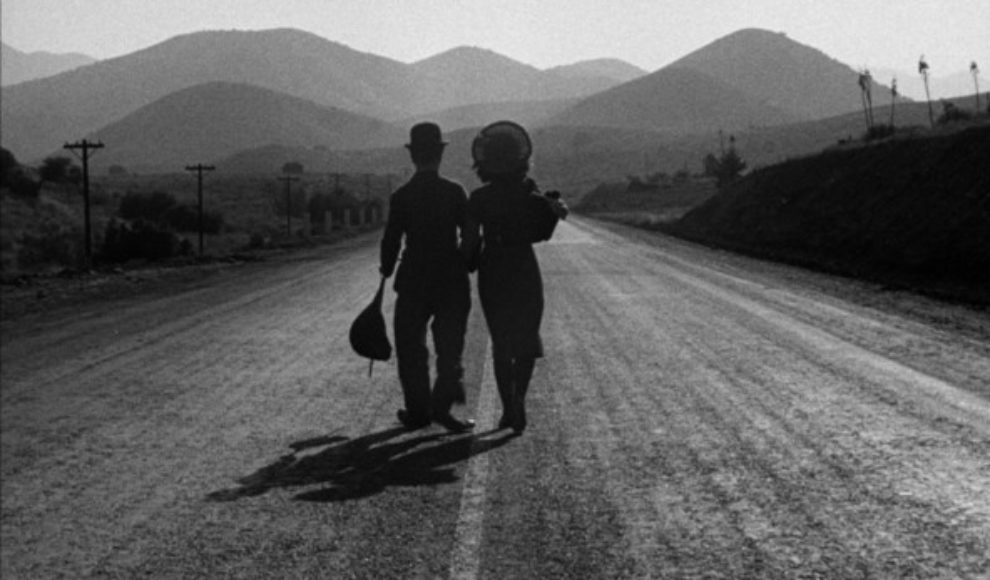
Mon Oncle (1958)

Mon Oncle
Directed by Jacques Tati
Written by Jacques Tati with artistic collaboration by Jacques Lagrange and Jean L’Hote
1958/France
Specta Film/Gray Film/Alter Films et al
Repeat viewing/Netflix rental
#351 of 1001 Movies You Must See Before You Die

[box] [at the 1959 Academy Awards] I find that the people who speak the worst English want to talk more than the others. — Jacque Tati[/box]

This is utterly charming and laugh out loud funny.  It is my favorite of Tati’s films and I love them all.

Monsieur Hulot just can’t help innocently creating chaos anywhere he happens to be. Naturally, children love him.  He lives in a quaint and traditional part of Paris.

Hulot’s sister and brother-in-law live with their son Gerard in a monstrosity of an ultra-modern house.  Think Disneyland’s Home of the Future gone insane.  Gerard’s father, an industrialist, is jealous of Hulot’s warm relationship with his son.  So he tries various schemes to give Hulot a “goal in life”.  Of course all of these go haywire.

Tati was a genius and this is a practically perfect comedy.  The sight gags often happen simultaneously.  It can be watched over and over again and you will find several things you missed on all previous viewings.  I particularly like the dogs and the fish fountain.  Highly recommended.

Mon Oncle won the Oscar for Best Foreign Language Film.

Trailer

Some Came Running (1958)

Some Came Runningsome-came-running-movie-poster-1958-1020435021
Directed by Vincente Minnelli
Written by John Patrick and Arthur Sheekman from a novel by James Jones
1958/USA
Metro-Goldwyn-Mayer
Repeat viewing/Amazon Instant
#352 of 1001 Movies You Must See Before You Die

Dawn Hirsh: Bumming around, doing all sorts of jobs – didn’t that help to make you a better writer?
Dave Hirsh: Dawn honey, bumming around can only help to make you a bum.

Despite its fine acting and production values, I cannot get behind the story of this movie or its portrayal of women.

Hard-drinking writer Dave Hirsh (Frank Sinatra) arrives in his provincial home town by bus almost against his will.  He has recently been discharged from the service and is still in uniform.  On the bus with him is ditzy bimbo Ginnie Moorehead (Shirley MacLaine) who is madly in love with the soldier despite his insulting treatment of her.  Hot on her heels will be the Chicago thug that is in love with her.

Early on, Dave meets professional gambler Bama  Dillert (Dean Martin).  Since he plays a mean game of poker himself, the two partner up together and become roommates.  Dave has an even dimmer view of Ginnie (whom he calls a “pig”) than Dave does.

some-came-running-1958-001-dave-and-bama-smoking-in-bar

Dave does everything possible to be an embarrassment to his social climbing brother Frank (Arthur Kennedy).  He seems willing to get out of town, though, until he casts his eyes on creative writing teacher Gwen French (Martha Hyer).  The repressed, possibly frigid, schoolmarm is a big fan of Dave’s writing but less so of the man’s lifestyle.

Dave falls instantaneously in love with Gwen and cuts out the booze in an attempt to win her.  Will he succeed and what will happen to poor, lovesick Ginnie?

some-came-running-1958-5

I have never liked this critically acclaimed movie and it took me until this viewing to figure out why.  All the female characters are stereotypes and all their lives revolve around men, specifically Dave.  MacLaine’s character with her stupid stuffed dog purse is the worst.

On the positive side, I really, really like Dean Martin in this one.  Minnelli demonstrates a mastery of both color and the wide screen.  The tracking camera in the final carnival scene is pretty marvelous.

Some Came Running was nominated for Academy Awards in the categories of Best Actress (MacLaine); Best Supporting Actor (Kennedy); Best Supporting Actress (Hyer); Best Costume Design; and Best Music, Original Song (“To Love and Be Loved”).

Trailer

Equinox Flower (1958)

Equinox Flower (Higanbana)
Directed by Yasujiro Ozu
Written by Yasujiro Ozu and Kogo Noda from an original story by Ton Satomi
1958/Japan
Shochiku Eiga
Repeat viewing/Hulu


[box] “It was against all scientific reason for two people who hardly knew each other, with no ties at all between them, with different characters, different upbringings, and even different genders, to suddenly find themselves committed to living together, to sleeping in the same bed, to sharing two destinies that perhaps were fated to go in opposite directions.” ― Gabriel Garcí­a Márquez, Love in the Time of Cholera[/box]

Here is an Ozu film in which the father does not want his daughter to marry – at least not  the man she has chosen.  It goes without saying that it is a slow burn that moved me to tears but I laughed more than usual as well.

Mr. Hirayama is a successful business man who likes to give relationship advice.  He had a traditional arranged marriage to a traditional and subservient wife (Kinuyo Tanaka).  He proclaims that he envies modern love matches.  But when his daughter’s boyfriend shows up and asks to marry her, he is adamantly opposed.

Hirayama is so upset that he orders his wife to lock up his daughter.  This works about as well as might be expected.

My husband and I watched this together and our verdict was “almost great”.  Its only fault might be the slow pace but that just gives one the time to appreciate the composition and Ozu’s palette in his first color film.  It’s fun spotting the pop of red in almost every frame.

This film is full of gentle humor.  The part where Hirayama’s subordinate tries to keep his boss from finding out he is a regular at a bar the two stop at made me laugh out loud.  The story builds to Ozu’s usual moving and satisfying conclusion.  Highly recommended.

Clip (click the cc icon if you don’t see the subtitles)

TCM Intro

Fiend Without a Face (1958)

Fiend Without a Face
Directed by Arthur Crabtree
Written by Herbert J. Leder from an original story “The Thought Monster” by Amelia Reynolds Long
1958/UK
Producers Associates/Amalgamated Productions
Repeat viewing/Netflix rental

[box] Maj. Cummings: It’s as if some mental vampire were at work.[/box]

The best part of this one are the creatures.

The setting is an American military base on the border with Canada.  Nuclear power fuels its radar experiments.  The local cows are off their feed and the populace is not a fan of the base.  Then various folks are found mysteriously murdered.  Base personnel are blamed.

The audience knows better.  Invisible forces are at work.  These are the result of a professor’s research into mind control.  The forces are mortal and need to be materialized before they can be destroyed.

The creatures turn out to resemble brains with attached spinal cords.  What makes them creepy is the way they move and the sounds they make.  They are like disgusting marauding insects.  They also die in a gruesome manner.  It’s all pretty tame now but at the time this was thought to be so graphic that the filmmakers had to be concerned about the censors.  The plot is standard 50’s fare.  Worth a watch for fans of the genre.

Trailer

The Bravados (1958)

The Bravadosbravados poster
Directed by Henry King
Written by Philip Yordan from a novel by Frank O’Rourke
1958/USA
Twentieth Century Fox Film Corporation
First viewing/Amazon Instant

Sheriff Sanchez: Ladies and gentlemen, there’s no need for me to tell you – the emergency arose and the man appeared. Mr Douglass, it’s not often a man gets to do so much for his neighbors and do it like you did. We want you to know we’ll always be grateful… and in our hearts always.
Jim Douglass: Thank you… and in your prayers, please.

There is a certain sameness in all the 1958 Westerns so far.

Jim Douglass (Gregory Peck) rides into town hoping he is in time for a hanging.  There is an aura of mystery about the man.  He asks to see the condemned men and appears to be satisfied.  The “hangman” visits later and soon the sheriff has been stabbed and the men have escaped taking a local girl hostage.

bravados 2

It turns out Douglass believes these are the men that raped and murdered his wife.  He takes charge of the posse that spends the rest of the film chasing them.  With Joan Collins as a peripheral love interest and Steven Boyd, Albert Salmi, Lee Van Cleef and Henry Silva as the bad guys.

the.bravados.1958_0004

This is at least the third 1958 movie I have seen with Lee Van Cleef and/or Henry Silva as villains.  Their presence is always welcome of course.  Also we get the standard tortured hero. There is little that makes this movie special.  The church here is a grand Roman Catholic mission, though.  The moral is that vengence is a very bad thing.

Trailer

Damn Yankees! (1958)

Damn Yankees!
Directed by George Abbott and Stanley Donen
Written by George Abbott and Douglass Wallop
1958/USA
Warner Bros. presents a George Abbott and Stanley Donen Production
Repeat viewing/Netflix rental

[box] Joe Boyd: One long ball hitter, that’s what we need! I’d sell my soul for one long ball hitter.[/box]

Here is another movie I remember in black-and-white.  I could still sing along with all the songs.  Love it!

Joe Boyd is a rabid fan of the Washington Senators baseball team, an affection about as fruitless as being a Chicago Cubs fan most years.  The middle-aged realtor is glued to the tube during baseball season but otherwise enjoys a loving relationship with his wife Meg. As the Senators lose yet another game, Joe offers to sell his soul for their success.

Enter Mr. Applegate (Ray Walston) who takes Joe up on his offer.  He knows Joe not only loves the Senators but has fantasized about being a baseball hero his whole life.  Joe cannot help but agree.  He is cautious enough to negotiate an escape clause and promises he will return to his wife.  He then morphs into the 22-year-old Joe Hardy (Tab Hunter).

Joe is such an outstanding hitter that he is hired directly onto the Senators despite his lack of previous experience.  He still is drawn to his wife, even renting a vacant room in their house.  Mr. Applegate retaliates by sending his acolyte Lola (Gwen Verdon) to seduce him. We follow the Senators winning season and Lola’s efforts in various directions.  With Jean Stapleton as a baseball fan and Meg’s friend.

As far as I am concerned this movie is perfect in every way.  Most of these people are reprising their Broadway performances, which had been honed to a vey fine edge.  Verdon is fantastic as is her chemistry with Walston.  I wish she had done more film work.  It may be her slightly goofy appearance that held her back, but I find even that totally endearing. Bob Fosse did the choreography and we get the joy of seeing him dance with Verdon. The staging comes off as a filmed play but I don’t mind in the least.

Damn Yankees! was nominated for an Academy Award for Best Music, Scoring of a Musical Picture.

Trailer

Clip – “Those Were the Good Old Days”

Ashes and Diamonds (1958)

Ashes and Diamonds (Popiol i diament)
Directed by Andrezej Wajda
Written by Jerzy Andrezejewski and Andrezej
1958/Poland
Zespol Filmowy “Kadr”
Repeat viewing/Netflix rental
#348 of 1001 Movies You Must See Before You Die

[box] Krystyna: So often, are you as a blazing torch with flames/ of burning rags falling about you flaming, /you know not if flames bring freedom or death. /Consuming all that you must cherish /if ashes only will be left, and want Chaos and tempest…

Maciek Chelmicki: …Or will the ashes hold the glory of a starlike diamond… /The Morning Star of everlasting triumph.[/box]

The beauty and power of this film take my breath away.

The film takes place on the day the Germans surrender to the Allies at the end of WWII. The Polish Home Army continues to fight.  Maciek is now a soldier and hitman for the nationalists.  He takes orders from Andrezej.  Their mission is to assassinate a leader of the Communist side.  The first attempt goes badly wrong when they kill two innocent men who show up at the wrong place and time.

The group proceed to town to take a second crack at the kindly old man.  They find themselves in a hotel where a banquet celebrating the Allied victory is taking place.  When Maciek falls for a beautiful barmaid, he has a crisis of conscience.

The story is a simple one but the psychological depth and symbolic representation of warring strains within society are profound.  Each frame is composed for maximum impact.  The deep-focus photography is stunning.  Highly recommended.

Clip

The Last Hurrah (1958)

The Last Hurrah
Directed by John Ford
Written by Frank S. Nugent from the novel by Edwin O’Connor
1958/USA
Columbia Pictures Corporation
First viewing/Amazon Instant

[box] Mayor Frank Skeffington: One more regret at my age won’t make much difference.[/box]

For me, the best thing about this old-fashioned homage to all things Irish-American was the chance to see so many great character actors from the 30’s and 40’s.  Not that Spencer Tracy is bad.

Mayor Frank Skeffington (Tracy) is running for his fifth term as mayor.  He seems like a shoe-in.  The old fox knows how to play his largely Irish-American constituency like a violin.  Rabid opposition from a newspaper editor (John Carradine) and others who trace their ancestry to the Mayflower is only a minor thorn in his side.

Skeffington’s nephew Adam Caufield (Jeffrey Hunter) works as a sports columnist for the opposition newspaper.  Skeffington invites Adam to tag along during the campaign.  Thus we see the politicking through an outsider’s eyes.  With many familiar faces including Donald Crisp, Jane Darwell, James Gleason, Pat O’Brien, and Basil Rathbone.

If I had not read the credits, I would have sworn that this was directed by Frank Capra only with less bite than his films ordinarily had.  Instead, of course, it is John Ford in humorous mode. This is a very highly rated film but for some reason I was not impressed.  All the acting is excellent though.

Trailer


Home Before Dark (1958)

Home Before Darkhome before dark poster
Directed by Mervyn LeRoy
Written by Eileen Bassing and Richard Bassing
1958/USA
Warner Bros.
First viewing/Amazon Instant


What is the natural reaction when told you have a hopeless mental illness? That diagnosis does you in; that, and the humiliation of being there. I mean, the indignity you’re subjected to. My God. — Kate Millett 

Jean Simmons shines as a woman who returns home from a mental institution only to find the same people that helped send her there waiting for her.

Arnold Bronn (Dan O’Herlihy) goes to fetch his wife Charlotte (Simmons) home from the state mental hospital.  He is clearly uncomfortable and very nervous.  She also is nervous and jittery, wanting so badly to get off on the right foot and reunite with Arnold.  She finds out right away that her step-mother and step-sister Joan (Rhonda Fleming) still share the house.  Bronn announces that he intends to continue to occupy a separate bedroom on the advice of Joan’s doctor (who said no such thing).

homebeforedarkscreencap3

The step-mother is super controlling, all for Charlotte’s own good of course.  Joan seems more sympathetic.  Arnold has remained a stuffy, slightly pedantic, academic who is absorbed in his professional advancement.  People stare at Charlotte in the street.  The only person that Charlotte can really relate to is Jake Diamond (Efrim Zimbalist Jr.) , the family’s boarder.  But Charlotte wants to concentrate on reestablishing intimacy with her husband.  This is much, much easier said than done.

home before dark

As we know from Gaslight, nothing is more crazy-making than being told one is imaging things.  This story shows that it is just as bad when the persons doing the telling mean well.  There were definite points when I thought this was straying into cliche territory but it never really did.  I loved the ending.  Recommended if the plot appeals.

Movie trivia from Robert Osborne

The Rickshaw Man (1958)

The Rickshaw Man (Muhomatsu no issho)
Directed by Hiroshi Inagaki
Written by Hiroshi Inagaki and Mansako Itami; story by Shunsaku Iwashita
1958/Japan
Toho Company
First viewing/Hulu

[box] I still ride horses and do a lot of laughing. But I was born this way. I can’t help it. When I was young, I played old men’s roles. But now I’m a little boy!- Toshiro Mifune[/box]

This story of the the impact of a simple man on a fatherless boy features Toshiro Mifune at his warmest and most lovable.

The film spans the period from 1898 to around 1920.  Matsugoro (Mifune) is a flamboyant rickshaw driver better known locally as “Wild Matsu”.  He delights in brawling and stirring up trouble when he isn’t carrying passengers in his rickshaw.  He is smart, big-hearted and honest despite his humble origins and lack of education.

One day Matsu sees an accident involving a young boy and carries him home.  The boy’s father is grateful and invites him to share sake with the family.  He immediately admires Matsu’s spirit.  Shortly thereafter, the father dies and Matsu adopts the widowed mother (Hideko Takamine) and her son.  The rest of the film follows Matsu as he serves as the rather timid boy’s surrogate father, teaching him his own courage and resourcefulness.

There are various moments of Mifune and children in other films – Seven Samurai comes immediately to mind – and he clearly had a way with them.  Here we get a whole film of his playful, humorous side.  We also get beautiful color views of traditional Japanese life.  I enjoyed this a lot.

Montage of clips – no subtitles