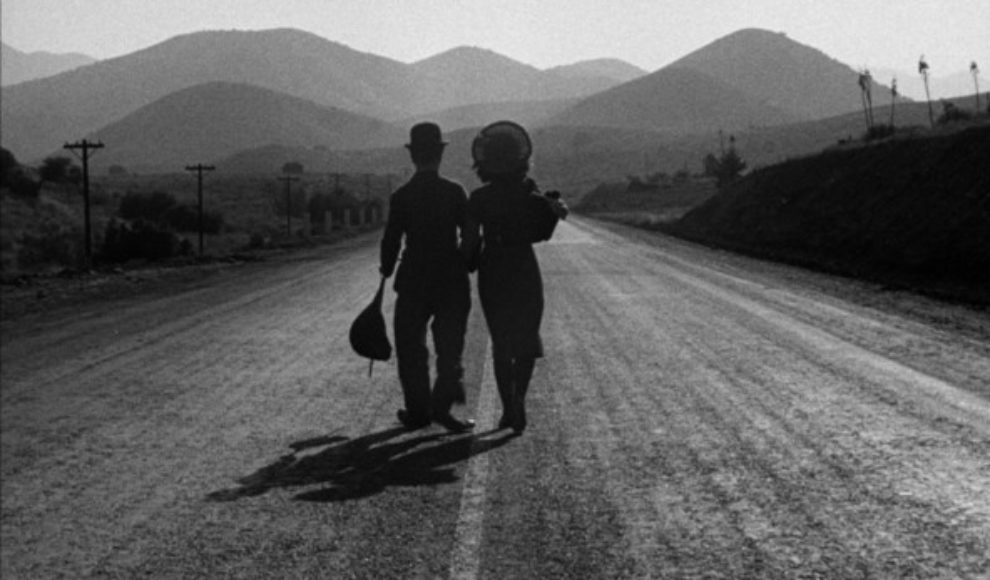
Antoine and Colette (1962)

Antoine and Colette (Antoine et Colette)
Directed by Francois Truffaut
Written by Francois Truffaut
1962/France
Les Films du Carrosse

First viewing/FilmStruck


[box] “I am glad it cannot happen twice, the fever of first love. For it is a fever, and a burden, too, whatever the poets may say.” ― Daphne du Maurier, Rebecca[/box]

Truffaut sustains the charm of The Four Hundred Blows in this short follow-up.

Having survived his childhood, seventeen-year-old Antoine Donel (Jean-Pierre Leaud) has achieved his dream of living independently.  He has a job at a recording company that provides him with lots of free tickets to concerts.  He spots a girl who attends the same concerts and eventually strikes up a friendship.  He wants more but she is taking her time deciding what she wants.

Poor Antoine can’t catch a break!  Even so, this charming film about the ups and downs of first love kept me smiling all the way through.  There is an interesting sequence when Antoine demonstrates how phonograph records were made by hand in the olden days. The film is about 30 minutes long.  Recommended.

Antoine and Colette was one of five films in a compilation of films of five nations called Love at 20.  I wish I could find the whole compilation on line somewhere.

Clip


Ride the High Country (1962)

Ride the High Country
Directed by Sam Peckinpah
Written by N.B. Stone Jr.
1962/USA
Metro-Goldwyn-Mayer
First viewing/Netflix rental

[box] Steve Judd: All I want is to enter my house justified.[/box]

Two classic actors go mano-a-mano amid some stunning autumn scenery in this enjoyable Western.

Steve Judd (Joel McCrea) is an aging ex-gunslinger and marshal who is now taking any job he can get.  His current assignment is to guard a shipment of gold coming out of a mine in the high country.  He knows he cannot do this alone and enlists the help of his old friend Gil Westrum (Randolph Scott) and Westrum’s protege, Heck Longtree.  We know from the beginning that Westrum’s plan is to divert the gold to the three “guards” or simply share it with Heck if Steve will not cooperate.

On their way to the mine, the men meet young Elsa Knudsen (Mariette Hartley) who is chafing under the fundamentalist rule of her father.  Although Heck immediately takes a hankering to Elsa she considers herself engaged to one of the miners.  She runs away from home to join the three men thereafter.

Elsa’s miner has some unpleasant surprises up his sleeve and she winds up in need of protection.  In addition, Steve is not a cooperative sort of guy.  The rest of the story follows the trip home with the gold and Elsa in tow.

I am always leery when starting a Peckinpah film but I liked this one a lot.  I had a tear in my eye at the end.  My readers who have seen this will know why.  Recommended to fans of Westerns or the actors.

This was Randolph Scott’s final film.  McCrea also retired at the time but was lured back for a few more films later.  It was Mariette Hartley’s big screen debut.

Ivan’s Childhood (1962)

Ivan’s Childhood (Ivanovo detstvo)
Directed by Andrei Tarkovsky
Written by Vladimir Bogomolov and Mikhail Papava from Bogomolov’s story
1962/USSR
Mosfilm/Trete Tvorcheskoe Obedinenie
First viewing/Netflix rental

[box] Ivan’s Mother: If a well is really deep, you can see a star down there even in the middle of a sunny day. [/box]

Loved it for the images but the story dragged.

As the film begins, the twelve-year-old Ivan is blissfully exploring nature.  He learns about the star at the bottom of a well when gunfire breaks out.  He awakens from his dream and makes his way across the Volga.  There he stops at the nearest Soviet post and demands that the officer inform the High Command of his arrival.  He refuses to answer any questions about his identity whatsoever.   The skeptical officer finally gives in and Ivan is taken to the Command where we learn that he is a valuable scout and loved by his adult colleagues.  They want to send him to the rear to study at the military institute but the defiant Ivan is interested only in vengeance.

The rest of the movie rather confusingly covers various episodes covering a few days in the lives of these people.  Ivan continues to dream sporadically while preparing for his next mission.

There are some unforgettable images and sequences in this movie.  The clip shows one of the best, though I wanted to smack that officer.  I think we were supposed to see him as manly.  My husband and I both thought the story became very repetitive.  In addition, I couldn’t quite grasp the military strategy underlying the whole thing.  In other words, it is an impressive feature film debut for Tarkovsky but not something I will need to see again.

Clip

Experiment in Terror (1962)

Experiment in Terror
Directed by Blake Edwards
Written by Gordon and Mildred Gordon from their novel
1962/USA
Geoffery-Kate Productions
First viewing/Amazon Instant

[box] “See now the power of truth; the same experiment which at first glance seemed to show one thing, when more carefully examined, assures us of the contrary.” ― Galileo Galilei, Discorsi E Dimostrazioni Matematiche: Intorno a Due Nuoue Scienze, Attenenti Alla Mecanica & I Movimenti Locali [/box]

This very good thriller might have been great.

Kelly Sherwood (Lee Remick) is a bank teller.  She lives alone with her teenage sister Toby (Stefanie Powers).  As the movie begins, she is grabbed from behind in her own garage.  A sinister asthmatic tells her that if she does not steal $100,000 from her bank for him, he will kill her and/or her sister.  She does not see the asthmatic’s face.  He seems to know everything there is to know about her and her schedule.

But Kelly is not about to steal the money and finally manages to contact the FBI, which puts agent John Ripley (Glenn Ford) on the case.  The rest of the movie moves briskly along to D-Day when we learn whether good or evil will prevail.

This is quite an enjoyable thriller.  I find I like about anything Lee Remick is in. I had higher hopes for the picture though.  It would have been more suspenseful if the FBI had been a little sloppier or the culprit a little bit smarter.  No one did these stories like Hitchcock or ever will.  Still recommended if the plot appeals.

The Exterminating Angel (1962)

The Exterminating Angel (El ángel exterminador)
Directed by Luis Buñuel
Written by Luis Buñuel and Luis Alcoriza
1962/Mexico
Producciones Gustavo Alatriste
Repeat viewing/Netflix rental
One of 1001 Movies You Must See Before You Die

[box] Rita Ugalde: I believe the common people, the lower class people, are less sensitive to pain. Haven’t you ever seen a wounded bull? Not a trace of pain.[/box]

What does it all add up to?  I don’t know but the images are unforgettable.

After an opera performance, the wealthy Edmundo and Lucia Nobile invite 20 of their closest friends to a midnight supper.  What they don’t know is that their many servants are, one by one, feeling compelled to take the night off.  By the time dinner is served, the only remaining servant is the butler.

Dinner finished, it is now high time for everyone to go home.  But all find it impossible to leave the dining room.  They fall asleep on the floor and assorted sofas.  The next day they eat leftovers but after that food and water run out, moods worsen, and these cultivated people descend into savagery.

Buñuel was one of the original surrealists and well knew how to create a true nightmare world.  From the beginning, when scenes repeat themselves over and over, to the end nothing is explained.  The inability to leave the room is almost like a dream from which the sleeper cannot seem to awaken.  Of course, Buñuel indulges in his favorite pastime of taking both the upper class and, eventually, the Church down a peg.  I like this movie though it is not one I will return to on a regular basis.

American re-release trailer

Mr. Hobbs Takes a Vacation (1962)

Mr. Hobbs Takes a Vacation
Directed by Henry Koster
Written by Nunnally Johnson from a novel by Edward Streeter
1962/USA
Twentieth Century Fox Film Corporation
First viewing/Netflix rental


Roger Hobbs: There ought to be an un-Edison, an un-Thomas Alva Edison who un-invents things, and the first thing they ought to un-invent is that television.

Family vacation movies have been a comedy trend since the early days on cinema.  This is an OK one.

Banker Roger Hobbs (James Stewart) is needs a vacation from his hectic life in the busy city.  He is particularly anxious for some time away from his children with his pretty wife Peggy (Maureen O’Hara).  Naturally, Peggy has other plans.  Her idea is to gather the whole clan, including a couple of married daughters and their families, for a month by the sea.  To this end she rents a vacation house.

Naturally, the house is a total disaster requiring the constant ministrations of Roger and the local plumber.  Both of the older daughters are having marriage problems, the teenager is going through a phase with new braces, and the all the youngest wants is to watch TV.  Finally, all comes to a head when the family also has to entertain the weirdo prospective employer of one of the sons-in-law and his wife.  Will Roger ever get a break?  With Fabian as a teenager and John McGiver as the boss from hell.

If you have seen Mr. Blanding Builds a Dream House or any of a number of other old house vs. city slicker movies you will have a fair idea of the kind of thing that goes on here.   There’s actually some pretty funny bits mixed in with the more predictible stuff.

Trailer

Forever My Love (1962)

Forever My Love
Directed by Ernst Marischka
Written by Ernst Marischka
1962/Austria
Erma-Film
First viewing/Netflix rental

[box] Duchess Elisabeth in Bavaria (24 December 1837 – 10 September 1898) was Empress of Austria by marriage to Emperor Franz Joseph I. Born into the royal Bavarian house of Wittelsbach, Elisabeth (also called “Sisi”) enjoyed an informal upbringing before marrying at the age of sixteen. The marriage thrust her into the much more formal Habsburg court life, for which she was unprepared and which she found uncongenial. She came to develop a deep kinship with Hungary, and helped to bring about the dual monarchy of Austria–Hungary in 1867. The death of her only son Rudolf, and his mistress Mary Vetsera, in a murder–suicide tragedy at his hunting lodge at Mayerling was a blow from which Elisabeth never recovered. While travelling in Geneva in 1898, she was stabbed to death by an Italian anarchist named Luigi Lucheni. — Wikipedia [/box]

This is a compilation of three films starring Romy Schneider and Karl Boehm about the romance between Emperor Franz Joseph and “Sissi”, who became his empress.  We follow their brief courtship, Sissi’s many run-ins with her mother-in-law, and Sissi’s role in easing tensions with Hungary and Italy.  Judging from the Wikipedia biography, the story was highly fictionalized.

This is OK as lavish storybook love stories go.  The costumes and scenery are truly grand. It didn’t make me want to go back and see the original three but I think it suffered in compilation.  For one thing, the ending kind of comes out of nowhere.  I watched a dubbed version.

I know it’s not the missing title tune, but this is the one became an earworm after watching this movie.


Mondo Cane (1962)

Mondo Cane
Directed by Paolo Cavera, Gualtiero Jacopetti, and Franco Prosperi
Written by Paolo Cavera and Gualtiero Jacopetti
1962/Italy
Cineriz
Repeat viewing/Netflix rental
One of 1001 Movies You Must See Before You Die

[box] “What we don’t understand we can make mean anything.” ― Chuck Palahniuk[/box]

Time and experience have made this shockumentary much less shocking.

This film contrasts “bizarre” behavior of primitive tribes with equally “bizarre” behavior of Western Europeans.  The ultimate message seems to be that humans are pretty disgusting.

Much of the primitive footage comes from Papua New Guinea, where I lived for three years.  The customs are indeed very different from our own but familiarity has made the people seem like just folks doing things the way they have always been done.  One of the problems that I have with the film is that the narrative provides a lot of the shocks.  The footage allows for a number of interpretations of which the film makers select the most “disgusting”.

I definitely could have died without seeing this once, let alone twice.

Mondo Cane was nominated for Best Music, Original Song for the song “More.”

Trailer

Frank Sinatra sings “More”- audio only

The War Lover (1962)

The War Lover
Directed by Philip Leacock
Written by Howard Koch from a novel by John Hersey
1962/UK/USA
Columbia Pictures Corporation/Columbia British Productions
First viewing/Netflix rental

Captain Buzz Rickson: Lady, I belong to the most destructive group of men the world has ever known. That’s my work.

I wasn’t quite prepared for a movie where I felt like slapping Steve McQueen throughout.

The story is set prior to D-Day while the US Air Force is conducting bombing runs out of Britain.  Buzz Rickson (McQueen) is an ace pilot.  He is also an arrogant a-hole and miserable human being.  Even his co-pilot Ed Boland (Robert Wagner) is getting sick and tired of him.  Buzz spends his off hours playing humiliating pranks and pursuing women. Ed meets Daphne (Shirley Anne Field), an upper-crust intelligence worker, and spends his off hours being in love with her.  Buzz wants everything he can’t have.

About half of the film is comprised of bombing runs.  The other half follows the love triangle and Buzz’s general ass-hattery.  With Michael Crawford in a small part as a raw recruit.

McQueen plays the kind of guy I love to hate.  He is evidently so damaged that the only pleasure he can get is from destruction.  This serves him well as a bomber pilot – less so as a human being.  McQueen does well as an anti-hero and it’s a solid film but not one I will likely watch again.

Trailer

That Touch of Mink (1962)

That Touch of Mink
Directed by Delbert Mann
Written by Stanley Shapiro and Nate Monaster
1962/USA
Granley Company/Arwin Productions/Nob Hill Productions Inc.
First viewing/Netflix rental


[box] Connie Emerson: [talking to Cathy] For 2000 years we’ve had their children, washed their clothes, cooked their meals and cleaned their houses. And what did they give us in return? The right to smoke in public. We sold out for a cigarette – and you don’t even smoke![/box]

Right before being a 40-year-old virgin was just plain embarrassing, Doris Day was tempting some mighty handsome man to the altar in just that condition.  Cary Grant makes a more than adequate stand-in for Rock Hudson.

Cathy Timberlake (Day) is an unemployed career woman with a great wardrobe and apartment.  One day, her immaculate attire is doused when fabulously wealthy Phillip Shayne’s (Grant) limo speeds through a large puddle.  He sends his minion (Gig Young) out in search for her to make things right.  Once he sees Cathy, though, he has more than mercy on his mind.  For her it is love at first sight.  That’s why she allows him to treat her to a deluxe romantic getaway in Bermuda.

Somehow, our heroine manages to maintain her virtue.  The rest of the story follows the wrangling and misunderstandings that usually lead to a happy ending.  With Audrey Meadows as Cathy’s friend.

This is up there with the Rock Hudson-Doris Day rom-coms of the period.  Grant is always a joy to watch.  Nice for a weekday afternoon.

That Touch of Mink was nominated for Academy Awards in the categories of Best Writing, Story and Screenplay – Written Directly for the Screen; Best Art Direction-Set Decoration, Color; and Best Sound.

Trailer