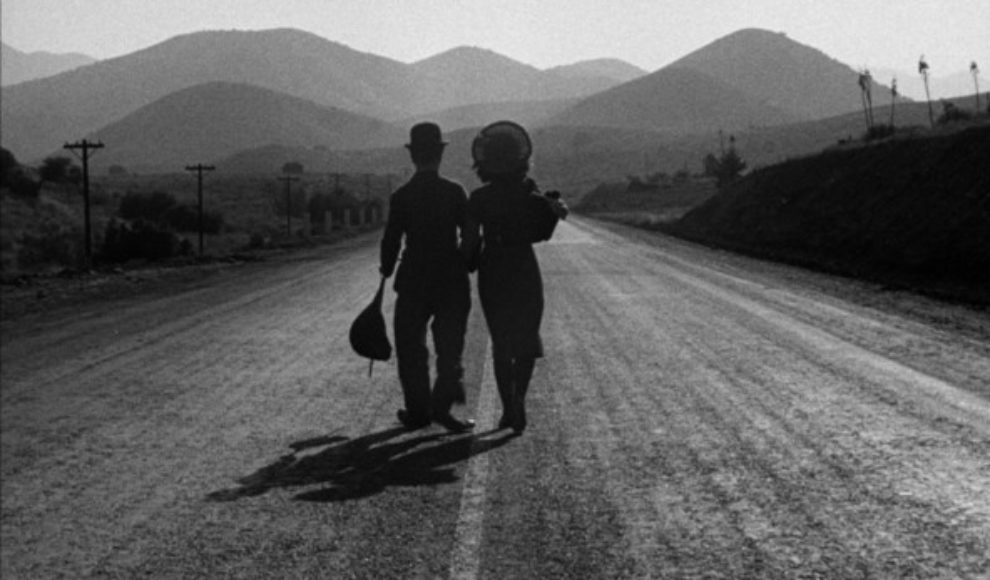
Heat Lightning (1934)

Heat Lightning
Directed by Mervyn LeRoy
Written by Brown Holmes and Warren Duff from a play by Leon Abrams and George Abbott
1934/USA
Warner Bros.
First viewing/Amazon Instant

George: Want another barbequed sandwich?
Jeff: I can hear the warden ask if I have any last words before they turn on the heat and you ask if I want another barbequed sandwich?

Unbelievable amount of classic pre-Code plot packed into just 63 fun minutes!

Olga (Aline MacMahon) runs a gas station/cafe with her younger sister Myra (Ann Dvorak) in the middle of the Mohave Desert.  She has become a crack auto mechanic.  The sisters’ location seems to be designed to keep young Myra as far away from men as possible.  This strategy is not working well and Myra is itching to slip away to a dance in town with her new boyfriend, a cad.

Matters heat up quickly when a pair of bank robbers happen to drop in.  One of these is George (Preston Foster), from whom Olga was escaping when she moved to the desert. He thinks he still has a hold on her but she just wants him to go away.  Then a couple of rich divorcees (Glenda Farrell and Ruth Donnelly) arrive fresh from Reno with their chauffeur (Frank McHugh).  George has no intention of leaving the place without their jewelry.  Can’t a girl get any privacy?

This has every single trope one might expect from a pre-Code drama including oodles of snappy dialogue delivered by actors who know how.  Warner Bros. had the best character actors ever!  It’s so nice to see perennial  “best friend” MacMahon in the lead.


Mary Poppins (1963)

Mary Poppins
Directed by Robert Stevenson
Written by Bill Walsh and Don DaGradi from books by P.J. Travers
1964/USA
Walt Disney Productions
Repeat viewing/Netflix rental
One of 1001 Movies You Must See Before You Die

[box] Mary Poppins: You know, you *can* say it backwards, which is “docious-ali-expi-istic-fragil-cali-rupus” – but that’s going a bit too far, don’t you think?[/box]

A treat at all ages.

The Banks children, Jane and Michael, go through nannies at a rapid rate.  The latest to leave in a huff is Katie Nanna (Elsa Lanchester).  What the children would really like is attention from their workaholic banker father (David Tomlinson) and sufragette mother (Glynnis Johns).  Like a miracle, Mary Poppins blows in on a favorable wind to make everything all better.  She introduces the children to Burt (Dick Van Dyke), a cockney jack of all trades, and takes them on fabulous adventures.

The little troupe travels to the English country side where they have fun at a carnival, on the farm, and in a fox hunt and over the roofs of London with the chimney sweeps.  Finally, Mary’s suggestion that Mr. Banks take the children for an outing to his bank eliminates the need for her services.  With Hermoine Baddeley as a maid, Arthur Treacher as a constable, Ed Wynne as Uncle Albert and Jane Darwell as the Bird Woman.

I’ve loved this movie since it came out and nobody’s going to change my mind now.  In fact, watching it this time I was amazed at how fast I was totally immersed in the story and music.  Dick Van Dyke’s execrable Cockney accent even had its peculiar charm.  Julie Andrews is the glue that holds the whole thing together.  She has a certain charming tartness that helps all that sugar go down.  Recommended.

Mary Poppins won Academy Awards in the categories of Best Actress; Best Film Editing; Best Effects, Special Visual Effects;  Best Music, Original Song (“Chim-Chim-Chiree”); and Best Music, Substantially Original Score.  It was nominated in the categories of Best Picture; Best Director; Best Writing, Screenplay Based on Material from Another Medium; Best Cinematography, Color; Best Art Direction-Set Decoration, Color; Best Costume Design, Color; Best Sound; and Best Music, Scoring of Music, Adaptation or Treatment.

The Eagle and the Hawk (1933)

The Eagle and the Hawk
Directed by Stuart Walker
Written by Seton I. Miller and Bogart Rogers from a story by John Monk Sanders
1933/USA
Paramount Pictures
First viewing/YouTube

[box] Henry Crocker: Why don’t you get wise? This is a war. I’m hired to kill the enemy, and there ain’t no book of rules about that. Every one I put away means one less to kill me. That’s my job, and I’m doing it.[/box]

A great cast ensures a solid anti-war film.

The setting is an RAF squadron in WWI.  Jerry Young (Fredric March) is a hot shot pilot. Henry Crocker (Cary Grant) is a cocky gunner.  They hate each other.  When the squadron is moved to France they get along even worse.  They are on surveillance duty and young “observers” accompany each flight.  Jerry agonizes each time a youngster dies.  Henry shares no such scruples and does not hesitate to shoot unarmed enemy observers who are trying to parachute to safety.

Despite everything, Jerry is continuously showered with medals after he completes his successful missions.  This only makes him feel worse.  His impending crackup is assisted along by copious amounts of alcohol.  Henry suggests to the brass that Jerry needs R&R in London.  There he is offered momentary comfort by The Beautiful Lady (Carole Lombard).  But things only continue to go downhill when Jerry returns to France.  With Jack Oakie to supply some laughs.

March and Grant were born to play these particular parts.  March, one of the great screen drunks ever, is the soul of sensitivity while Grant is the hard nut with a soft interior. Lombard has about five minutes of screen time and seems to have been added for some sex appeal in an otherwise all male story.  Quality film.

Clip

The Pumpkin Eater (1964)

The Pumpkin Eater
Directed by Jack Clayton
Written by Harold Pinter from a novel by Penelope Mortimer
1964/UK
Romulus Films
First viewing/Amazon Instant


[box] Peter, Peter pumpkin eater,/ Had a wife but couldn’t keep her;/ He put her in a pumpkin shell/ And there he kept her very well. – Nursery rhyme [/box]

Powerful performances anchor a story of marital breakdown.

Jo has eight children from three marriages.  Six are living at home with her and husband Jake.  Only one of the children is his but Jake apparently takes the chaotic household in stride.  Something tells Jo that all is not well and she becomes suspicious of the relationship between her live-in friend Philpot (super-young Maggie Smith) and Jake.

Unspoken tension in the marriage is pushing Jo to the point of nervous breakdown.  Then she finds herself pregnant again and the tension erupts into fireworks.  With Cecil Hardwicke in his final film as Jo’s father and James Mason as a wronged husband.

I enjoyed this for the performances but did not understand the dynamics of the relationship too well.  The film includes a nice Georges Delerue score and beautiful cinematography by Oswald Morris.

Anne Bancroft was nominated for an Oscar as Best Actress.

What a Way to Go!

What a Way to Go!
Directed by J. Lee Thompson
Written by Betty Comden and Adolph Green; story by Gwen Davis
1964/USA
Apjac-Orchard Productions
First viewing/Amazon Instant

[box] Rod Anderson, Jr.: What are you doing after the orgy?[/box]

A stellar cast and lavish production enliven a pretty silly story.

The story is framed by Louisa May Foster’s (Shirley MacLaine) session with a psychiatrist (Robert Cummings) telling her life story.  When Louisa May Foster (Shirley MacLaine) comes of age, her money-grubbing mother wants her to marry Leonard Crawley (Dean Martin), the big man in Crawleyville.  Louisa despises the conceited Crawley and marries Edgar Hopper, a Thoreau-reading general store keeper.  One day, Edgar is inspired to go to work and just can’t stop until he has amassed a fortune.  He dies of overwork leaving a rich widow.

Louisa seems to be condemned to repeat the same story over and over again.  In turn she marries a starving American artist in Paris (Paul Newman), a bored millionaire who wants to go back to the farm (Robert Mitchum), and a bad small-time comic (Gene Kelly).  As soon as MacLaine thinks she has found happiness, her husband becomes successful and leaves a rich and overworked corpse.  Each of the segments contains a movie spoof showing life with that husband.

There was a sort of craze for what I call “cartoon-style” colorful larger-than-life story in the 60s which this film exemplifies perfectly.  It’s fun to look at, especially MacLaine’s fantastic wardrobe, but ultimately unsatisfying to me.

What a Way to Go! was nominated for Academy Awards in the categories of Best Art Direction-Set Decoration, Color amd Best Costume Design color.

The Soft Skin (1964)

The Soft Skin (La peau douce)
Directed by Francois Truffaut
Written by Francois Truffaut and Jean-Louis Richard
1964/France
Les Films du Carosse/SEDIF/Simar Films
First viewing/Netflix rental


[box] Pierre Lachenay: I’ve learned that men’s unhappiness arises from the inability to stay quietly in their own room.[/box]

Adultery works out unsatisfactorily for every one concerned in this interesting film from Francois Truffaut.

Pierre Lachenay (Jean Desailly) is a famous literary critic who is popular on TV and the lecture circuit.  He is married to Franca (Nelly Benedetti) and they have one daughter, Sabine, about age 10.  She seems devoted to him.  One day on a flight to Lisbon he spots airline stewardess Nicole (Francoise Dorleac) and they keep running into each other in the airport and at the hotel where both overnight.  He calls her and so begins their affair.

The affair involves a lot of lying and sneaking and Pierre is not very clever at this game.  He literally cannot stay away from Nicole however.  Inevitably, his marriage hits the skids.  And then …

I liked everything about this movie.  Truffaut made all the characters very identifiable.  I really was not expecting the ending!!!  Dorleac, who was Catherine Deneuve’s elder sister, is a revelation.  Recommended.


Back Street (1932)

Back Street
Directed by John M. Stahl
Written by Gladys Lehman and Lynn Starling from a novel by Frannie Hurst
1932/USA
Universal Pictures
First viewing/YouTube

[box] Ray Schmidt: I know myself so well – it’s all the way or zero with me.[/box]

Irene Dunne gives heart to this top-drawer melodrama.

Fun-loving Ray Schmidt (Dunne) is playing the field around the turn of the last century when she falls hard for rich, handsome Walter Saxel.  It just so happens that he is engaged.  On the day he is supposed to introduce Ray to Mama as a potential future bride she is called away by a family emergency.  They meet again in New York five years later.  Ray does not wait for a wedding ring from the now married Walter and he begins to “keep” her in an apartment.

Walter refuses to let Ray work or have a child so she spends a lot of lonely time waiting around while he is with his family or on extended business trips.  Eventually, his children discover the affair but are unable to break it off.  Twenty-five yers of mutual devotion end as they inevitably must, even in the pre-Code days.

John Boles overdoes it but Dunne is solid as a rock in this.  I believed every one of her tears without feeling manipulated in the least.  Recommended.

Back Street was remade in 1941 with Margaret Sullavan and Charles Boyer and in 1961 with Susan Hayward and John Gavin, neither of which I have seen.

Montage of clips

Holiday (1930)

Holiday
Directed by Edward H. Griffith
Written by Horace Jackson from a play by Philip Barry
1930/USA
Pathé Exchange
First viewing/YouTube


[box] Linda Seton: Do you realize life walked into this house today?[/box]

I liked this original version of Holiday almost as much as its more famous 1938 .

Johnny Case (Robert Ames) and Julia Seton (Mary Astor) meet and fall in love while on vacation.  He proposes and she accepts.  Then she takes him home to meet her family in the big city.  She had kept quiet about the family’s immense wealth.  Johnny is of working class origins but has made good as a corporate lawyer.

Father rules the roost in the Seton family and is the soul of propriety.  He gives Johnny the once over and when he learns of the lucrative deals he has put together decides he is worthy.  Father’s domineering ways, however, have left sister Linda (Ann Harding) lonely and frustrated and son Ned a burgeoning alcoholic.

Johnny has kept a secret, too.  He is determined to take a long holiday from working once he has saved twenty thousand dollars.  He wants to find out who he is and what he really wants while he is still young enough to do something about it.  Things come to head on the night of the engagement party.  The sides square off with Linda and her free-thinking friends in the playroom, Julia and Dad in the ballroom and Johnny somewhere between the two …  With Edward Everett Horton as one on Linda’s friends.  He went on to reprise the same part in the 1938 version.

I wasn’t following along but I imagine most of the dialogue is word-for-word the same between the two versions of the story.  Robert Ames is a non-entity in the role very colorfully played by Cary Grant.  In contrast, Ann Harding is more than adequate in the Katharine Hepburn part.  She is less zany but perhaps more convincing in her thoughtful way.  Mary Astor is sublime, as usual.  Recommended.

Holiday was nominated for Academy Awards in the categories of Best Actress (Harding) and Best Writing (Adaptation).

Kiss Me, Stupid (1964)

Kiss Me, Stupid
Directed by Billy Wilder
Written by Billy Wilder and I.A.L. Diamond from a play by Anna Bonacci
1964/USA
The Mirsch Corporation/Phalanx Productions/Claude Productions
First viewing/Amazon Instant

[box] Dino: [responding to an offer to buy the rights for a song] I need another Italian song like a giraffe needs a strep throat.[/box]

By 1964, Billy Wilder had his peak behind him

Dean Martin plays an alcoholic womanizing version of himself called “Dino”.  Dino has finished a gig in Las Vegas and is driving to Hollywood to film a TV special.  He hits a detour and is routed through the desert.  He stops in tiny Climax, Nevada for gas.  The gas station attendant Barney (Cliff Osmond) and piano teacher Orville (Ray Walston) are a song-writing duo and conspire to create a mechanical malfunction that will keep the singer there overnight to listen to their catalogue.

Dino will wake up with a headache if he goes even one night without some action.  He expresses some interest in the insanely jealsous Orville’s wife Zelda (Felicia Farr).  Instead, they recruit “bar girl” Pistol Polly (Kim Novak) to entertain him.  Various hijinx ensue.

This is a bit of a mess.  Everything feels forced and overdone, unusual for the sophisticated Wilder.  It’s almost like he couldn’t handle the permissiveness of 1964, gave into it, and lost his way.  I also thought Novak’s New Jersey hooker was particularly grating.  Not a winner,

Adventures of Zatoichi (1964)

Adventures of Zatoichi (Zatoichi sekisho yaburi)
Directed by Kimiyoshi Yasuda
Written by Shozaburo Asai; story by Kan Shimozawa
1964/Japan
Daiei Studios
First viewing/FilmStruck


[box] Zatoichi: Such mischief, in broad daylight! Right under the watchful eye of Mister Sunshine. Put the young lady down. I don’t hear an answer. If I’m blind, and you’ve gone mute, this could be difficult. No, no. Don’t move. Move and you’ll find yourself split in two.[/box]

The presence of actor Shintaro Katsu as the blind swordman ensures that each film in the series will be at least enjoyable even as the style and quality of the direction varies.

In this one, blind Ichi shows up in a village to celebrate the New Year.  Vendors in town are feeling the pinch from the tax gouging of an evil magistrate and his gang boss enforcer. Simultaneously, Zatoichi promises to help a young girl locate her father, who was killed at the behest of the boss.  Ichi won’t enjoy a peaceful New Year after all.

The best of these films have an almost Yojimbo-like sense of grim humor.  This one is pretty bleak.  But Shintaro Katsu as the hero never takes himself seriously and is as lovable as always.

Trailer – No subtitles